Get Full Government Meeting Transcripts, Videos, & Alerts Forever!
Get email alerts on the Airport Operations topic
No spam. Unsubscribe anytime.
Ogden leaders pitch new airport rules, seek council'level direction on Title 8 and minimum standards
Summary
City and airport officials presented proposed changes to Ogden Municipal Code Title 8 and a set of airport "minimum standards." The pitch emphasized economic impact, FAA grant-assurance requirements, and a shift of detailed rules from ordinance to administrative policy. Council requested more time and examples before deciding to move language out
City leaders and aviation consultants told the Ogden City Council on July 15 that the city should rewrite municipal Title 8 and adopt a modern set of airport minimum standards and supporting policies to protect investment, comply with Federal Aviation Administration (FAA) grant assurances and attract businesses to the airport.
"We have a generational opportunity to move this airport into its future," Mayor said in opening remarks that framed the presentation as the result of more than a year of stakeholder work. Airport staff and consultants stressed that federal grants and FAA "grant assurances" limit how sponsors may regulate airport businesses and require clear, nondiscriminatory policies.
"There's no such thing as a free lunch," consultant Ryan Lyke told the council. "You take federal money, you're federally obligated then to what we call grant assurances." He said the Airport Improvement Program (AIP) grants the airport has received come with enforceable conditions, including requirements that users be treated without economic discrimination and that minimum levels of safety and service be maintained.
Consultants and airport staff recommended moving detailed operational and commercial-service standards out of city ordinance and into administratively maintained documents (minimum standards, rules and regulations, lease policy and a consolidated rates-and-fees schedule). They said the change is intended to let airport management respond quickly to market changes and FAA guidance while council retains policy oversight.
Presenters listed several reasons for rewrite and reorganization:
- Economic impact and urgency: Staff cited a state economic-impact report noting an estimated $328 million in economic activity tied to the airport, more than 2,000 jobs and roughly $12 million in tax revenue; consultants said outdated or vague Title 8 wording is impeding some business decisions. - Grant-assurance compliance: Consultants highlighted key FAA obligations including preserving sponsor rights, avoiding economic discrimination, preventing exclusive rights and ensuring airport revenues remain within the airport's financial system. - Minimum standards purpose: Consultants described minimum standards as the baseline required services, facilities and insurance for commercial aeronautical operators (fixed-base operators, maintenance providers, flight schools and specialized operators). The standards would set required services in exchange for rights such as fuel sales and would include insurance and personnel requirements.
Legal counsel Margaret Martin told the council the proposed approach also reflects a drafting practice: Title 8 currently contains only a small excerpt of modern operational detail; a full, modern minimum-standards document would be considerably longer and better suited to administrative policy than to a short municipal-code section.
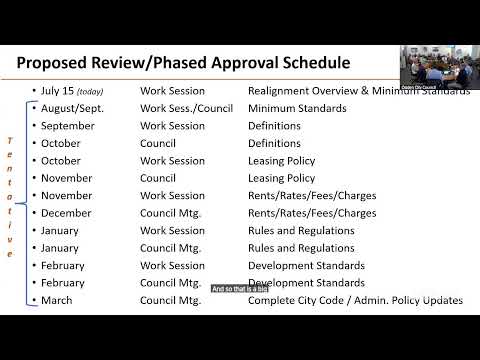
Council members asked for more concrete, side-by-side examples showing what would move from ordinance into policy, and how changes to a living policy would affect existing tenants and long-term leases. Consultants said the airport's stakeholder process would continue and that staff would return with more detailed drafts and examples; the council set no deadline and took no vote at the session.
Ending: Staff proposed additional work sessions in August and requested direction on whether council wanted an earlier briefing; the consultants said minimum standards are the highest near-term priority because the current Title 8 language is limiting business decisions at the airport.