Get Full Government Meeting Transcripts, Videos, & Alerts Forever!
Get email alerts on the Land Use Zoning topic
No spam. Unsubscribe anytime.
Ogden staff previews overhaul of development code; ADU, signage and business-chain rules on table
Summary
City planning staff on July 15 previewed a near-complete rewrite of Ogden's development code that would standardize residential lot rules, relax some accessory dwelling unit (ADU) limits, tighten special-use controls and change signage and billboard rules.
City planning staff on July 15 previewed a near-complete rewrite of Ogden's development code that would standardize residential lot rules, relax some accessory dwelling unit (ADU) limits, tighten special-use controls and change signage and billboard rules.
Planning staff said the draft is intended to make the code more consistent and user-friendly and to finish specialty and development standards before moving to land-division chapters. "We're trying to make it easier for people to use their yards," Planning staff member Brandon said while summarizing design and rear-yard coverage changes.
The draft would unify lot-coverage and height limits across residential zones and would exempt open patios and covers from rear-yard building-coverage calculations. Detached ADUs would be allowed up to 1,000 square feet (up from 800) or up to 50% of the primary dwelling's floor area. Staff said a homeowner may not have more than one ADU on a lot and that the homeowner must live in either the primary dwelling or the ADU.
The rewrite also addresses retail, formula-based (chain) businesses and a narrowly drawn downtown area. Staff said earlier conversations have focused on 20 Fifth Street, where the city may limit the number of formula-based businesses in order to preserve a mix of local retail. "We talked about really focusing on 20 Fifth Street and potentially making a limit to 10 formula-based businesses on 20 Fifth Street," Brandon said. Staff said they are still working on a formal definition of what constitutes a "formula-based" business and on a local exception for businesses that started in Ogden.
Accessory structures and home-occupation rules were detailed. Staff proposed allowing up to two dogs and two cats per household, allowing six chickens on lots 8,000 square feet or smaller and 12 chickens on larger lots, and adding setback and water-source requirements for bees. For home-based classes and services, staff proposed capping in-person participants at six and limiting employees to one nonresident employee in addition to household members; retail sales from a home would remain prohibited.
Other changes in the draft include:
- Historic preservation: Applications for an individual landmark designation would require the owner's written approval; a proposed historic district would require written approval from at least 33% of owners, and the Landmarks Commission could also propose districts. Staff said the form of written approval (petition vs. letter) needs clearer definition. - Shipping containers and ADUs: The planning team reported mixed public and Planning Commission input on allowing shipping containers as accessory structures; some reviewers favor covering containers with siding and a roof. - Group homes: Uses housing six or more people would be counted as group homes and the draft retains a 1,000-foot separation requirement to avoid concentration of facilities. - Drinking establishments and downtown density: The change clarifies the existing rule limiting drinking establishments to two per block side; staff proposed counting both sides of a block and using a 660-foot standard block length for the measure. - Signs and billboards: Staff flagged a potential billboard "cap-and-replace" program used in other cities that would let a company install a digital billboard in exchange for removing multiple static billboards; staff asked the council whether to restrict billboards in certain viewsheds such as Harrison Boulevard or 20 Fourth Street approaches.
Council members asked for more precise drafting, especially on vague definitions and grandfathering. A council member raised concerns that limiting formula-based businesses could unintentionally penalize successful local businesses that expand, and suggested a local-origin exception.
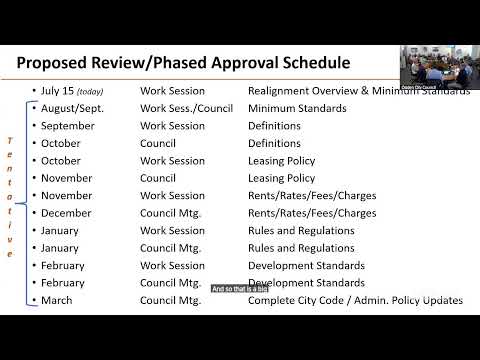
Staff said next steps include public outreach in October-November, focus groups with developers, and further Planning Commission workshops. No formal action was taken; staff asked for direction on definitions, newspaper-notice timing and whether the council wants additional work sessions before transmittal to the Planning Commission.
Ending: Staff said the August work session will address land division chapters and that the full draft will be posted for public comment ahead of later Planning Commission and council hearings.