
Highland council continues vote on PO zoning rewrite after wide code changes and resident concerns
Get AI-powered insights, summaries, and transcripts
Sign Up Free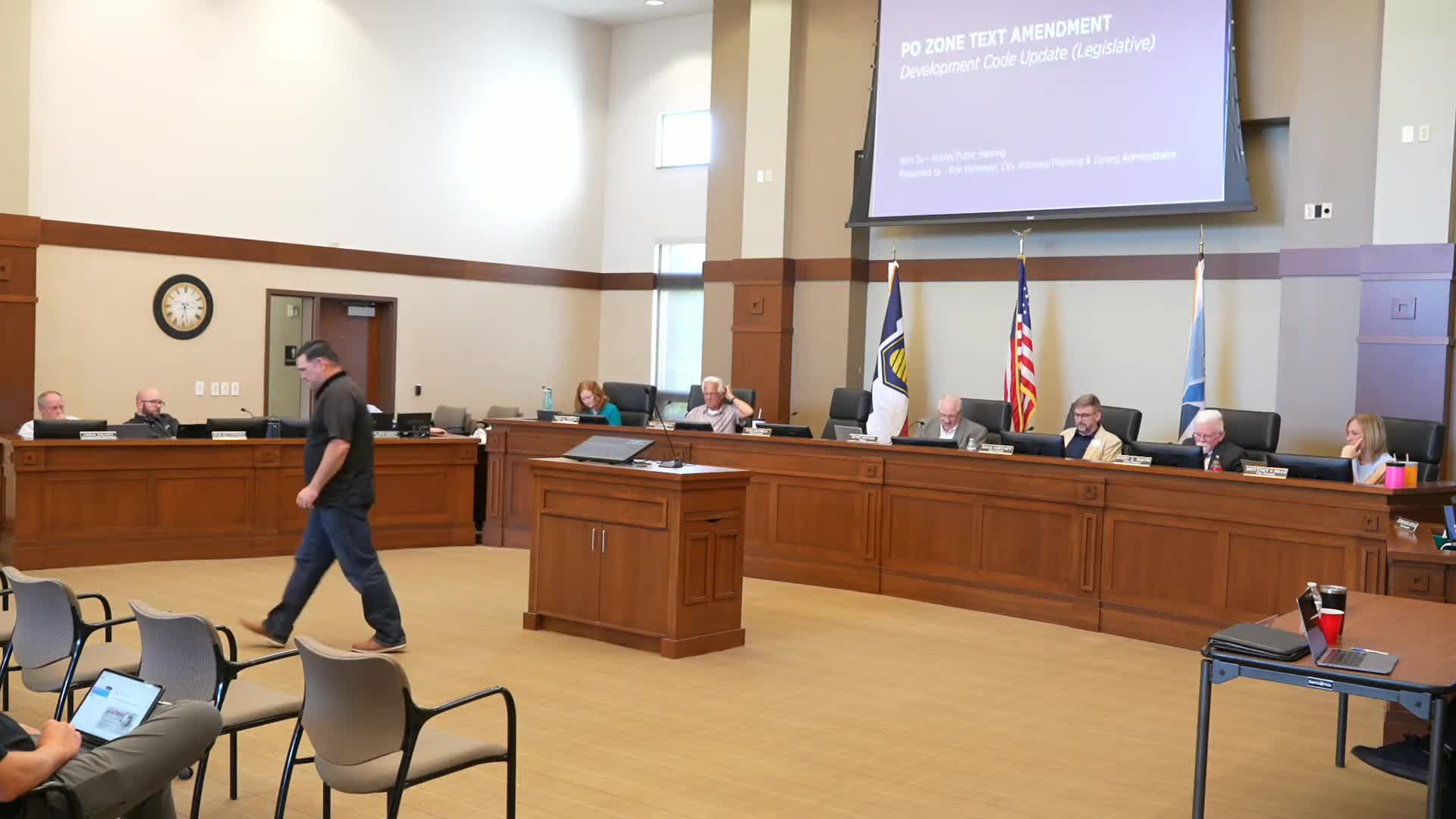
Summary
Council held public hearing and detailed staff presentation on proposed Professional Office (PO) zone text amendments, discussed building heights, roof limits, landscaping and notice requirements, then voted to continue the ordinance to allow staff to incorporate clarifications requested by council.
Highland — City staff presented a broad rewrite of the Professional Office (PO) zone at the Highland City Council meeting on Aug. 5, 2025, and the council voted to continue the ordinance to allow additional clarifications after public comment and several council questions.
The proposed code changes would remove the original site exhibits and replace them with a flexible, standards-based PO zone that keeps the zone’s original intent while adding new rules for building massing, roofing, parking, setbacks and landscaping. Staff said the goal is to preserve a traditional residential look along Highland Boulevard while allowing modern office designs elsewhere in the district.
Planning staff said the Planning Commission reviewed the amendments in June and unanimously recommended adoption with five stipulations: measure building height from the top back of the curb, limit exterior material reflectivity (LRV) to 70 percent or lower, restrict flat roofs to no more than 50 percent of a building’s footprint, require traditional residential design for buildings on the east side of Highland Boulevard, and remove certain parking requirements deemed unnecessary. Rob Patterson (staff) told the council he had incorporated those changes into the draft presented to the council and identified a number of other clarifications and new standards.
Council members and attendees pressed staff on multiple technical points: how to measure building height on sloped sites; whether the LRV standard should be 60 or 70; how to define and limit flat or low-slope roofs; the appropriate percentage of two-story massing versus single-story massing; clarifying permitted and prohibited uses (including whether incidental activities such as jewelry making or small-scale kit-assembly should be considered industrial); and how xeriscape and "natural landscaping" would be treated near residential areas. Staff agreed to remove language that could be read as permitting bare rock or weeds under the label "natural landscaping," and to clarify definitions and cross-references.
Multiple residents who attended the meeting spoke during the public hearing portion. One resident, Liz Rice, said she prefers traditional peaked roofs and urged council to tighten design controls; staff answered questions about how the proposed standards would be applied in practice.
After extended discussion on wording and thresholds — with several council members asking staff to adopt clearer, less ambiguous terms — Councilmember Doug moved to continue the ordinance so staff could incorporate the requested changes. The motion carried on the council vote to continue the PO text amendment for final drafting and re-notification.
Pending clarifications include the LRV threshold, exact measuring point for building height on sloped curbs, the final flat-roof percentage, and clearer language about industrial and accessory uses. Staff said they would return the edited ordinance for final action once the textual edits have been made and reviewed.