
New Mexico Military Institute tells LESC SB280 makes it PSFA-eligible as it seeks funding for aging campus and new prep school
Get AI-powered insights, summaries, and transcripts
Subscribe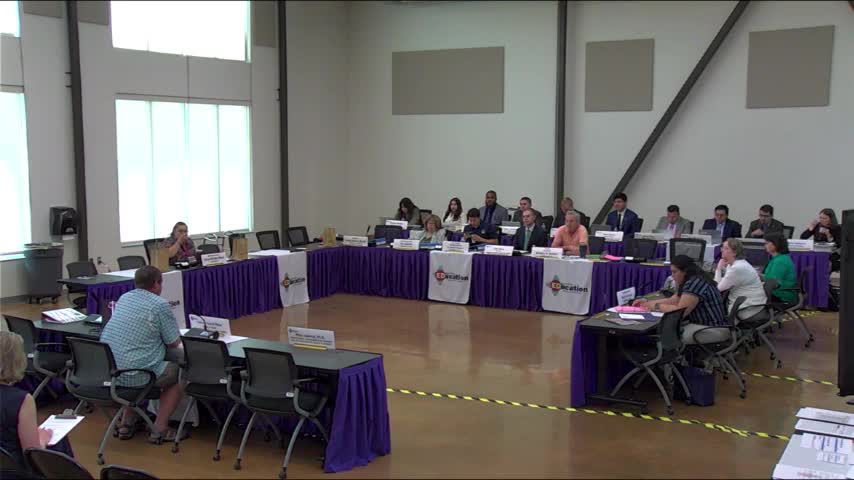
Summary
NMMI officials told the Legislative Education Study Committee in Roswell on June 24 that Senate Bill 280’s designation makes the New Mexico Military Institute eligible for Public School Facilities Authority funding and that the school will pursue assessments and capital outlay opportunities to address aging facilities.
NMMI officials told the Legislative Education Study Committee in Roswell on June 24 that Senate Bill 280’s designation makes the New Mexico Military Institute eligible for Public School Facilities Authority (PSFA) funding and that the school will pursue assessments and capital outlay opportunities to address aging facilities.
The designation “is simply another tool in our toolbox,” Colonel David West, chief of staff at the New Mexico Military Institute, said as he described the institute’s long capital funding timeline and limits on other revenue sources.
The change matters because NMMI’s main quadrangle is listed on the State and National Register of Historic Places and several buildings date to the early 20th century; officials said deferred maintenance and slow funding cycles have left needs that general obligation, severance tax and revenue bonds alone do not meet. West told the committee that the institute’s capital funding mix includes general obligation bonds, severance tax bonds, revenue bonds and occasional legislative allocations, and that the institution faces constraints such as a roughly $15,000,000 cap tied to its annual revenue for borrowing.
NMMI representatives outlined the mechanics and limits of each revenue source. “General obligation bonds…take up to five years once we identify a capital project by the time we can actually turn shovels,” West said. He said severance tax bond projects typically range from about $500,000 to $2 million and can take up to three years, and that revenue bonds are constrained by annual revenue and debt capacity.
The committee also heard about the institute’s Intermediate Preparatory Academy (IPA), a non-boarding, day middle school the institute opened in 2023 to build a feeder program and raise academic readiness among students who historically tested below grade level. Dr. Nina Leacock, head of the IPA, described the program’s purpose and early results: “We are not an elite school academically… We are serving students who are looking to learn and move at that time in their lives,” she said.
Key details the institute provided:
- The IPA started with a sixth-grade founding class in 2023; next year the site will have a fuller program as the initial cohort advances. The institute’s target enrollment for the Roswell IPA site is 210 students; officials expect to be at about half that total next year and said some classrooms and facilities are not yet completed.
- Tuition and fees were stated at $4,500 for the IPA’s most recent year; pilot financial aid and scholarship programs covered need-based costs for New Mexico resident students, and West said the Daniels Foundation provided more than $300,000 in scholarships this past year to support students’ costs.
- The IPA is a day school only (no boarding), and the IPA currently does not run its own busing; families generally provide transportation or arrange local solutions.
- The IPA emphasizes a structured leadership curriculum, daily practice with limited screen time, hands-on learning and a 1-to-1 Chromebook program used selectively. Dr. Leacock said the program deliberately minimizes calculator and routine computer use in math and English classes to emphasize fundamental skills.
- Special education and support services are limited at the IPA. Dr. Leacock said the school has “a skeletal admin staff and no support services, so we have no counselors, no learning specialists,” and that some students for whom the school cannot provide appropriate support do not enroll or do not remain at the IPA.
Academic standards and student progression: the IPA uses a 2.0 GPA minimum policy. Students who fall below 2.0 may be placed on probation for a semester; students who fall substantially below that level face academic suspension and must apply for readmission. Dr. Leacock said waivers exist in exceptional cases when teachers report a student is a constructive community member and making progress, and she described using teacher reports when considering waivers.
Officials described the broader impact of SB280 and PSFA involvement as requiring a full facility assessment and creating a pathway to new funding. West said the legislation “simply added NMI to the capital outlay as a constitutional special school” and that the PSFA process will require an assessment of needs before PSFA funding recommendations are made.
Committee members asked about the institute’s long-term plans, possible expansion of IPA sites in other towns, and how PSFA will develop rules for the new special-school status. Vice Chair Romero asked what NMMI wanted in PSFA’s proposed rules; West said the institute expects the assessment to be the first step and emphasized needs tied to aging facility materials such as asbestos roof tiles, lead paint and other historic-preservation challenges that complicate repair work.
No formal committee action or vote was taken on funding at the Roswell meeting. NMMI officials invited legislators to tour the campus and to consider scholarship referrals under existing legislative scholarship processes.
The session provided the committee with a clearer inventory of NMMI’s funding constraints and the IPA’s early operations, enrollment targets and academic standards; staff flagged that PSFA rulemaking will be needed to operationalize SB280 for special schools like NMMI.