
LESC warns federal funding uncertainty could reduce K‑12 services; staff outlines state response
Get AI-powered insights, summaries, and transcripts
Subscribe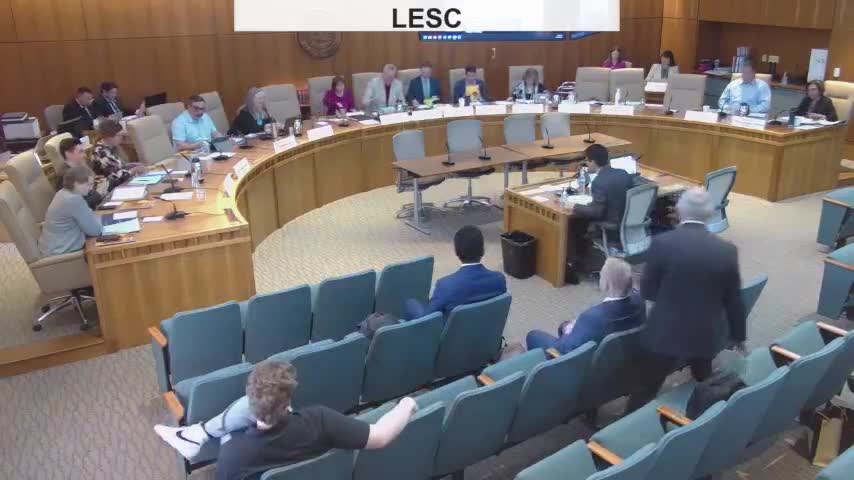
Summary
LESC staff told lawmakers that proposed federal consolidations and cuts could shrink Title I, Title III and special‑education funding and urged the Legislature to plan how — and whether — to backfill lost federal dollars.
The Legislative Education Study Committee was told June 1 that uncertainty at the federal level — including proposals to consolidate formula grants into block grants and to cut several funding streams — could reduce money for English learners, special education, school meals and other K‑12 services across New Mexico.
"We as staff plan to monitor what's going on at the federal level," Daniel Estupignan, the LESC analyst who covers public school finance, told committee members during a detailed presentation on federal funding flows and risks. He outlined possible changes the Biden administration and Congress have floated and the practical implications for state budgeting and school operations.
The presentation mattered because New Mexico’s public schools currently rely on a mix of federal and state funding that the committee said may be disrupted. Federal relief dollars expanded state K‑12 funding after the pandemic; those funds largely phase out in fiscal 2026, and the U.S. Department of Education and the White House have proposed consolidating multiple formula and competitive awards into broader grants that could reduce federal oversight and cut aggregate funding.
LESC staff listed specific state estimates and concerns: preliminary FY26 federal award estimates cited in the presentation included roughly $121 million for Title I, $14.9 million for Title II‑A, $4.7 million for Title III‑A, and an $84.1 million preliminary IDEA Part B award. School‑meals federal reimbursements were shown at about $202.5 million, with the state adding roughly $48.8 million to cover universal meals. Staff also reported prior federal actions that already reduced state funding — a $12.3 million rescission from ESSER, loss of $5.1 million for a teacher‑residency program and a $5 million loss for school‑based mental‑health grants that put 18 positions at risk in Silver Consolidated and Central regional education cooperative sites.
Staff emphasized that two separate federal proposals would change how money reaches states and districts. One idea being discussed in Washington would convert multiple formula streams into a block grant, reducing the specific federal reporting and programmatic rules that currently govern use of Title I and other funds. Another proposal would consolidate several IDEA funding streams into a single pot. Daniel Estupignan said those changes raise three questions for New Mexico: what the Legislature would want to do with flexible funds, how to distribute them to districts and charters, and what state accountability should look like absent current federal requirements.
Committee members and staff repeatedly referenced House Bill 63, enacted this year, as strengthening New Mexico’s capacity to respond. HB63 creates a separate English‑learner factor in the state’s school funding formula and replaces reliance on federal Title I data in the at‑risk index with state tax, public‑benefits and Census data beginning July 1. LESC staff said the law helps the state limit reliance on federal data and should ease distribution choices if federal block grants arrive.
Several members raised operational concerns. Representative Brian Baca urged staff and agencies to examine districts’ cash balances and the reimbursement process for federal grants (request for reimbursement, or RFR), arguing that unusually high cash balances can indicate delayed reimbursements or unspent dollars not reaching students. Lawmakers also asked about maintenance‑of‑effort obligations under IDEA, ancillary unit generation for special education staffing, and the potential need to backfill targeted grants that support counseling, residency stipends and other personnel.
Senator Bill Sowell, the committee vice chair, urged calm but vigilance. "Don't overly panic," he said, but added that the Legislature must be prepared to weigh which federal reductions to replace with state funds and which to absorb or redesign.
LESC staff told members they will continue to track federal developments closely, coordinate with the Legislative Finance Committee, the Department of Finance and Administration and the Public Education Department, and present options to lawmakers. No formal funding decisions or statutory changes were made at the meeting; committee members directed staff to return with analysis and potential budget and policy responses during the interim.
The discussion underscored tradeoffs: some federal programs are narrowly targeted to low‑income students, English learners or students with disabilities; replacing federal funds with state dollars would require lawmakers to choose recurring versus nonrecurring commitments and to consider whether state statutes should codify protections previously enforced by federal rules.
The committee scheduled continued monitoring and cross‑agency coordination as the next steps, and LESC staff said they will provide regular updates on federal funding developments for the Legislature to consider ahead of the next session.