
New Mexico says stipend program helped fill 412 special-education positions; questions remain on retention and scope
Get AI-powered insights, summaries, and transcripts
Subscribe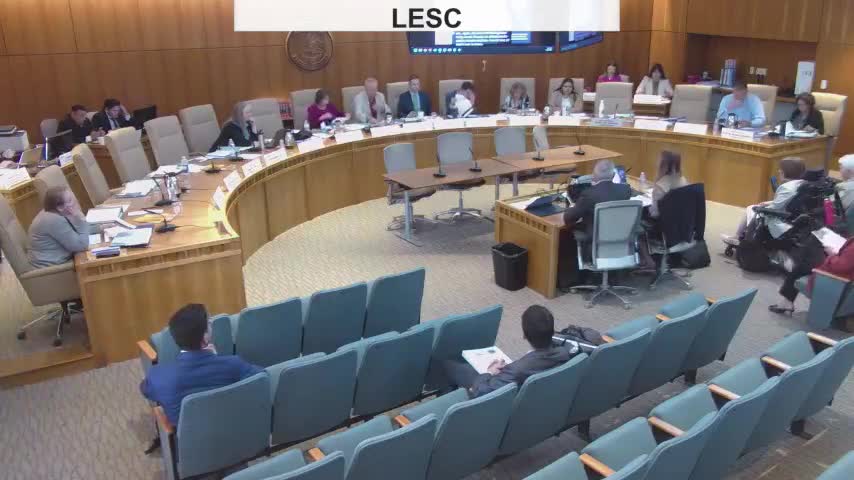
Summary
New Mexico Public Education Department officials told the Legislative Education Study Committee that a Hard-to-Staff Pay Differential initiative has verified 412 special-education hires and that the program will shift from recruitment to retention in year two; lawmakers pressed officials for data on statewide staffing, eligibility, and long-term留
The New Mexico Public Education Department told the Legislative Education Study Committee that a state-funded stipend program aimed at hard-to-fill special-education positions has verified 412 certified special-education hires and that the initiative will move from recruitment to retention in its second year.
The Office of Special Education presented the Hard-to-Staff Pay Differential Initiative as a phased program created after recommendations from the Legislative Education Study Committee and an executive order establishing the Office of Special Education. "412 special education positions have been filled by certified special education staff," Assistant Deputy Director Jessica Dinsmore said during the committee presentation, adding that the licensure validations came from both local education agencies and the NMPED licensure bureau.
Committee members said the program addresses a longstanding staffing shortage but pressed officials for details on allocation, eligibility and long-term effects. At the 120-day reporting point this school year the department recorded 834 total teaching vacancies and 140 special-education vacancies, officials said. The state authorized funding of $5 million per year for fiscal years 2025–27, for a total appropriation of $15 million; the Office of Special Education described a two-payment semester model that delivers funds directly to eligible employees after verification.
Why it matters: Special-education classrooms have been identified as among the hardest to staff in New Mexico and nationwide, and stable staffing affects services required by law for students with disabilities. The committee’s questions focused on who receives stipends, whether the program creates staff resentment, and whether stipends alone will keep teachers in the field.
Program design and early results The department said the initiative began with a LESC recommendation for differential payments and national research suggesting stipends of $10,000 can recruit and retain certified special-education teachers. The legislature provided $5 million a year beginning in the 2024 session, and the Office of Special Education launched a phased rollout. "This initiative was created to address the challenge directly, providing financial incentives for certified special education teachers to both fill high turnover or vacant positions and retain existing educators in the field," Dinsmore said.
Year one emphasized recruitment; year two shifts to retention and a working group of special-education directors, superintendents, union representatives and teachers will meet to refine priorities. Officials described an application and verification process: local education agencies submit applications certifying licensure and caseloads; the department verifies licensure with the NMPED licensure bureau; and employees are paid directly after the department confirms they met a 75% instructional-hours requirement for a semester.
Officials reported other early findings from surveys of stipend recipients: more than 70% were already working in New Mexico schools (many moving into special education from other roles or districts); roughly 30% entered through nontraditional or out-of-state pathways; and 66% of recipients indicated they intend to stay in their current roles next school year. Dinsmore said additional verification for second-semester numbers was ongoing.
Lawmakers press for more data and clarity Committee members raised several concerns: Representative Baca asked why a limited stipend pool might create resentment among experienced teachers who do not receive funds; Senator Stewart asked for grade-level and elementary/secondary breakdowns of vacancies and of the 412 hires; Representative Torres Velasquez asked whether bilingual and related-service staff (speech-language pathologists, occupational therapists, educational assistants) are included or planned for later phases.
Officials answered that the phased model reserved year one for certified special-education teachers, that year two will emphasize retention and a later phase could include educational assistants and related-service providers "if funding permitted," and that stakeholder feedback favored a simple, equitable stipend structure rather than many small role-based variants.
Funding and payment mechanics The department said the stipend funding was structured to avoid increasing local maintenance-of-effort (MOE) obligations: the stipend is paid to employees directly rather than routed through LEAs in a way that would raise local special-education funding baselines. Payments are split by semester; an employee who worked at least 75% of instructional hours for a semester would qualify for that semester's payment.
Officials acknowledged limits: the $15 million across three years cannot cover every certified special-education teacher at the recommended $10,000 total per person, and staff said the program is one part of a broader pipeline strategy that includes residencies, paid student teaching and principal residencies.
Next steps The Office of Special Education will continue verifying hires from semester two, convene the stakeholder working group, collect more detailed grade-level vacancy data requested by the committee, and identify data gaps in pipeline and caseload metrics. Lawmakers asked the department to provide more disaggregated figures on vacancies, hires, and participation in alternative licensure and educator-fellow pathways.
The department emphasized that stipend recipients’ longer-term retention remains uncertain: "We don't have that data today," the assistant deputy director said of multi-year attrition, noting officials will use recipient employment histories and ongoing surveys to shape year-two priorities.