Get Full Government Meeting Transcripts, Videos, & Alerts Forever!
Get email alerts on the Short Term Rentals topic
No spam. Unsubscribe anytime.
Planning commission recommends short-term rental code, asks council to hold public hearing on fees
Summary
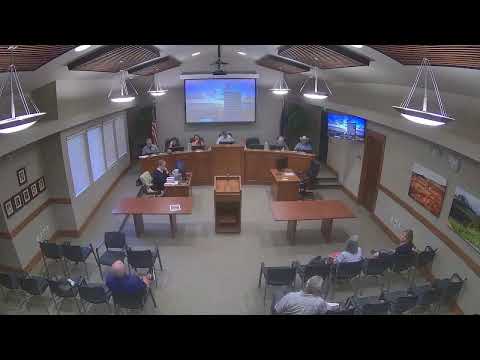
The Planning and Zoning Commission voted Aug. 20, 2025, to forward a draft short-term rental ordinance to city council and recommended that council hold a public hearing that includes a proposed fee schedule.
The Planning and Zoning Commission voted Aug. 20, 2025, to forward a draft short-term rental (STR) ordinance to city council and recommended that council hold a public hearing that includes consideration of fee schedules.
The commission’s recommendation came after an extended discussion of occupancy limits, parking requirements and a citywide 10% cap on homes operating as STRs. A staff presentation summarized changes already made to the draft — including the removal of a 300-foot separation requirement and the insertion of the word “permanent” where applicable — and identified unresolved issues for commissioners to resolve before sending the draft to council.
Why it matters: the ordinance would set local standards for how many people can occupy a rental, how many off-street parking spaces are required, and how the city will limit the total number of STRs. Those rules affect neighborhood parking, enforcement workload and how existing and prospective hosts must advertise and operate their properties.
Key details from the discussion: - Occupancy: the draft includes a provision described by staff as “no more than a maximum of 1 guest per 150 square feet.” Commissioners said they were generally comfortable with that measure as written. (Staff presentation excerpted during the meeting.) - Parking: commissioners reviewed four approaches: 1) a ratio tied to bedrooms (for example, one off-street space per bedroom, capped); 2) a ratio tied to advertised occupancy (for example, one parking space per two, three or four occupants); 3) a flat requirement (the draft currently lists two off-street spaces for all STRs); and 4) a hybrid approach. Several commissioners favored a hybrid formula described in the meeting as: “2 off-street spaces shall be required for all STRs plus 1 additional off-street parking space for every 4 guest capacity beyond 4.” Commissioners discussed rounding, enforcement challenges and variations such as using bedrooms instead of advertised capacity. - Saturation/cap: the draft retains a 10% citywide cap on STRs. Staff proposed language that would require the city council, by resolution, to adopt rules for administering a waiting list or permitting process if the cap is reached; the council would determine the operational detail of that process. - Fees: commissioners agreed that fees are usually set by city council, not written directly into the zoning code. Staff said they would prepare a comparative table of fees used by other cities to inform the council discussion. - Enforcement: commissioners and members of the public noted practical enforcement would often depend on complaints and online listings. The staff recommendation emphasized setting upfront, administrable metrics (occupancy, advertised capacity, parking) so permits could be granted or denied at issuance rather than relying solely on complaint-driven enforcement.
Public comment: Cindy Lafoon asked how the 10% cap would be tracked and how the city would decide which properties could operate if the cap is reached. Staff responded that the ordinance would require the council to adopt a resolution specifying how to administer the cap (for example, an annual review and waiting list), and that the cap calculation would be based on total housing units citywide.
Formal action: Commissioner Weston Reese moved to forward the short-term rental code to city council with the recommendation that council hold a public hearing that includes fee schedules. The motion was seconded and carried by voice vote.
Next steps: the commission forwarded the draft and its recommendation to city council. Council staff will prepare fee options and a public-notice schedule; council will decide whether to adopt the ordinance, modify it, or schedule additional hearings.
(Quotes used in this article are taken from the meeting transcript and attributed to speakers listed in the article’s speaker array.)