Get Full Government Meeting Transcripts, Videos, & Alerts Forever!
Get email alerts on the Metropolitan Transportation Plan topic
No spam. Unsubscribe anytime.
Eagle Pass MPO advances project-selection framework for 2050 Metropolitan Transportation Plan
Summary
The Eagle Pass Metropolitan Planning Organization policy board reviewed proposed project selection criteria and the MTP timeline, and directed staff to finalize scoring weights before issuing a call for projects to build the financially constrained 2050 plan.
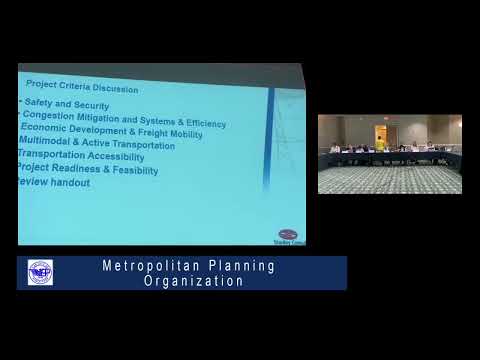
The Eagle Pass Metropolitan Planning Organization policy board on Wednesday reviewed proposed project selection criteria that will guide the Metropolitan Transportation Plan (MTP) 2050 and authorized staff to return with a draft scoring system for final approval.
The MTP will use a 2025 base year, a 2035 intermediary year tied to TxDOT’s Unified Transportation Program (UTP), and a 2050 forecast to meet federal 20-year planning-horizon requirements, Stanley Consultants planner Tim Juarez said. "The UTP serves as the road map for defining projects, prioritizing projects, and most importantly, the available funding," Juarez said.
Board members discussed objectives such as safety, congestion mitigation, freight mobility for the port-of-entry region, multimodal accessibility, resiliency to flooding and environmental impacts, and equitable access to transportation modes. Juarez explained the planned sequence: data collection and public workshops, a call for projects, technical evaluation using agreed criteria, project prioritization, and final adoption after public review and a technical-advisory-committee recommendation.
"Part of today's discussion is I'm gonna give an overview of the MTP development, what are some of the key objectives and regional needs, the project selection process, as well as criteria for consideration," Juarez said. Stanley Consultants noted they have assembled network GIS, functional classifications and several years of traffic counts, and that public-workshop input identifying local problems (for example recurring flooding or signals with long cycles) will be used in scoring and in the project-readiness assessment.
Staff emphasized project readiness as a scoring factor — whether schematic or environmental work, PS&E design, right-of-way, or utility relocation are complete — because funding agencies routinely ask where a project stands in development when allocating funds. Juarez said MPO staff will provide example scoring schemes (percent-weight or point systems) and recommended the board decide weights before the call for projects; the MTP is due to TxDOT and USDOT by Dec. 31, 2026.
The board made a motion to proceed with the project-selection discussion and asked staff to provide a draft scoring approach at the next meeting; the motion carried unanimously on a motion by Padilla and a second by Councilman Elias Diaz. The board also asked members to help publicize the online survey and to encourage community responses to supplement the workshop record.
Next steps include finalizing evaluation criteria and weights, issuing the call for projects, evaluating submissions, publishing results for public review, and obtaining a technical-advisory-committee recommendation prior to policy-board approval and submission to state and federal agencies.
Less-critical timeline and funding details — including a note that some committed projects are carried from TxDOT’s Laredo district allocations and will appear in the plan — taper the story.