Get Full Government Meeting Transcripts, Videos, & Alerts Forever!
Get email alerts on the Municipal Budget topic
No spam. Unsubscribe anytime.
Council reviews FY2026 budget; proposes $300,000 from reserves to boost streets spending while holding tax rate at 63 cents
Summary
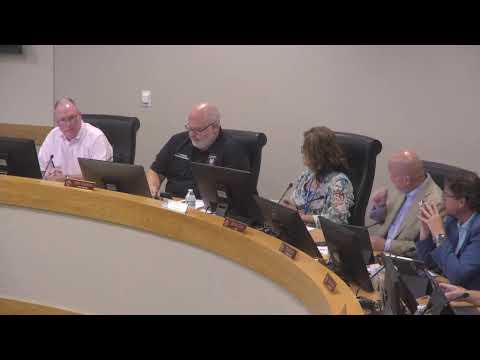
The City Council at a special meeting Aug. 25 reviewed the proposed fiscal year 2026 budget and discussed using $300,000 of the city—s fund balance to increase streets and sidewalks funding to $2.6 million while keeping the proposed property tax rate at 63 cents.
The City Council at a special meeting Aug. 25 reviewed the proposed fiscal year 2026 budget and discussed using $300,000 of the city—s fund balance to increase streets and sidewalks funding to $2.6 million while keeping the proposed property tax rate at 63 cents.
Rachel Winslow, head of office management budget, told the council the proposed general fund is balanced and meets the city—s 25% fund‑balance policy. "We do presently have a balanced budget and we are meeting our 25% policy minimum, with $313,000 over policy minimum or 91 days of reserves," Winslow said. She said using roughly $300,000 of that excess would raise the streets and sidewalks allocation from $2.3 million to $2.6 million for fiscal 2026 with no effect on the proposed 63¢ tax rate.
That proposed streets allocation would represent an $800,000 increase from fiscal 2025 and, Winslow said, "would be the largest general fund commitment for streets and sidewalk rehabilitation in the general fund operating budget since we started tracking these dollars specifically." The council discussed whether to adopt the budget at a 63¢ tax rate or proceed with the legally published maximum rate of 63.5¢.
Trent Epperson, city staff member, said the city will publish notices at the legally approved maximum rate of 63.5 cents but include language allowing an amendment down to the 63¢ rate in the final adoption. "The city is prepared to have an ordinance and resolutions reflecting both tax rates," he said, and staff will have numbers ready should the council amend down when the item is considered.
Epperson also summarized advice from the city—s financial adviser, John Roebuck, that the city could release some reserve cash while remaining within its broad fund‑balance parameters without a near‑term adverse impact on borrowing or rates. "His view is that if we keep within the broad parameters that we've already set for our fund balance he doesn't anticipate any impact on the... debt industry yet," Epperson said, describing ongoing analysis of possible short‑term releases to reduce rate pressure.
Council members asked procedural and fiscal questions. Council member Carbone asked why agenda materials and public notices show a higher maximum tax rate than the rate discussed during the budget workshops; staff replied that the maximum approved rate was set earlier and that state notice requirements and the city—s process require publishing that maximum. Council member Coburn asked staff to be prepared with ordinances and numbers reflecting both rate options when the item returns.
Staff noted process and calendar steps: the first reading of the budget, the first reading of the tax rate, and the public hearing are scheduled for Sept. 8. Council members were reminded that setting a tax rate one penny above the "no‑new‑revenue" rate triggers a supermajority requirement; because the proposed rate is 1 penny above the no‑new‑revenue rate, adopting that rate requires a 60% vote (five council votes). Staff said that if the council fails to secure five votes to adopt the rate above the no‑new‑revenue rate, the city must revert to the no‑new‑revenue rate, which staff estimated would be a fraction under 62 cents and would require removing about $1.7 million in proposed expenditures from the budget.
Winslow also reviewed the water and wastewater rate model history, telling the council that the model expanded from a two‑year projection in 2022 to a five‑year forecast in 2023 to align with the capital improvement plan. She said capital work in recent years and underway includes a JHEC rehabilitation, upgrades to the surface water plant, and projects at Berry Rose and Longwood, and that the rate forecast is sensitive to variables such as growth factors, debt issuance and payments, and weather.
Council members requested follow‑up information. Council member Patel asked for scenarios showing where cuts would be made if the council needed to reduce the proposed budget to meet the no‑new‑revenue rate; staff agreed to provide options. Staff also asked the council to confirm use of the approximately $300,000 above policy minimum toward streets; no council member objected during the workshop discussion.
Next steps listed by staff are the Sept. 8 first readings and public hearing, ongoing availability of staff to answer additional questions, and preparation of ordinance/resolution language that can support either the 63¢ proposal or the 63.5¢ maximum as necessary for legal notice.
(Procedural note: there was no formal motion or final vote on the budget or tax rate at this meeting; the council held a workshop and direction to staff was conceptual and preparatory for upcoming readings.)