Get Full Government Meeting Transcripts, Videos, & Alerts Forever!
Get email alerts on the Capital Improvement Plan topic
No spam. Unsubscribe anytime.
City of Pearland reviews FY2026 capital improvement plan, projects and water/sewer rate outlook
Summary
City staff presented a five-year capital improvement plan and preliminary models for debt-service and water/sewer rate changes at a June 23 special workshop; staff will return July 14 with updated rate models and funding clarifications and the first year of the CIP will be adopted with the budget in September.
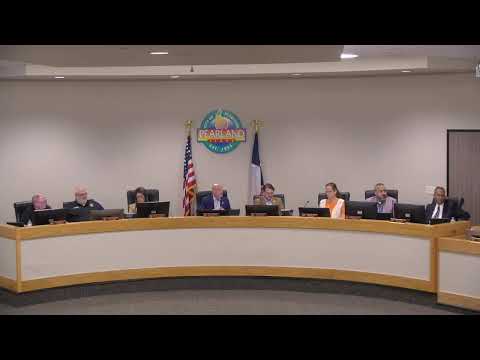
City of Pearland staff presented an updated five-year capital improvement plan (CIP) and preliminary debt- and rate-models at a special council workshop Monday, June 23, outlining projects scheduled for design or construction in fiscal year 2026 and potential effects on the city’s debt-service tax rate and water and sewer rates.
The presentation covered ongoing and planned drainage, facilities, parks and streets work funded primarily by the voter-approved 2023 bond election, General Land Office funding, Pearland Economic Development Corporation (PEDC) contributions and other sources. "This will be the first budget-related workshop as we move into budget season," Trent, a city staff member, told the council as he introduced the general fund portion of the CIP. Rachel Winslow, a city staff member, presented the debt-service and enterprise-fund rate models.
Why it matters: The CIP and related debt sales determine near-term tax-rate pressure and enterprise debt service that affect water and sewer rates. Winslow said the current model reflects a flat debt-service rate of 30¢ for FY 2026 and noted the FY 2026 debt sale will affect the FY 2027 debt-service rate. On the enterprise side, staff reported the city must meet bond-coverage and reserve targets; the model showed enterprise debt service rising from about $38 million in FY 2025 to roughly $44.2 million in FY 2026 because of recent and planned debt sales.
Most important facts
- Ongoing and planned projects: Staff highlighted drainage projects funded by the 2023 bond program (Veterans Drainage, Longwood Park, Shadow Creek Ranch drainage, among others), GLO funding for specified drainage locations, facility work including the Hill House (construction complete by December), parks projects (Hickory Slough, Clear Creek Trail segment to University of Houston–Clear Lake) and streets improvements (Shadow Creek intersection, Broadway expansion managed by TxDOT, Sherwood Street reconstruction). Berry Rose and Longwood water-reclamation projects remain large enterprise efforts in design and construction.
- Funding sources and unfunded items: The bulk of drainage and many parks projects are funded from the 2023 voter-approved bond election; other projects use PEDC funds, grants, certificates of obligation and enterprise funds. Staff moved several large, discretionary items onto a prioritized “potential future projects” list and labeled two partially funded projects — Fire Station 6 (FA 22 0 2) and the Public Safety Training Complex (FA 24 0 5) — as unfunded within the CIP because only land acquisition has been funded to date. Winslow said those two projects remain shown in the CIP to reflect land acquisition already paid.
- Debt-service tax-rate outlook: Winslow said the model currently projects a 30¢ debt-service rate for FY 2026 (a quarter-cent decrease from an earlier model) and cautioned the slide deck does not assume any future bond elections; the final debt-service tax rate will be set later in the budget process and adopted in September.
- Water and sewer rates: Staff said enterprise rates are not property-tax supported and are driven by the city’s debt obligations and rate policy (including bond-coverage and reserve requirements). The preliminary rate model — current as of the week of June 16, 2025 — shows a reduction from prior larger spikes but still anticipates increases in FY 2027–FY 2028 as additional debt is sold. Winslow told council a finalized enterprise rate model will be provided July 14.
Questions and follow-up directions from council
Councilmembers pressed staff for clarifications on project timing, funding and presentation format. Councilmember Cozza asked when design for the ISLA/Gales/Sherrill drainage improvements would begin; Fabiola de Carvalho, a city staff member, estimated design selection and council authorization would start the process and suggested design could begin around December with construction estimated in 2027. Councilmember Chevrier asked about the nonworking HVAC at the Stella Roberts Recycling Center; staff later confirmed the HVAC installation is scheduled for July 12 (Lorenzo, staff member). Staff also committed to add the historical funding column back into the CIP tables so totals on slides align, to mark unfunded items clearly and to return with a confirmed impact estimate if the $61 million public-safety training complex were added to a future bond program.
No formal votes or budget adoptions were taken at the workshop. Staff laid out the next steps in the calendar: July 14 (enterprise funds, special revenue funds and PEDC), July 28 (follow-up), August 11 (general fund and debt service discussion), and budget readings and first reading of the CIP adoption on September 8 and September 22. The council was reminded the FY 2026 CIP’s first year is adopted with the budget ordinance; years two through five remain planning years until acted upon in their respective years.
Context and background
Staff explained that many projects include multi-year schedules and that construction awards and debt sales may be timed to match project progress — which can make funding schedules and project schedules appear misaligned on summary slides. Several projects listed for FY 2026 design or construction are part of or were moved from the 2023 bond program; PEDC funding was shown on individual project sheets for projects the corporation is funding. For enterprise projects, the city uses impact fees, certificates of obligation and enterprise cash where appropriate; voter-approved GO bonds are not available for enterprise fund projects.
What council asked staff to return with
- Confirm whether the $61 million Public Safety Training Complex is included in the current debt-service model and, if not, provide a modeled tax-rate impact if the council pursues the project. - Reinsert a historical funding column into the CIP tables and add clear footnotes or asterisks identifying unfunded items. - Provide a more detailed timeline for ISLA/Gales/Sherrill design and construction and an email timeline for council to distribute to constituents. - Deliver a finalized enterprise rate model on July 14 and run a scenario showing the impacts of maintaining a 7% water/sewer increase in FY 2026 versus the proposed 5.5%. - Provide a query showing what percentage of residential accounts stay at or below the 2,000-gallon minimum billed amount.
Ending
Councilmembers generally commended the new phased budget-review schedule and asked staff to return with the requested clarifications at the July 14 meeting; the council will review and adopt the first year of the CIP as part of the FY 2026 budget process in September. No formal action was taken at the workshop.
Quotes used in this story come from the workshop transcript of the City of Pearland City Council special meeting on June 23, 2025.