Get Full Government Meeting Transcripts, Videos, & Alerts Forever!
Get email alerts on the Water And Wastewater Rates topic
No spam. Unsubscribe anytime.
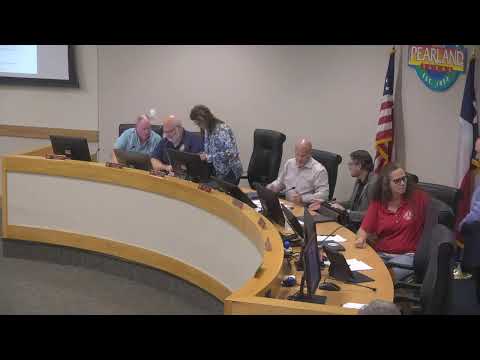
Pearland council reviews 5.5% water-rate proposal, agrees to fund hydrant maintenance crew
Summary
At a July 2024 special meeting, Pearland staff proposed a 5.5% water and sewer rate increase for fiscal 2026 and recommended a three-person hydrant inspection and repair crew. Council members discussed a 7% alternative, the enterprise fund’s reserves and debt-driven rate spikes, and asked staff for follow-up analysis and a memo.
At a July 2024 special meeting, Pearland staff recommended a 5.5% increase to water and sewer rates for fiscal 2026 to meet debt and operating needs, and asked council to consider a 7% alternative to mitigate larger increases in later years. The council discussed the proposal, staffing additions for Pearland Water and a dedicated hydrant inspection and repair crew, and requested follow-up financial analysis and a memo from staff.
The rate model presented by Rachel Winslow, head of the Office of Management and Budget, showed that a 5.5% change would raise the enterprise operating budget to about $93.4 million from roughly $82.9 million, with the enterprise debt fund rising to about $44 million from $38 million. Winslow said the enterprise must “bring in enough money to pay for our debt and operations,” and that rate increases are the primary mechanism to sustain the fund. The presentation noted approximately $523 million in planned water and wastewater infrastructure investments and a required bond coverage ratio of 1.15 and an enterprise cash equivalent target above 15% of operating expenses.
Under the 5.5% proposal, an average household with a 5/8-inch meter using about 6,000 gallons a month would pay an additional $5.95 per month; a 7% option would raise that increase to $7.59 per month in the model shown to council. Staff said the 7% scenario would slightly reduce projected spikes in later years but recommended 5.5% as the preferred option.
Council members debated the rate structure and distribution of costs. Councilmember Carbone said the current meter-size–based base charges “stick it to our small businesses” and urged exploration of alternative rate structures. Several members asked staff to include more comparisons of how other cities bill commercial meters and to model the residential impact if Pearland returned to its prior structure.
Council members also questioned a projected spike in rates for 2027–2028 tied to debt for the Berry Rose project. Staff said the city is issuing that debt as construction proceeds to reduce impacts, and that they will consult the city’s financial advisers about possible structuring options to smooth future spikes.
On operations, staff proposed adding 6.5 full-time equivalents to Pearland Water overall and creating a new asset management division. The proposal also included three full-time equivalents for a distribution-and-collections hydrant crew (a crew leader and two maintenance workers) plus a truck and trailer. Public Works staff said the vehicle is roughly $107,000 and the trailer about $95,000 and that the engineering/public-works vehicle replacement schedule is nine years.
Mister Saenz (Public Works staff) told the council the department is not meeting industry standards for hydrant inspection. “The industry standard is to inspect once a year. We’re not getting to every hydrant every year,” he said, and explained that in the last two years the department has inspected about 2,800 of the city’s roughly 5,400 hydrants and produced roughly 800 work orders for repairs; staff said about 500 of those work orders remain outstanding. Council members who expressed concern said those figures supported the need for a dedicated crew to ensure annual inspections and more timely repairs.
Staff emphasized the distinction between discussion and a formal decision: council provided feedback and expressed preferences (several members signaled support for the 5.5% recommendation while a few said they would consider 7% for predictability), but did not adopt rates at the meeting. Staff said they will circulate a follow-up memo responding to outstanding questions and return to council in August with the budget after assessed-value information is available; a July 28 workshop is available if council wants further discussion before August.
Clarifying details raised at the meeting included changes to customer fees and delinquency penalties. Staff noted new incentives—$1 per month for ACH enrollment and $1 for e-billing—and updates to deposits (commercial $250; residential renter $200) and temporary fire-hydrant meter fees ($3,800). Delinquent commercial late fees would be tiered at 10% after 24 days, 15% after 48 days and 20% after 72 days to align with the city’s billing cycle; the current flat late fee is 10%.
Next steps: staff will prepare a memo responding to council questions (including comparative meter-size billing practices and a rate-model sensitivity analysis for 5.5% vs. 7%), consult the city’s financial advisers on debt structuring to reduce future spikes, and return with final budget and rate recommendations in August.