Get Full Government Meeting Transcripts, Videos, & Alerts Forever!
Get email alerts on the Agritourism Code Update topic
No spam. Unsubscribe anytime.
Yakima County holds final public hearing on agritourism, outdoor-festival code updates; board sends draft to work session
Summary
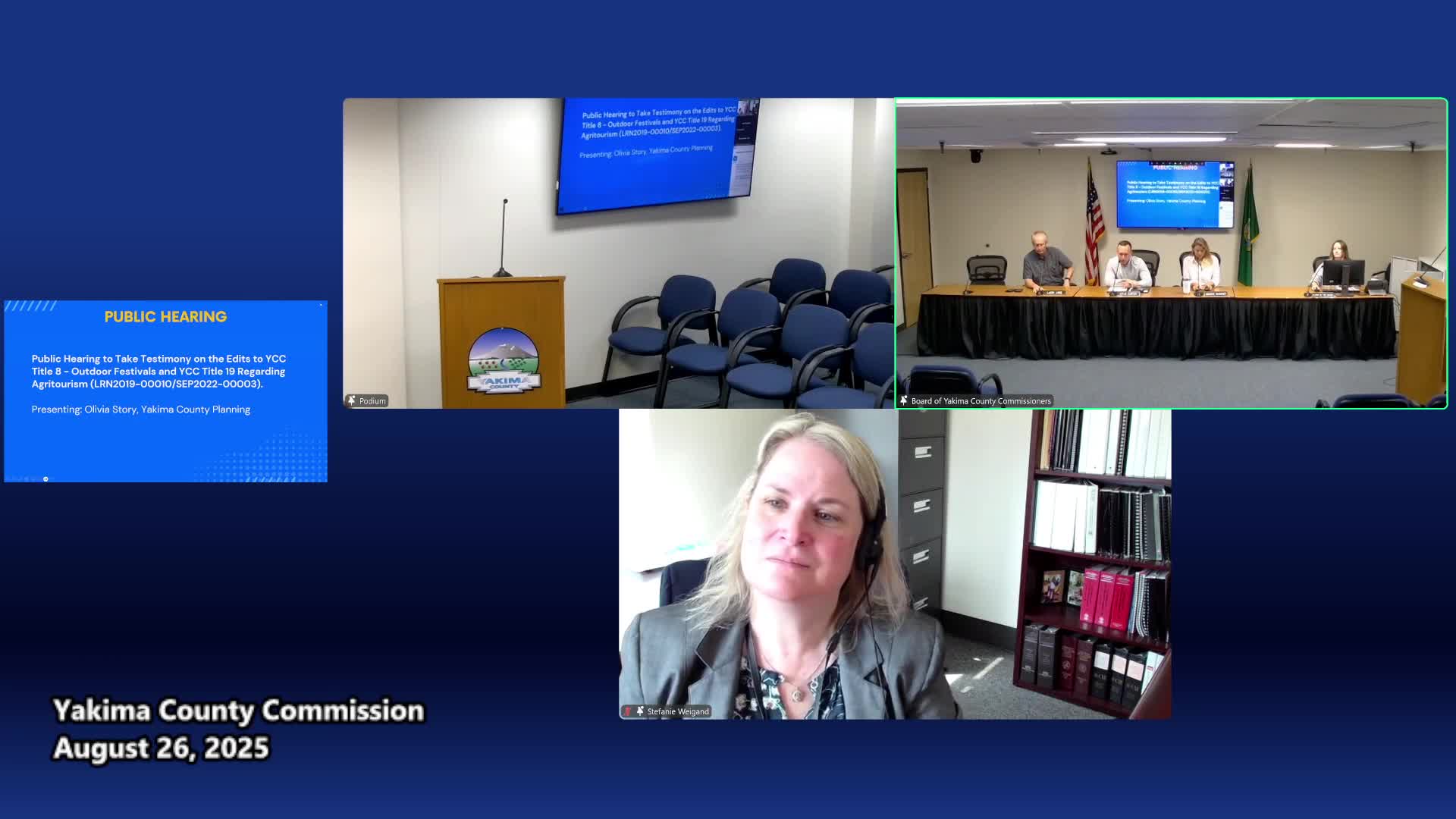
The Yakima County Board of Commissioners closed a public hearing on proposed changes to County Code Title 8 (outdoor festivals) and Title 19 (agritourism) on Aug. 26 and directed planning staff to bring the revised draft to a work session for further deliberation.
The Yakima County Board of Commissioners closed a public hearing on proposed changes to Yakima County Code Title 8 (outdoor festivals) and Title 19 (agritourism) on Aug. 26 and directed county planning staff to bring the latest draft to a work session for detailed deliberation and potential refinement.
The proposed code revisions, presented by Olivia Story of the Long Range Planning Department, are intended to update how wineries, breweries, agritourism operations (ATOs) and outdoor festivals are regulated in agricultural zoning. “At the beginning of this project, we created the Agri tourism Advisory Group,” Story said, describing six advisory-group meetings and a multi-year review that included planning-commission hearings and prior county hearings in December 2023 and April 2025.
The draft includes multiple substantive changes: lowering the minimum producing-acre threshold for ATOs (the draft discusses reducing the current 5 producing-acre requirement to either three or one acre); removing a square-foot cap on event or food-service structures (staff said there remains a separate limit that events with 500 or more attendees would require an outdoor-festival permit); eliminating the previous cap on units of lodging so long as on-site acreage limits are met; allowing restaurants associated with wineries, breweries and distilleries to be open to the public (rather than limited to overnight guests at lower-tier ATOs); and requiring adequate road access and signed road-maintenance agreements when projects use private roads. Staff also noted a SEPA determination of non-significance issued in February 2022 and that no public comment letters had been received in advance of this hearing.
Public commenters both supported and raised concerns about wording and practical effects. Sal Leone of Rattlesnake Hills urged broader, more technology-neutral language for overnight structures, noting emerging units such as capsule-style fiberglass homes, shipping-container units and park-model recreational vehicles are not explicitly named in the draft and may be excluded if code language is too narrow. Tommy Carroll, Yakima County Planning, told the board the term “membrane structures” was intended to cover tents and yurts and that the board could refine definitions during deliberations to allow flexibility while staying consistent with building and fire codes: “Membrane structures was the term used to cover tents, yurts, and those types of things.”
Commissioners asked staff about outreach. Story said staff maintained an online project page with drafts, hearing notices and meeting materials; staff also emailed parties of record and agency stakeholders and held multiple public hearings to gather input. The board heard additional comments from winery and tourism supporters who said agritourism can boost local economic activity and from residents pointing to land-use constraints, such as parcels zoned agriculture but lacking irrigation or otherwise unsuitable for crop production.
After public comment, Commissioner Curtis moved to close the public hearing and ask staff to bring the latest draft to a work session for deliberation; Commissioner McKinney seconded the motion and the board voted unanimously to close the hearing and schedule the work session. Staff reminded the board that if the code is adopted, changes would become effective 90 days after the published notice of adoption, and that further deliberation at the work session could include clarifying lodging and recreational-vehicle language and examining building-height/vertical constraints already governed by existing codes.
The board indicated it will review staff edits at a work session and that, if it moves forward after deliberations, adoption would return to a future public meeting for formal resolution and ordinance action. Commissioners thanked staff and community stakeholders for the multi-year engagement on the code update.
Ending: The planning department will present the latest draft at a future work session for commissioner deliberation; no adoption vote was taken at the Aug. 26 meeting.