Get Full Government Meeting Transcripts, Videos, & Alerts Forever!
Get email alerts on the Rights Of Way topic
No spam. Unsubscribe anytime.
Council adopts updated utilities-in-right-of-way manual to expand rules and clarify warranties
Summary
Pierce County Council adopted the seventh edition of the county manual on accommodating utilities in rights of way, extending notification periods, clarifying occupancy rules, adding a general right-of-way permit and a 12-month pavement warranty for restorations.
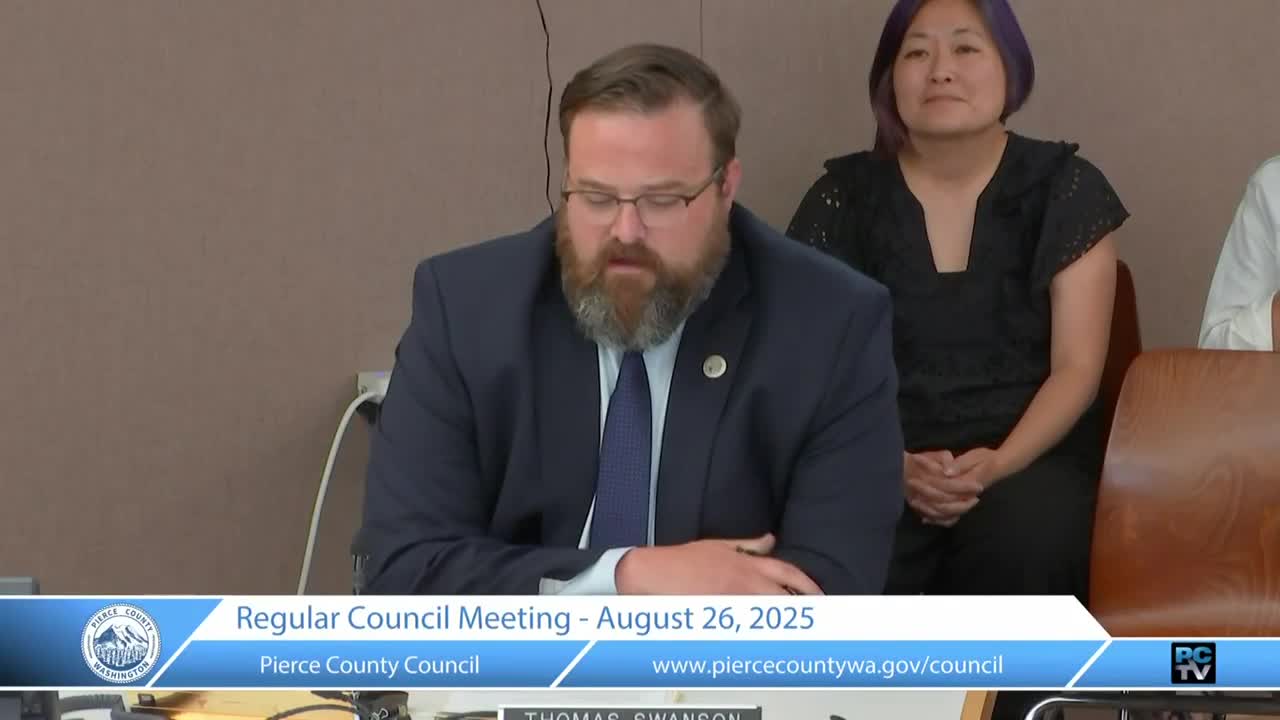
The Pierce County Council on Aug. 26 adopted Ordinance O2025-521, approving the seventh edition of the county manual on accommodating utilities in county rights of way. Planning and Public Works staff said the manual governs how utilities and their contractors perform projects within county rights of way and supplements franchise agreements. Significant updates in the seventh edition include: extended notification periods for utility movements, clarified rules on occupancy of the right of way (including equipment and material storage during working and nonworking hours), introduction of a general right-of-way permit for contractors without a franchise, updated consultation requirements for projects occurring within 100 feet of pipeline company rights of way, new pavement repair policies and inclusion of the county’s Dig Once broadband policy. Staff also said there is a 12-month warranty period for pavement restorations following accepted work. An equity and fiscal analysis accompanied the ordinance in the meeting packet. The council adopted the ordinance by roll-call vote, 7-0. Pierce County officials said the manual aims to reduce conflicts between utilities and the county roadway program, improve pavement longevity after repairs, and coordinate broadband and other trenching work through the Dig Once policy. The county will enforce permit and restoration standards in subsequent projects and rely on inspections and complaint-driven follow-up to ensure warranty compliance.