Get Full Government Meeting Transcripts, Videos, & Alerts Forever!
Get email alerts on the Housing Related Services topic
No spam. Unsubscribe anytime.
Council updates housing-services plan, allocates up to $150,000 for medical respite pilot and reschedules final action
Summary
The Pierce County Council approved two committee amendments to the six-year Housing and Related Services advisory expenditure plan, including a reallocation of modest permanent supportive housing funds to start a medical respite pilot, and moved the larger ordinance into a second substitute with continuation to Sept. 9 for additional work.
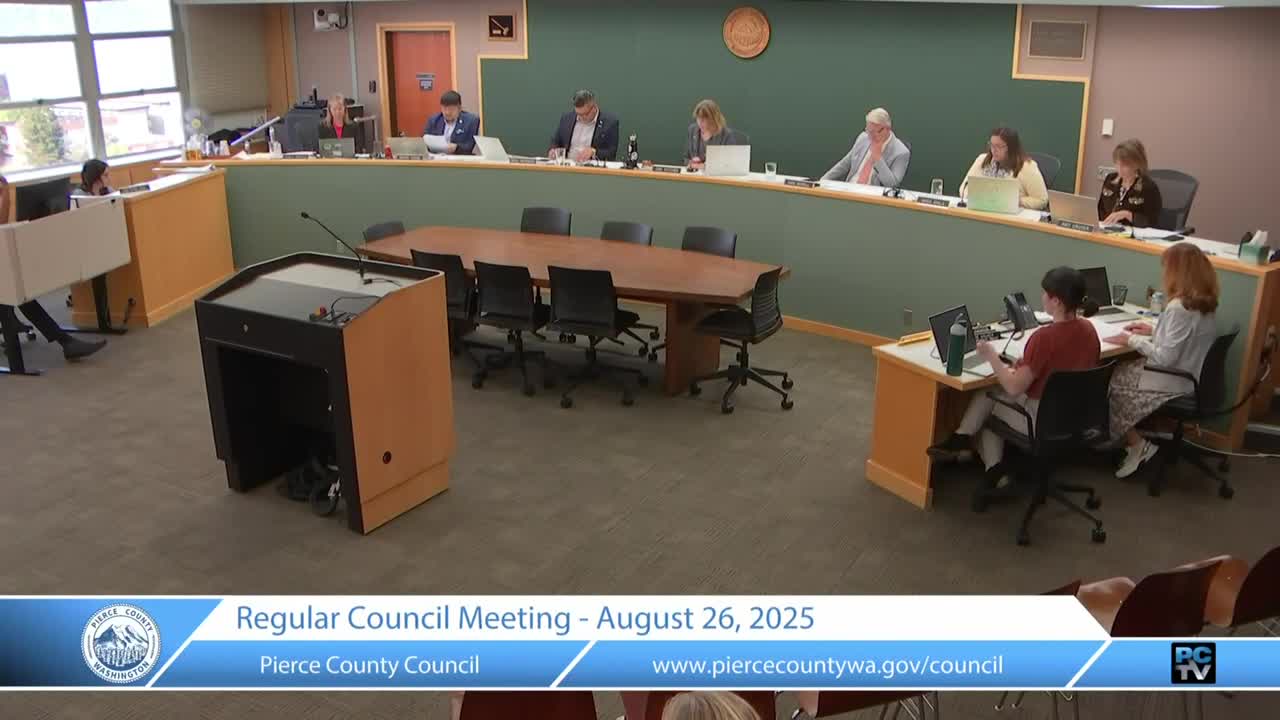
The Pierce County Council on Aug. 26 amended and continued work on the county’s six-year advisory expenditure and implementation plan for the Maureen Howard Affordable Housing Act fund (one-tenth of 1% sales tax for housing and related services). Council staff summarized the plan’s structure and funding splits: 10% for administration and 90% for program uses; within program costs, 50% for development and preservation capital serving households at 30–60% of area median income (AMI), 30% for capital serving households below 30% AMI, and 20% for permanent supportive housing (PSH) services. Staff noted available PSH services funding from 2024–25 totals about $6.5 million and provided 2026 figures for the buckets used in planning. Council adopted Council Amendment Number 1, which revises membership requirements for evaluation committees that score applications for PSH services and clarifies that PSH services funding will be distributed through a competitive notice of project availability (NOPA) rather than through the homeless housing NOFA process. The amendment also updates board names and corrects scrivener’s errors. Council also adopted Council Amendment Number 2 to provide up to $150,000 in total for a proposed temporary medical respite facility repurposing (up to $50,000 start-up in 2026 and up to $50,000 operating support in each of 2026 and 2027), with any unused medical-respite funds reverting to PSH services. Staff said the change was intended to pilot a temporary medical respite option that agencies would operate to provide short-term medical recovery for people exiting hospitals without stable housing. After adopting those amendments, the council voted to roll the ordinance into a second substitute and continue the matter to the Sept. 9 regular meeting for further work and to allow staff time to finalize details. The motion to continue into a second substitute was approved by voice vote. Councilmembers discussed the intended meaning of “lived experience” membership on evaluation committees and expressed a preference for recent lived-experience representatives. Members also requested additional time to consider the broad, systemic implications of requiring reversionary or merger clauses in conservation or housing-related agreements (a separate item discussed earlier in the meeting). The resolution amends the advisory plan that guides Human Services Department funding recommendations; staff emphasized the plan is advisory and the department is to coordinate with advisory bodies when developing funding proposals to the executive and council.