Get Full Government Meeting Transcripts, Videos, & Alerts Forever!
Get email alerts on the Permitting topic
No spam. Unsubscribe anytime.
Kitsap County rolls out "2 by 6" permitting program; staff urges quality submittals and offers new prep tools
Summary
Department of Community Development staff described the county's new 2x6 review program to speed certain land‑use and site‑development permits under Senate Bill 5290, introduced resources including a parcel "prep report" and intake checklists, and took public questions about online application tools and what constitutes a complete application.
Kitsap County Department of Community Development staff outlined steps the county has taken to implement a new expedited review program, known locally as "2 by 6," aimed at meeting statutory review timelines for selected Type 2 and Type 3 permits under Senate Bill 5290.
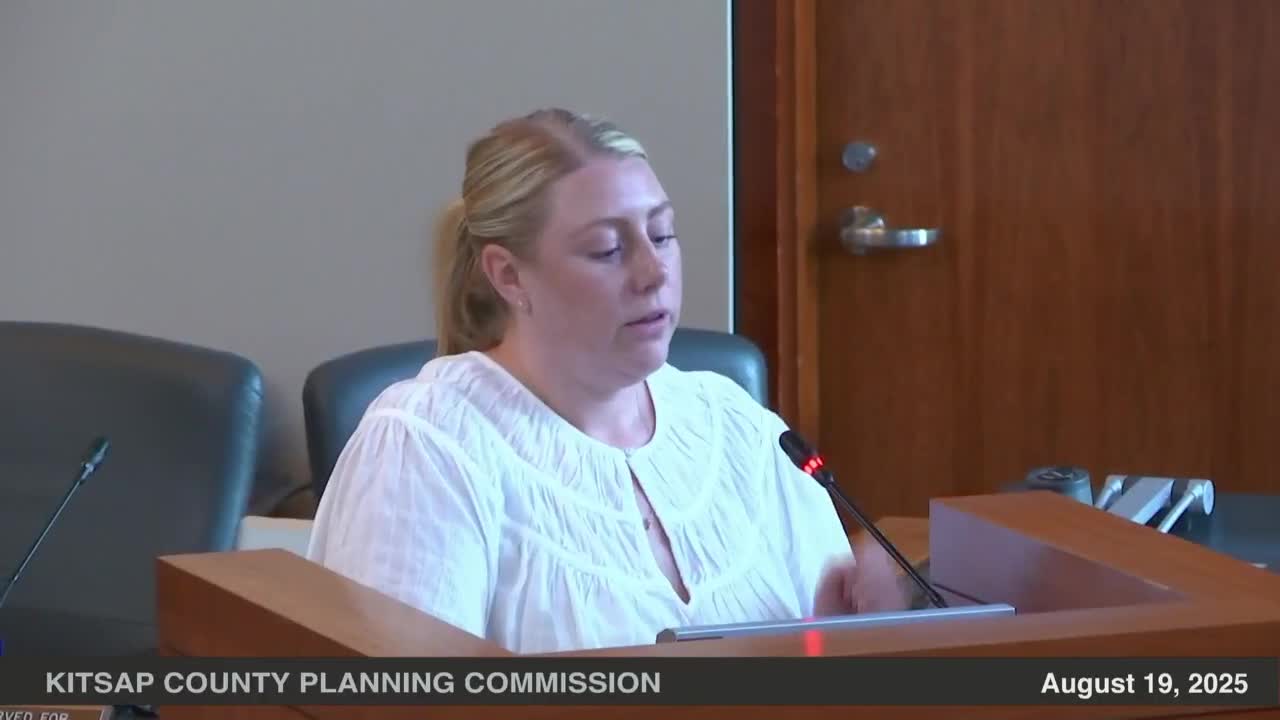
Caitlin Schlatter, a program specialist and 2x6 coordinator with the Department of Community Development, told the Planning Commission on Aug. 19 that 34 permit types will be affected by the program and that the county has designed a two‑cycle review process of six weeks each for qualifying permits. "The idea of 2 by 6 is that there would be 2 review cycles lasting 6 weeks each," Schlatter said, and she added that state timelines tied to the bill are 100 days for certain Type 2 permits and 170 days for Type 3 permits.
Schlatter described a set of new customer resources intended to improve the quality of initial submittals and reduce cycle time: a public "prep report" GIS tool that flags parcels as green/yellow/red for potential critical areas; robust intake checklists that list required documents by permit type; site‑plan examples; and a "submittal success guide." She said those resources are intended to help applicants submit complete materials so staff can begin formal review promptly.
Responding to a public question from a commenter who identified himself as "Mr. Palmer," Schlatter emphasized that her office will investigate specific technical issues raised about the online permitting portal and invited the commenter to follow up by email. She said permit intake follows two checkpoints: an initial counter completeness check by permit technicians and then an intake screening by reviewers to determine whether the application is ready for the first review cycle. "Our permit techs are processing for high level completeness. And then once the application makes it through that first checkpoint, it will go to its first intake screening," Schlatter said.
Schlatter reviewed the program rollout: the county launched site development activity permits under the 2x6 process on March 31, added preliminary plat reviews on June 6, and brought a larger set of land‑use permit types online on Aug. 11. She reported an increase in 2x6 submittals after the most recent phase and said there were 24 active 2x6 permits in the queue at the time of the presentation.
Several commissioners and Department of Community Development leaders joined the discussion. Jenny Kreifels (DCD planning) explained a formal stream‑typing modification process run by the Washington Department of Natural Resources and tribal/state reviewers for landowners disputing mapped critical areas. Cecilia Olson, assistant director at DCD, explained procedural consequences built into the statute: jurisdictions may adopt a menu of alternative options to avoid fee refunds if timelines are missed and must report performance to the Washington State Department of Commerce.
Commissioners asked for clarification about outreach and stakeholder selection for prior design workshops; Schlatter said participants were selected with commissioner involvement and included a mix of staff, developers and community members. Commissioners also asked whether the county intends to replace multiple software tools used for applications and permit records; Schlatter said the county currently uses separate systems (Clarity as the application portal, SmartGov for permit records) and acknowledged ongoing evaluation of more integrated solutions.
Schlatter and DCD staff offered to provide additional follow‑up on several items raised during general public comment, including how the county treats specialized permit types such as reasonable‑use exceptions within the portal and how applicants can request intake meetings or prep‑report assistance before submitting applications.
No formal commission action was taken; the presentation served as an informational briefing on program implementation and early results.