
Kitsap Public Works proposes new sewer construction standards, sparks debate on private roads and lift-station rules
Get AI-powered insights, summaries, and transcripts
Subscribe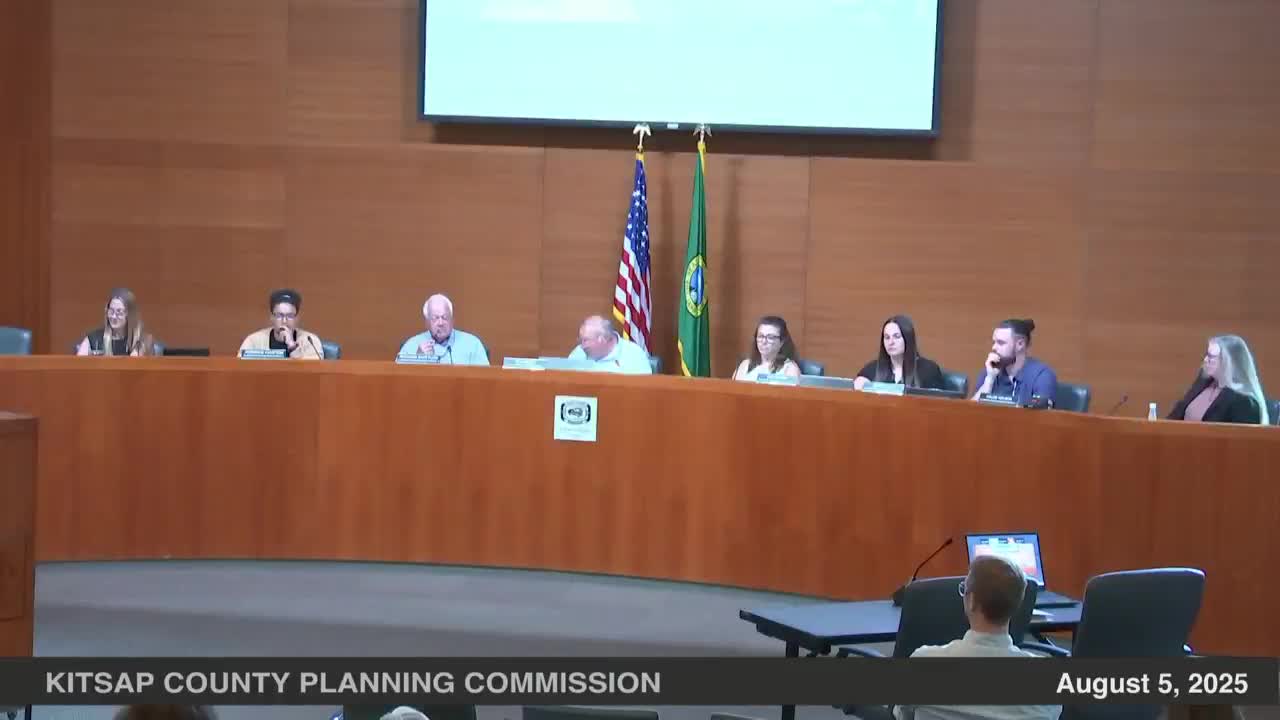
Summary
Anthony Burgess, capital project manager for Kitsap County Public Works's Sewer Utility, presented a two-part update to the county's sanitary sewer construction standards and said many technical requirements had not been comprehensively updated since the 1990s.
Anthony Burgess, capital project manager for Kitsap County's Sewer Utility Division, presented a two-part update to the county's sanitary sewer construction standards on Aug. 5, describing technical edits that staff say are overdue and a set of discretionary development-policy proposals that drew extensive commissioner and stakeholder questions. "Sewer has not had a comprehensive update to their standards in many, many years," Burgess said.
Burgess divided the rewrite into (1) means-and-methods technical updates intended to reflect current construction practice and safety, and (2) discretionary development policies that need public conversation. Immediate technical changes include banning pea-gravel ("pea gravel") trench backfill for pipe bedding and requiring a compacted, angular material; tightening TV-inspection tolerances (developers must repair any pipe "belly" exceeding 1/8 inch); and updating standard details and figures. Burgess said crews already are enforcing the material change for projects that began construction this summer.
The workshop's most contested proposals concern policy choices: staff proposed that sewer mains installed within private roadways or on private property remain privately owned and not be dedicated to the county (a change that would keep maintenance and long-term risk with property owners or HOAs); they also proposed raising the developer-built lift-station threshold from 10 lots to 15 equivalent residential units (ERUs) with a staged requirement for larger projects. Burgess said the private-road proposal grew out of cost-share discussions and a Board request to explore ways to reduce countywide rate burdens. Commissioners and other attendees raised concerns about equity, HOA governance capacity, and long-term risk if small private communities cannot afford major repairs. "It seems to me...we're not going to get into those situations in the future," Burgess said about inheriting septic systems; on private roads he added that the county would be "very curious" about commissioner direction.
Commissioners asked staff to limit the private-road proposal to commercial properties for now and to return with a revised draft and a comparison to other jurisdictions. Other technical recommendations covered: minimum easement widths that increase with pipe depth; clearer requirements for emergency-access and minimum lift-station site dimensions (staff cited a 75-by-75-foot minimum in code); requirements for redundant pig-launch points for pressurized systems; and clarifying that the county will not accept ownership of septic systems. Burgess said he met with the Kitsap Builders Association and received feedback on July 10; he also recommended the county review and update the standards on a 2- to 3-year cycle rather than leaving them unchanged for decades.
On operational policy the staff proposed new procedures for responding to blockages: requiring homeowners to do initial due diligence (hire a licensed plumber to locate internal blockages) before the utility responds except in true emergencies. Commissioners asked staff to clarify the cadence of events, whether the county would do initial TV inspection before asking homeowners to pay for a plumber, and whether a reimbursement (chargeback) mechanism would exist if the homeowner pays and the county later finds the problem to be its responsibility. Burgess agreed the language needs clarification and said staff would revise it to require "mutual discovery" on site and ensure licensed professionals perform diagnostic work.
Burgess recommended immediate adoption of some technical items (e.g., ban on pea gravel) and continued public review on development-policy items. Commissioners voted to schedule a second work study so commissioners could review the draft revisions, see an item-by-item comparison to the prior standards and provide more precise direction before the public hearing stage.