King County auditors find improper payments, recommend tighter controls for DCHS grants
Loading...
Summary
A King County Auditor's Office report found delayed oversight, improper payments and potential fraud across multiple Department of Community and Human Services (DCHS) contracts, prompting council questions, public testimony from Best Starts for Kids grantees and a pledge from DCHS to implement audit recommendations and seek added capacity.
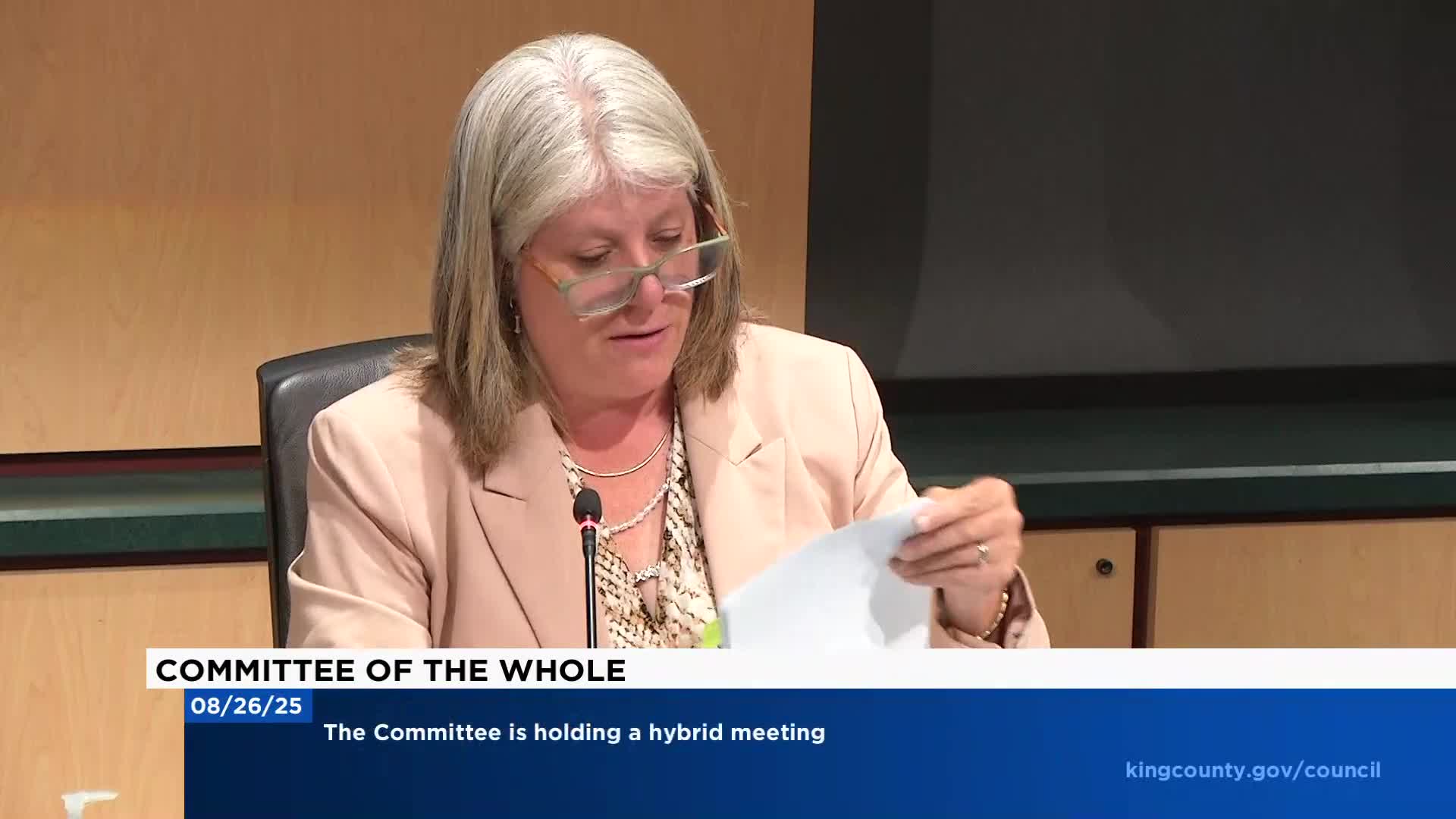
King County Auditor Kimber Waltmanson told the Council Committee of the Whole on Aug. 26 that the county's Department of Community and Human Services made a series of oversight errors that led to improper payments and potential fraud in multiple local grant contracts.
Waltmanson, presenting the office's audit of DCHS contract management for 2023 and 2024, said DCHS distributed more than $1.5 billion during the audit period and "made a policy choice to focus on reducing barriers to county contracting for organizations without much government contracting experience." She added the agency implemented that policy "without installing a safety net to monitor whether the funds were being used appropriately." Principal auditor Megan Coe said the audit found examples of altered or forged supporting documents, cash-withdrawal receipts used as backup, and contracts paid without consistent detailed expense reports.
The findings prompted council members to press DCHS leadership and the auditor's office on next steps and resources. Kelly Ryder, director of the Department of Community and Human Services, said DCHS "takes these findings very seriously" and has organized an internal work group, will propose budget requests this fall to add compliance and finance staff and aims to implement most recommendations by mid-2026, with fuller internal-control work extending to 2027.
Why it matters
Auditors said the county asked DCHS to expand funding to smaller, less experienced nonprofit organizations but did not provide timely fiscal oversight, increasing the county's financial risk. The report singled out a hybrid payment model used for Best Starts for Kids (BSK) contracts that pays set monthly amounts based on contract budgets and delays reconciliation and quarterly expense reporting. The hybrid model, Coe said, accounted for more than $130 million in DCHS provider payments in 2024 and can allow payments to accumulate ahead of later reconciliation: auditors found at least one case where a grantee was paid about $80,000 more than it had spent before payment was paused.
Key points from the audit and council discussion
- Scope and findings: The audit examined a sample of locally funded community grants (36 contracts in the sample representing roughly $34 million in program budgets across youth programs) and found limited early fiscal monitoring, delayed fiscal site visits, inconsistent application of hybrid-model reconciliation, and weak written policies for invoice review. Auditors concluded that DCHS did not prioritize "responsible stewardship" and identified improper payments and opportunities for fraud, waste and abuse.
- Hybrid payment model: The hybrid approach (monthly fixed payments with later true-up) delays routine monthly expense review and the reconciliation that helps prevent excess payments. Auditors recommended DCHS identify hybrid-model risks, set clear reconciliation thresholds and build written procedures staff can follow.
- Financial capacity building: The audit reviewed the BSK capacity-building program and found that of nearly 23,000 consulting hours provided between 2022 and 2024, only about 6% focused on financial management training for grantees. Auditors recommended more training and clearer contract guidance.
- DCHS response and resourcing: Director Kelly Ryder said DCHS has begun implementing recommendations, added three compliance positions in 2025, and will propose additional staffing for compliance and finance in the fall budget to increase site visits and more frequent invoice reviews so issues are caught earlier.
Public testimony and community concerns
Before the audit briefing, a series of public commenters — many connected to the Best Starts for Kids 'Liberated Village' strategy and related youth programs ' urged the council to address what they described as punitive or inconsistent financial oversight by DCHS. Nikkom Pan, who identified himself as an external evaluator for the Liberated Village, said the strategy faced "punitive treatment including withholding of payments for receipts that were previously approved" and asked the council to "close King County's value gaps, bring Yolanda back, let her lead, and let us keep this work going." (Nikkom Pan, external evaluator; public comment.)
Multiple community speakers described delays in invoice payments, shifting documentation requirements, and the administrative leave of a program manager they named as central to their strategy. Titus Britt said his group had experienced withheld payments and repeated requests for documentation for approved expenses. Lee Garrett described building an enrollment portal and monitoring tools that, he said, recovered over $2.5 million from nonperforming contracts but said community partners still faced operational harm from abrupt compliance actions.
Council direction and next steps
Council members of different districts acknowledged the audit's seriousness and focused on three next steps: (1) insist on rapid implementation of the auditors' recommendations; (2) provide DCHS the resources it requests to increase compliance staffing and financial-review capacity; and (3) pursue legislative or budget actions to establish a clearer countywide framework for grant administration. Councilmember Dunn said she plans legislation to create a framework of best practices for community grants; Dunn and others urged council oversight of DCHS's implementation plan.
Auditors and DCHS asked the council to use the upcoming budget process as a venue to authorize staffing and tools the department needs. Ryder said most recommendations could be implemented by mid-2026, while a comprehensive internal-control program might take longer, through 2027, to fully embed.
What the report did not conclude
The auditors did not provide a final dollar total of funds that require recovery because documentation was incomplete; DCHS is conducting follow-up investigations to determine whether funds should be reclaimed or other corrective action taken. Auditors did not recommend ending the hybrid model outright; they recommended written procedures, thresholds for pausing payments and more timely reconciliation.
Ending
The audit presents both management failures and potential fixes: auditors called for clearer policies, more frequent fiscal monitoring and training; DCHS said it would add staff and submit budget requests this fall to fund the work. Council members signaled a willingness to support added resources and legislative changes to shore up stewardship of hundreds of millions in county grant funding while several community members urged fast action to avoid further harm to nonprofit partners and the people they serve.