Get Full Government Meeting Transcripts, Videos, & Alerts Forever!
Get email alerts on the Critical Areas Monitoring topic
No spam. Unsubscribe anytime.
Committee acknowledges receipt of Critical Areas Monitoring and Adaptive Management Program Plan; staff outline costs and next steps
Summary
The Local Services and Land Use Committee on Aug. 20, 2025, voted to forward proposed motion 2025‑0205 acknowledging receipt of the Critical Areas Monitoring and Adaptive Management Program Plan, which describes monitoring types, timelines and estimated staffing and cost needs.
Lede: The Local Services and Land Use Committee on Aug. 20, 2025, voted to forward proposed motion 2025‑0205 acknowledging receipt of the Critical Areas Monitoring and Adaptive Management Program Plan, which describes monitoring types, timelines and estimated staffing and cost needs.
Nut graf: The staff report responds to a 2025 budget proviso and recommends a program framework that focuses initial monitoring on riparian areas and wetlands (where proposed departures from best‑available science were noted), defines three types of monitoring (permit implementation, permit effectiveness and ecological validation), and estimates development and multi‑year implementation costs and staff needs.
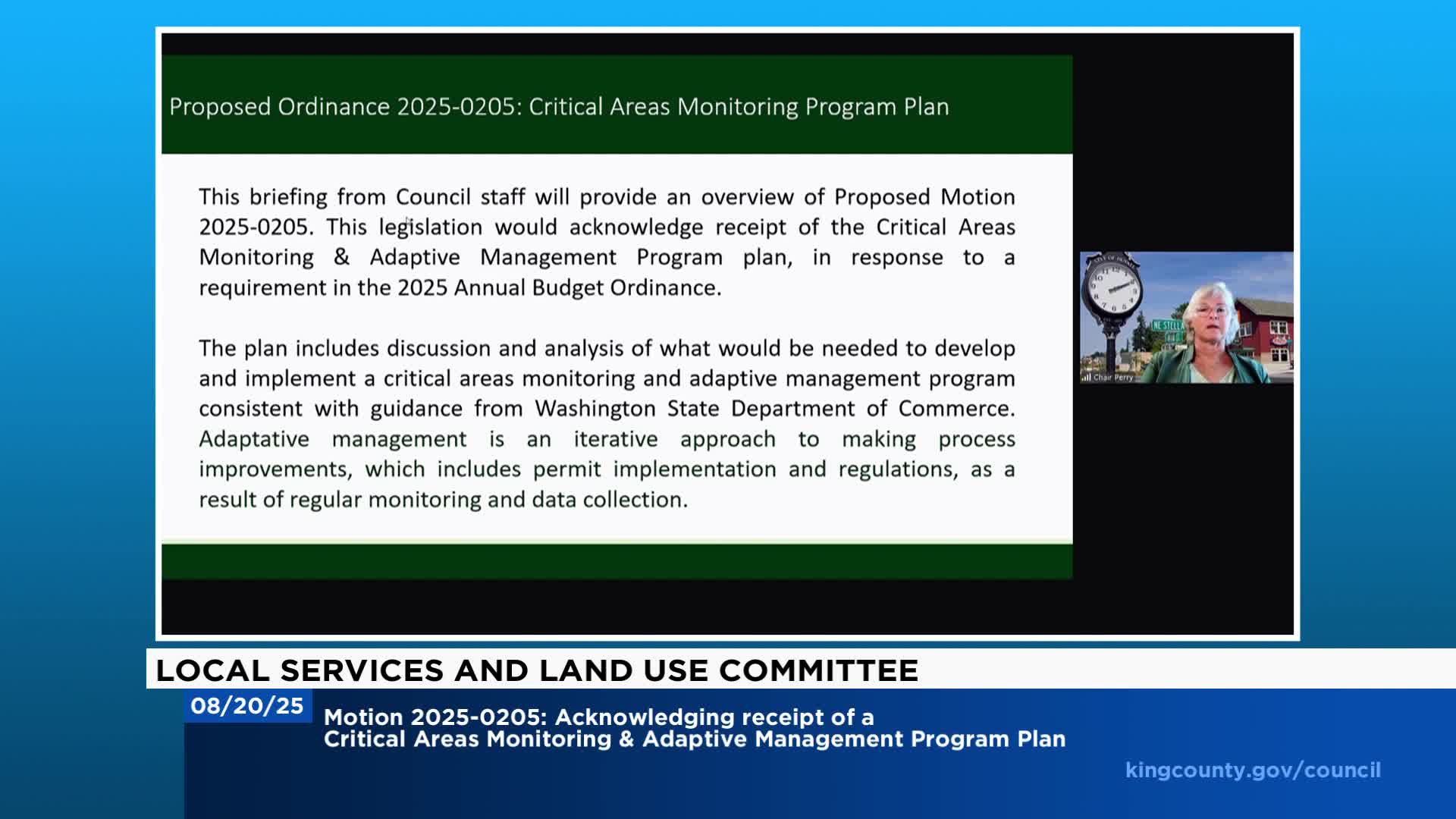
Body: Erin Ozenes of Council Central staff summarized the report. She said the report describes three monitoring categories: permit implementation (verifying that permits are issued and built consistent with conditions), permit effectiveness (ensuring ongoing compliance after permit issuance), and ecological validation (verifying that environmental outcomes expected from mitigation and other actions are achieved). The report recommends prioritizing initial development work on wetlands and riparian areas because the proposed code changes for those critical areas include departures from previously documented best‑available science.
Ozenes summarized estimated costs included in the report: developing the program for wetlands and riparian areas would take about two years and cost roughly $1,400,000 in labor hours (development costs are broken out in the staff packet). After program development, a recurring five‑year implementation cycle was estimated at about $6,600,000 and would require approximately 6.5 new full‑time equivalents (FTEs), plus an incremental $1,800,000 for each subsequent five‑year cycle, according to the staff report.
Committee members asked executive staff about next steps and resource needs. Jim Chan, Division Director for Permitting, said the county already requires mitigation bonds and post‑construction inspections and that the proposed monitoring program would require more robust review capacity, enhanced post‑implementation inspections and additional staffing to carry out monitoring and adaptive actions. Josh Laterrell (Science and Technical Support, Water & Land Resources) said the written plan provides a framework but that implementation will require an integration effort across departments to finalize details, and he described that process as roughly a two‑year development period followed by implementation that would require new staff resources.
Chair Perry and other members asked staff to keep the committee apprised as the executive fleshes out the program design and resource needs and to integrate monitoring outcomes into decision‑making for critical areas permitting and mitigation.
Ending: The committee forwarded the motion acknowledging receipt of the plan to the council with a due‑pass recommendation (3‑0). Staff emphasized that implementation would require interdepartmental integration and additional funding and that the committee should expect further budget and staffing requests if the program proceeds.