Get Full Government Meeting Transcripts, Videos, & Alerts Forever!
Get email alerts on the Forest Plan 30yr topic
No spam. Unsubscribe anytime.
Committee forwards King County 30‑Year Forest Plan to council with due‑pass recommendation
Summary
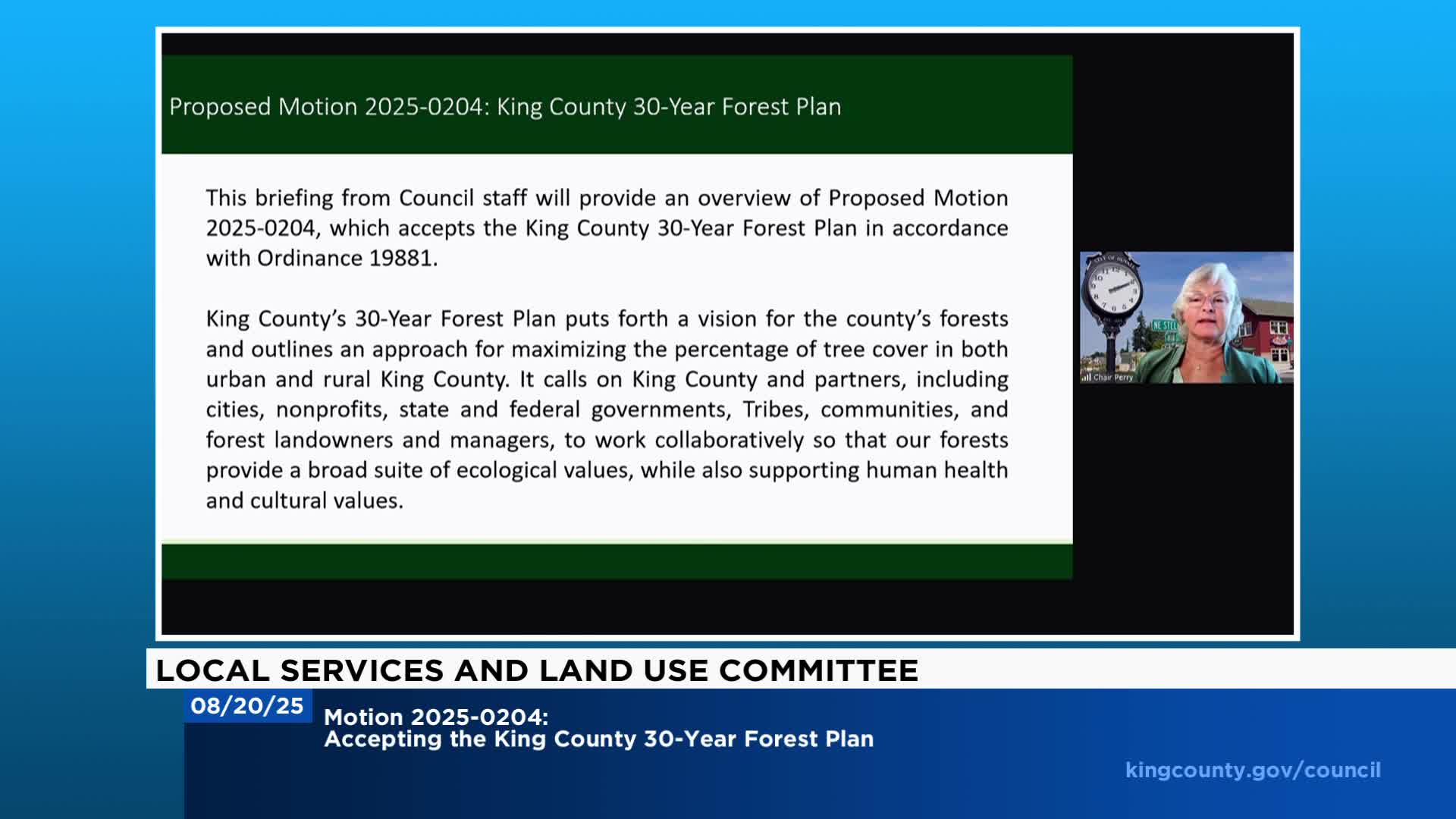
The Local Services and Land Use Committee voted 3‑0 to forward a motion accepting the King County 30‑Year Forest Plan, acknowledging pilot projects and near‑term actions and directing a progress report in 2026; public commenter urged clearer, measurable urban canopy goals.
Lede: The Local Services and Land Use Committee on Aug. 20, 2025, voted to forward proposed motion 2025‑0204 accepting the King County 30‑Year Forest Plan to the full council with a due‑pass recommendation.
Nut graf: Committee members and staff described the plan’s seven priority areas — climate, forest health, urban forest canopy, human health, salmon habitat, water quality and quantity, and sustainable timber — noted pilot projects already initiated and that the plan will be revisited every five years. A public commenter urged the county to adopt clearer, time‑bound urban canopy goals for under‑resourced areas including White Center and Boulevard Park.
Body: Brandy Parabello of Council Central staff told the committee the motion would accept the 30‑Year Forest Plan and that the plan was transmitted in accordance with the adopted 2024 comprehensive plan update. She summarized plan contents, noting it identifies seven priority areas and sets out goals and strategies; figure tables in the plan link goals to Department of Natural Resources and Parks (DNRP) actions and related policies. The implementation period in the plan was described as 2021–2026, with pilot projects and a five‑year review cycle; staff said a progress report on implementation will be available in the second quarter of 2026.
Prior to the staff briefing, a member of the public, Sandy Hunt of Defenders of Highline Forest, provided public comment on urban forestry. Hunt said she is ‘‘advocating for really strong SCAP, and the 30 year forest plan is part of that,’’ and urged clearer, ambitious canopy goals and offered resources and meetings focusing on White Center and Boulevard Park.
Councilmembers discussed stewardship and measurable urban canopy objectives. Vice Chair Quinn, the motion’s sponsor, highlighted the Strategic Climate Action Plan (SCAP) directives to support tree retention, planting and maintenance on private property and to promote a tree code toolkit for cities. Quinn and staff spoke about volunteer and youth stewardship work in Skyway and White Center and noted federal funding that will support an urban canopy analysis and related programming.
Kathleen Farley Wolf, from DNRP’s forestry program, described recent staff additions and program activity: hiring an urban forest program manager, youth engagement and stewardship projects in Skyway and White Center, climate‑adapted planting trials and an assisted migration paper published in 2024. She said the plan explains why it did not adopt a single countywide urban canopy percentage target and recommended doing a more detailed urban canopy analysis for urban unincorporated areas before setting specific numeric goals.
Vice Chair Quinn moved the motion, "proposed motion number 2025‑0204 with a due pass recommendation." The clerk called the roll and the committee vote was recorded as 3 ayes, 0 nos; Councilmember Dunne was excused. Chair Perry said the motion will be forwarded to the full council with a due‑pass recommendation and placed on the consent agenda.
Ending: The committee accepted the plan for transmittal and urged staff to produce the progress report scheduled in 2026 and to share details of urban forestry pilot projects and the forthcoming urban canopy analysis. No amendments to the motion were made at the committee; further council review and potential amendments are expected as the plan is revisited in future five‑year cycles.