Get email alerts on the Solid Waste Disposal topic
No spam. Unsubscribe anytime.
King County officials narrow long‑term solid waste options to rail export or mass‑burn; more analysis ordered
Summary
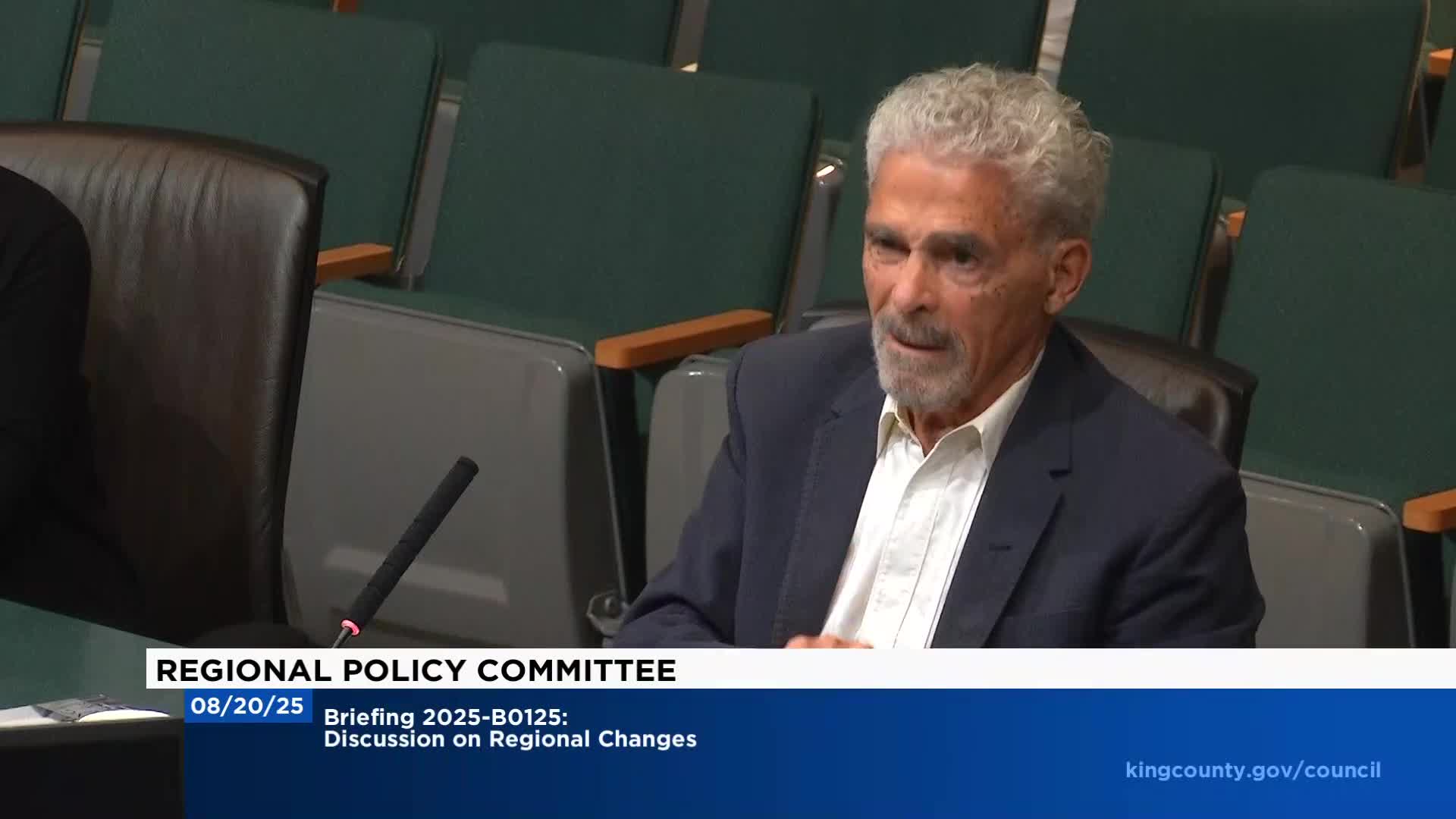
King County Regional Policy Committee Chair Joe von Reichbauer called a briefing on the Solid Waste Division’s draft long‑term disposal study on Aug. 20, 2025, after staff warned the county’s regional landfill is expected to reach capacity about 2040 and a decision will be needed soon.
King County Regional Policy Committee Chair Joe von Reichbauer called a briefing on the Solid Waste Division’s draft long‑term disposal study on Aug. 20, 2025, after staff warned the county’s regional landfill is expected to reach capacity about 2040 and a decision will be needed soon.
The study matters because the county must choose a disposal approach that will replace the services provided by the regional landfill and that decision will affect costs, emissions and communities along rail and trucking routes.
Rebecca, Solid Waste Division staff, told the committee the plan presented is a draft “and it does provide you a window into some of our thinking for long term disposal.” John Walsh, strategy and performance section manager for the Solid Waste Division, summarized the study’s purpose: “The purpose of the study is to help inform us of our options for long term disposal.”
The consultant‑based study evaluated five disposal approaches under three waste tonnage scenarios (business‑as‑usual, moderate diversion under the REplus program, and a deep‑reduction “zero waste” scenario) and examined composition as well as quantity. The five approaches analyzed were: rail export to out‑of‑county landfills, mass‑burn (incineration) with ash export, gasification, pyrolysis, and refuse‑derived fuel (RDF). The study drew on comparative work done for the 2019 county comp plan.
Staff reported the advisory committees recommended further focus on two options—waste export by rail and mass‑burn with outbound ash—because three options were eliminated for practical reasons. Walsh said RDF was eliminated because municipal solid waste’s variable chemistry, including chlorides, makes it hard to guarantee a buyer for pellets or “fluff,” leaving the county the risk of creating a secondary waste stream. Gasification and pyrolysis were removed from further consideration because, staff said, most commercial facilities are still at demonstration scale and are not proven to handle the county’s tonnages or the heterogeneous mix of municipal solid waste.
Committee members pressed staff on outreach and community impacts. Mayor Amy Roth asked how much the consultants had engaged private firms; Walsh said the consultant performed desk research and outreach and that he would follow up with a written list of the private companies contacted. Chair von Reichbauer asked staff to provide those specifics as factual follow‑up.
Members also pressed on likely impacts along rail corridors. Mayor Roth and others stressed that either of the two leading options would affect communities with rail lines. Rebecca said further analysis is required and that the next phase will study community impacts along the rail line, including traffic and rail‑crossing downtime, and tribal engagement.
After questions, the committee asked staff to return at a future RPC meeting with additional detail. Chair von Reichbauer suggested rescheduling the briefing for the next RPC meeting so committee members would have answers to the community‑impact and outreach questions raised during the session.
The study and staff presentation noted two other constraints that shaped the analysis: previous work stating the county would not site another landfill within its borders (from the 2019 comp plan) and cost considerations that make barge transport unlikely compared with established rail intermodal options.
Committee members did not take formal action; they directed staff to provide more documentation on private‑sector outreach, community and tribal engagement plans, and rail‑corridor impact analysis before decision points are set.
AI generated
The text on this page is AI generated. Summaries, highlights, analysis, and video transcripts are all produced from the original source material.
AI can make mistakes, so if you spot one, and we will fix it for everyone.
Note: the source content is unaltered by us. Any content source we link to, be it a video, an audio recording, or a document, is presented exactly as its publisher released it. That publisher is usually a government body, sometimes an individual official or another organisation.