Get Full Government Meeting Transcripts, Videos, & Alerts Forever!
Get email alerts on the School Impact Fees topic
No spam. Unsubscribe anytime.
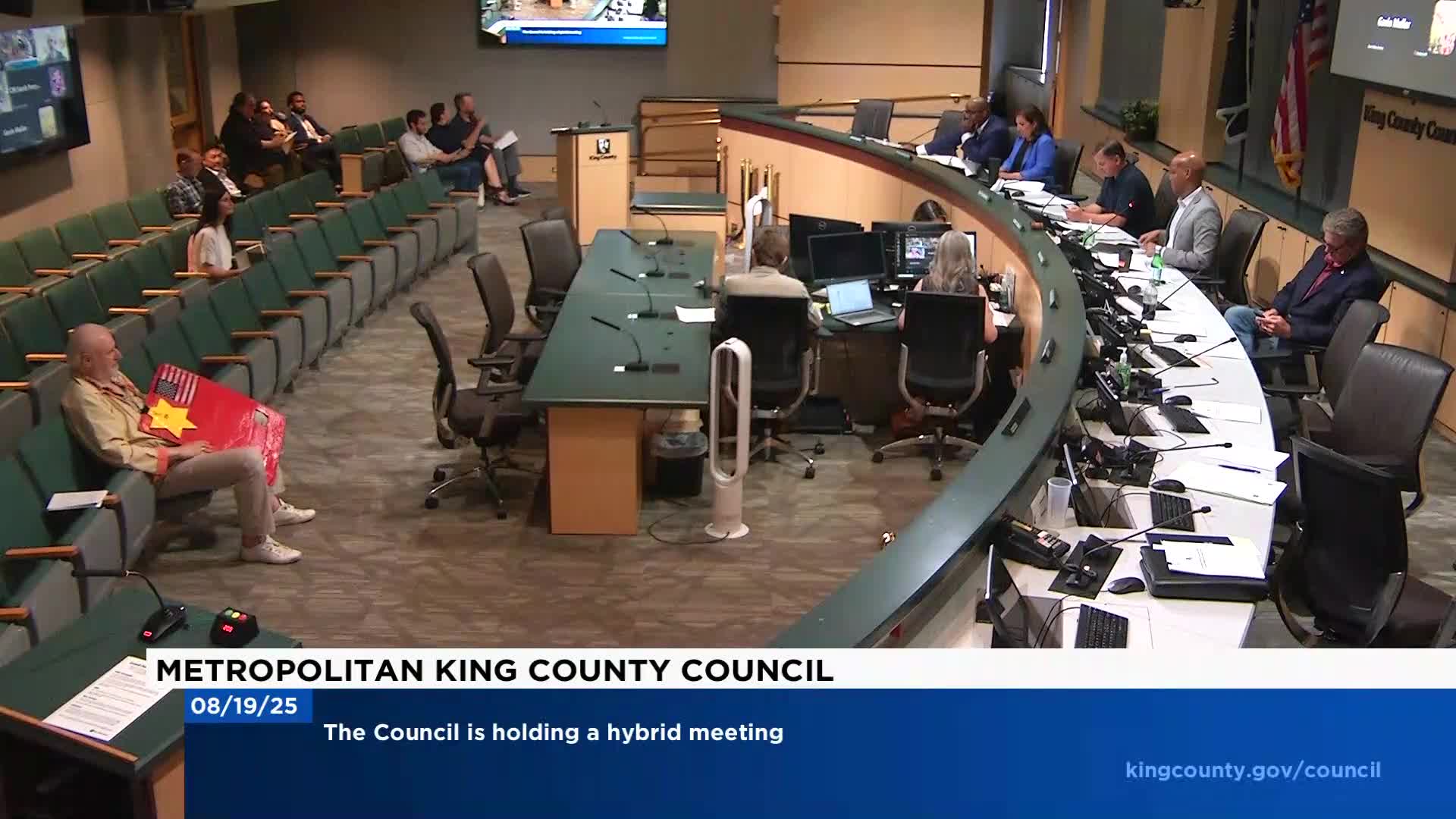
King County holds wide-ranging public hearing on proposed school impact fee changes; council delays vote
Summary
Council heard hours of testimony on a proposed ordinance to change how school impact fees are calculated in unincorporated King County, including proposed amendments to exempt affordable housing, require district analyses and cap fees for certain multifamily family-sized units; the council granted a one-week courtesy delay for further review.
The Metropolitan King County Council held a lengthy public hearing Aug. 19 on proposed Substitute Ordinance 2025-0127, a measure to revise how school impact fees are calculated in unincorporated King County to comply with recent state law. Councilmember Teresa Mosqueda introduced amendments that would require districts to analyze housing impacts, establish a standardized affordable-housing exemption policy, and cap bedroom-based charges on certain multifamily family-sized units.
The proposed ordinance responds to state legislation and the Growth Management Act by changing student-generation categories from two (single-family and multifamily) to six groups defined by dwelling type and bedroom count, and by directing counties to produce proportionally lower fees for smaller housing units. Erin Ozen, council staff, told the council the new categories reflect school districts’ data and the anticipated growth of “middle housing” formats such as duplexes, townhouses and cottage housing.
Why it matters: School impact fees fund capital projects such as new classrooms and additions that districts say are needed to serve students created by new housing. Witnesses and council members framed the debate as a trade-off: higher impact fees can fund school construction but may increase development costs and impede production of family-sized and affordable housing that can stabilize or reverse declining enrollment.
In public testimony, speakers argued both sides. School-district representatives and districts’ counsel said fees are an important capital funding stream and opposed additional caps beyond King County’s existing 50% reduction policy, warning that deeper cuts could shift costs to taxpayers and leave funding gaps for needed school capacity. Jeff Gross of Auburn School District’s capital projects unit said a hypothetical $5,000 cap would result in a projected $21 million shortfall for his district’s planned schools over the next 20 years based on anticipated housing growth.
Housing advocates, labor and affordable-housing developers urged adjustments to avoid penalizing construction of family-sized and income-restricted units. Patience Malaba, executive director of the Housing Development Consortium, said that if fees are not carefully structured, they “risk undermining the very housing that families need,” and urged support for the Mosqueda amendments. Several speakers including Joe Mizrahi, a school-board director and union representative, said affordable family-sized units actually generate more students per unit than single-family homes in some local studies and favored targeted exemptions for income-restricted housing.
Councilmembers debated timing, analytical needs and potential unintended consequences. Several members asked staff for numerical analyses that compare the likely capital revenue from impact fees to the state-driven per‑student funding that flows to districts through enrollment, and for clearer district-level accounting of how impact fees factor into multi-jurisdictional capital plans. Councilmember Dan Dombrowski and others noted year-to-year volatility in fee calculations and urged mechanisms to increase predictability for developers and districts.
Action taken: Councilmember Mosqueda requested a one‑week courtesy delay for members to review the ordinance and amendments and to allow staff to provide additional analytic detail. The council did not vote on the ordinance or the amendments on Aug. 19. A briefing was provided; action was deferred to a future meeting.
Context and next steps: The executive transmitted the ordinance to implement state legislative changes (referenced in the package as Engrossed Second Substitute Senate Bill 258) that require bedroom‑ or size‑based student generation metrics. Council staff said the county currently applies a 50% reduction to calculated fees; Mosqueda’s amendments would preserve a role for impact fees while trying to reduce disincentives to build family‑sized and affordable units. Council and staff agreed to provide additional district‑level and trade‑off analysis during the delay period.
Speakers quoted in this article spoke during the Aug. 19 council meeting and are listed in the speaker section below. Direct quotes are reproduced from the meeting record.