Get Full Government Meeting Transcripts, Videos, & Alerts Forever!
Get email alerts on the Water Quality Clean Water District topic
No spam. Unsubscribe anytime.
Clean Water District monitoring, MST testing and GIS dashboard guide prioritization for septic and agricultural fixes
Summary
County water-quality staff described the Clean Water District PICK program, microbial-source‑tracking results showing mainly ruminant rather than human markers in sampled streams, and a new GIS dashboard to focus outreach and repairs; staff said the work is grant‑funded and continues in phases.
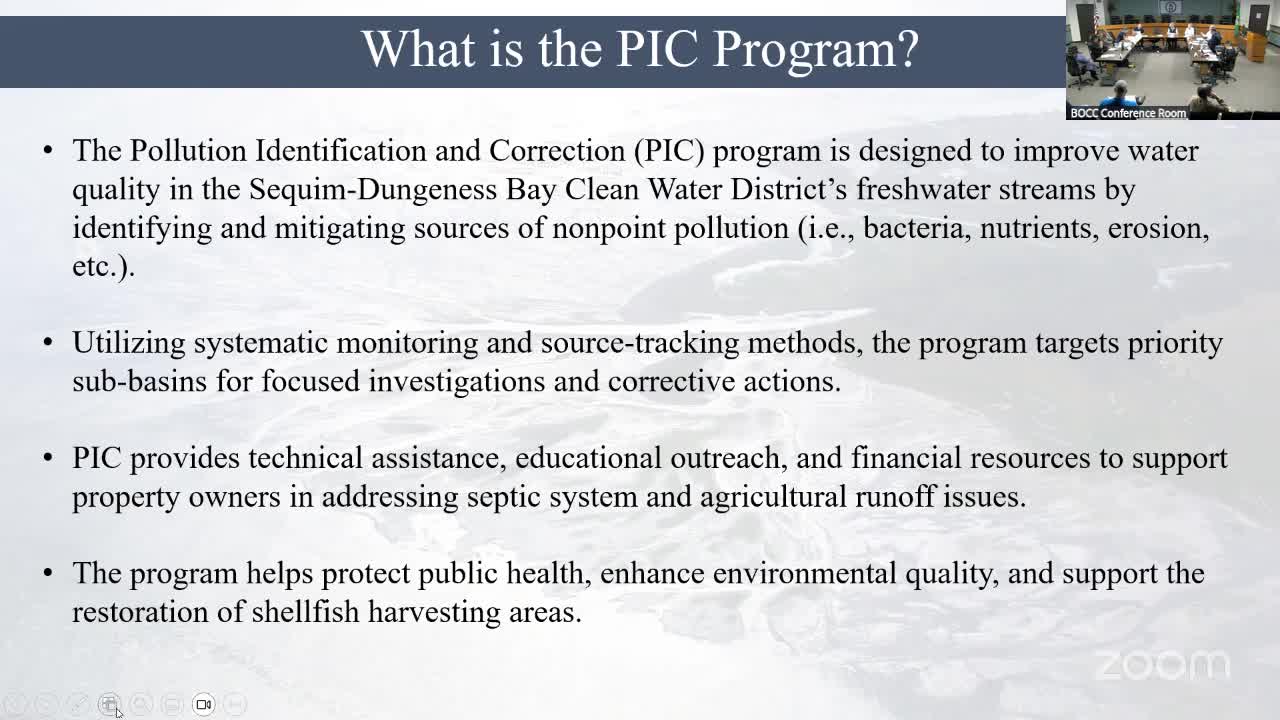
At the Aug. 19 public‑health meeting, water‑quality staff reviewed the county’s Clean Water District and PICK (priority intervention) activities, including long‑term monitoring, targeted sampling, microbial source tracking (MST) results and a new public GIS dashboard intended to prioritize outreach and corrective actions.
Presenters described the program structure: long‑term monitoring points at stream mouths, volunteer streamkeepers collecting regular samples, targeted upstream sampling where tests indicate hot spots, and property surveys and technical assistance for corrections. Staff said work is conducted in phases and relies heavily on variable grant funding.
MST and sampling: County staff said duplicate samples from selected PICK areas were analyzed at Manchester Laboratory (an EPA‑affiliated laboratory), which tested for human, dog and ruminant (e.g., deer or cattle) markers. The MST results in the sampled areas identified primarily ruminant markers and a single dog detection; staff reported no human markers in those samples for the period described. Presenters cautioned that the MST snapshot covered specific times and places and that additional context — including historic septic repairs and agricultural changes — could affect interpretation.
Prioritization and outreach: Staff said they have used monitoring trends and a ranking system that combines bacteria measures, nutrients and other factors over a three‑year average to set priorities. They reported sending about 170 letters to property owners in focus areas that were more than 12 months overdue for required inspections; of those, staff said 32 inspections have been completed and 14 remain pending (status at the time of the presentation). The county reported identifying three on‑site septic system failures in an upper Matriotti focus area; those failures are at different stages of correction and some cases have been referred to conservation‑district partners for financial and technical assistance.
GIS dashboard: Staff demonstrated a live GIS dashboard that maps shellfish growing areas, stream sampling points and multi‑year trends; presenters said the dashboard is public facing and will be used to prepare a trends status report and set focus areas for 2026–2028. Board members asked for additional context tying remediation and repair permits to monitoring results; staff agreed to produce snapshots correlating repairs and sampling over the same time frames.
Funding and next steps: Presenters said the program has used a blend of grants and local OSS management funds and is seeking additional funding for phase‑4 work, street‑keeper expansion, incentives and database modules to improve tracking. No formal policy action was taken at the meeting; the presentation informed board priorities and funding requests.