
Regional stakeholders debate proposed forest‑practice buffer rule for non‑fish perennial streams
Get AI-powered insights, summaries, and transcripts
Subscribe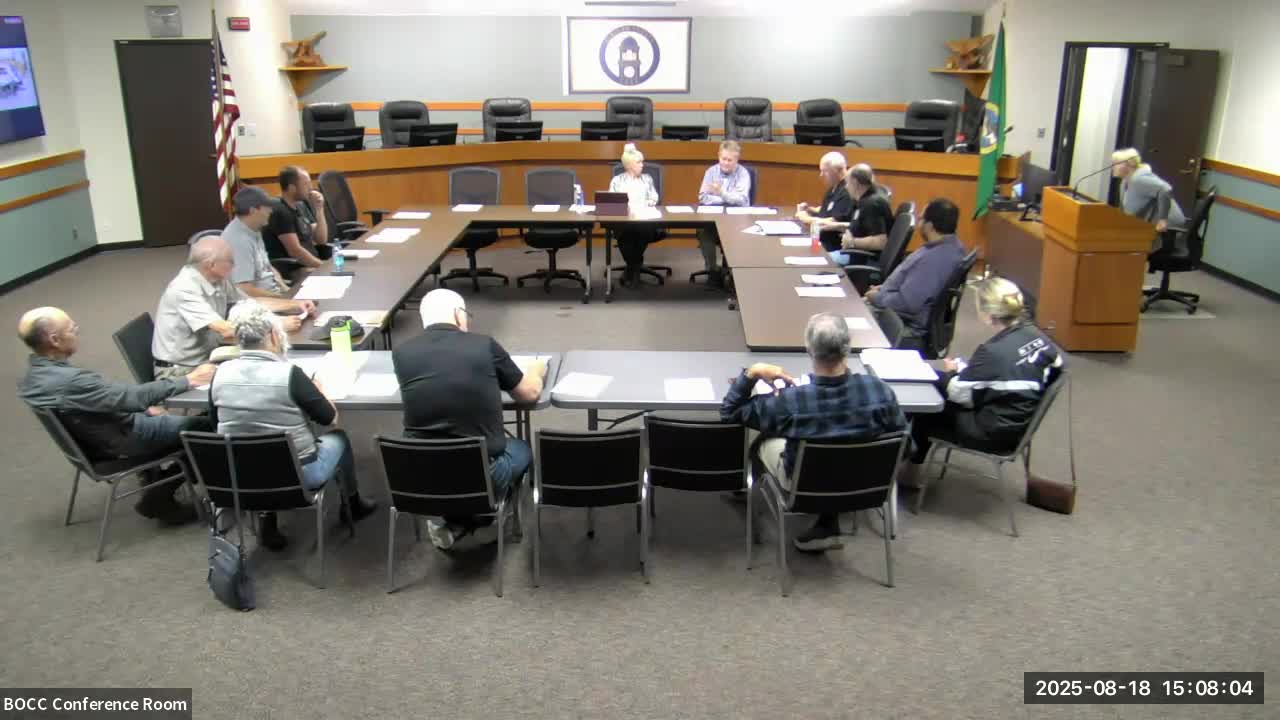
Summary
DNR region staff and local forest‑land owners discussed a proposed Washington Forest Practices board rule that would increase buffers on non‑fish perennial streams, with participants raising potential economic impacts and noting public comment hearings.
At the meeting, DNR staff briefed the committee on a proposed forest‑practice rule under consideration by the Washington Forest Practices Board that would require larger buffers for non‑fish perennial streams where those streams flow into fish‑bearing waters. DNR staff said the rule is the result of Ecology and Forests & Fish negotiations and that public hearings have been held across western Washington.
Committee members and private landowners described the proposal as having potentially large economic consequences for small timberland owners and mills. One presenter cited a University of Washington analysis—mentioned at the meeting by a forest‑landowner representative—which estimated statewide impacts of setting aside an additional roughly 200,000 acres and an economic effect in the billions of dollars; the presenter also noted an estimated stream‑temperature difference of about one‑half degree Fahrenheit from the measure the rule is designed to address.
DNR staff clarified that state‑managed lands already have protections under habitat conservation plans and that DNR’s existing buffers vary by stream; the proposed rule by contrast would add a near‑continuous buffer (discussed in the meeting as roughly 50 feet) on non‑fish perennial streams feeding fish streams. Staff emphasized the rule applies primarily to private forest‑land owners; the committee heard that public hearings were well attended and that the formal comment period was open and scheduled to close on the twelfth (as stated at the meeting). Regional and local elected officials have taken positions opposing the measure as inappropriate, and committee participants said they had reached out to state legislators.
No formal RAC action was taken on the rule; the committee’s role for this discussion was informational and to allow local stakeholders to hear DNR staff explanations and public‑comment summaries.