Get Full Government Meeting Transcripts, Videos, & Alerts Forever!
Get email alerts on the Public Works Property topic
No spam. Unsubscribe anytime.
Supervisors approve downtown courthouse demolition site as parking lot; direct public works to solicit solar proposals
Summary
After environmental review flagged the historical value of an on‑site jail structure, the board voted to build a parking lot on the former courthouse site and authorized Public Works to solicit third‑party turnkey proposals for a solar array to offset energy costs.
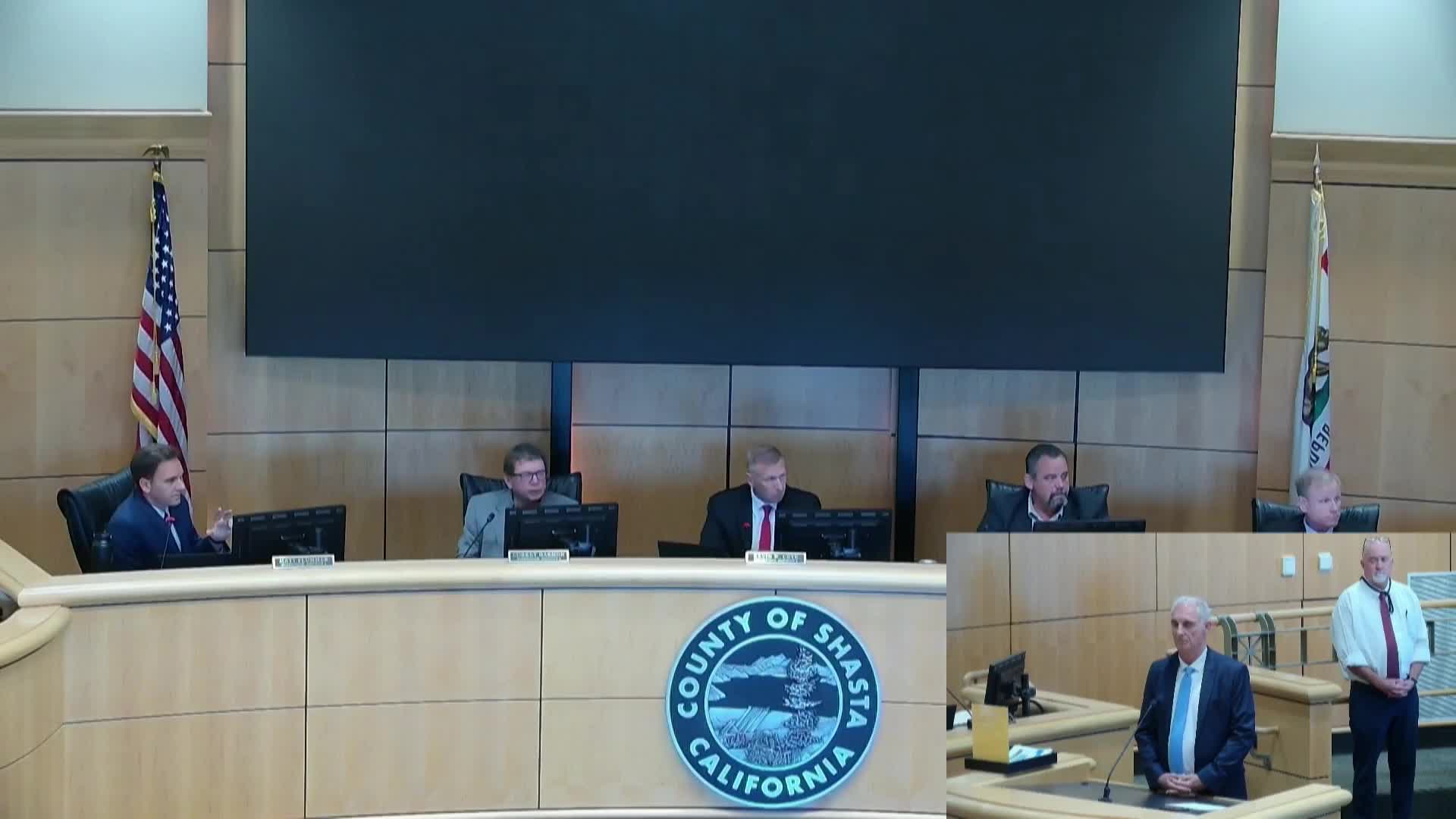
Shasta County supervisors voted Aug. 19 to convert the former courthouse demolition site into a paved parking lot and authorized public‑works staff to solicit proposals from third‑party firms to evaluate a turnkey solar canopy or array option.
Public Works Director Troy Bartlett‑May told the board an updated historical survey identified the old jail on the property as historically significant, a finding that requires a more extensive environmental review and possible mitigation steps if the county proceeds to alter or remove that structure. Bartlett‑May said the quickest way to avoid duplicative environmental work would be to decide a near‑term site use now and complete environmental review for that use. He recommended a parking lot because it would be the least expensive durable option for staff uses and for weekend community events.
“Originally we said we’d tear everything down and put a bare lot up,” Bartlett‑May told supervisors. “Now we have this building here sitting in the middle of the whole project … the consultant saying we’ve got to make a decision which way we’re going to go.”
What the board decided - Cost and scope: Bartlett‑May provided rough project estimates: demolition ~ $5.3 million and parking‑lot construction ~ $1.7 million (total roughly $7.0 million). He also said an interim option of grading and lawn would be modestly cheaper but could require additional environmental review and later rework. - Historical building: the county’s consultant concluded the jail structure could be historically significant and identified mitigation options that range from documentation and plaque installation to retention and adaptive reuse; those mitigations can add cost and complexity, the director said. - Solar solicitation: the board authorized Public Works to solicit proposals from third parties for a turnkey solar installation that could be financed and maintained by a vendor. Bartlett‑May said prior county solar projects have run near break‑even and that program vendors sometimes bundle infrastructure work so net county payments can be offset by energy savings.
Vote and motions - Motion to construct a parking lot on the demolition site and to authorize Public Works to solicit third‑party turnkey solar proposals was moved by Supervisor Scribe and seconded by Supervisor Harmon. The motion passed on a 5–0 roll call vote. - A substitute motion to instead conduct a full demolition and create lawn/grass for interim use (a lower‑cost interim option) was made and discussed but failed for lack of second and was not adopted.
Questions and public comments - Several supervisors and members of the public asked for clearer cost‑breakdowns. Supervisors raised concerns about signing long‑term solar financing if the site’s final use could change later and about the risk of vendor failure in the turnkey solar market; Public Works said any third‑party proposal would include financing and maintenance terms and that staff would not recommend a contract that did not pencil out. - County staff noted ongoing monthly carrying costs of keeping the courthouse building vacant (Bartlett‑May cited $15,000–$20,000 per month in utilities/maintenance/insurance), which factored into the board’s decision to move forward promptly with a defined, low‑complexity use.
Next steps Public Works will proceed with the environmental work tied to the parking‑lot plan, prepare solicitation documents for potential solar partners, and return with contract recommendations and cost analyses for board approval. If subsequent boards prefer a different long‑term use, the county will still have to manage environmental and financing implications for any replacement project.
Ending note: The board requested that staff preserve historic‑resource mitigation options in planning so the county can document the site history while providing usable downtown space in the near term.