Get Full Government Meeting Transcripts, Videos, & Alerts Forever!
Get email alerts on the Airports topic
No spam. Unsubscribe anytime.
Board adopts policy barring new commercial "through‑the‑fence" airport access agreements
Summary
Riverside County supervisors on Tuesday adopted a resolution directing county airports not to enter into, adopt or consider new commercial through‑the‑fence agreements for county‑owned airports.
Riverside County supervisors on Tuesday adopted a resolution directing county airports not to enter into, adopt or consider new commercial through‑the‑fence (TTF) agreements for county‑owned airports. The measure, passed with amendments, passed by a 4‑0‑1 vote.
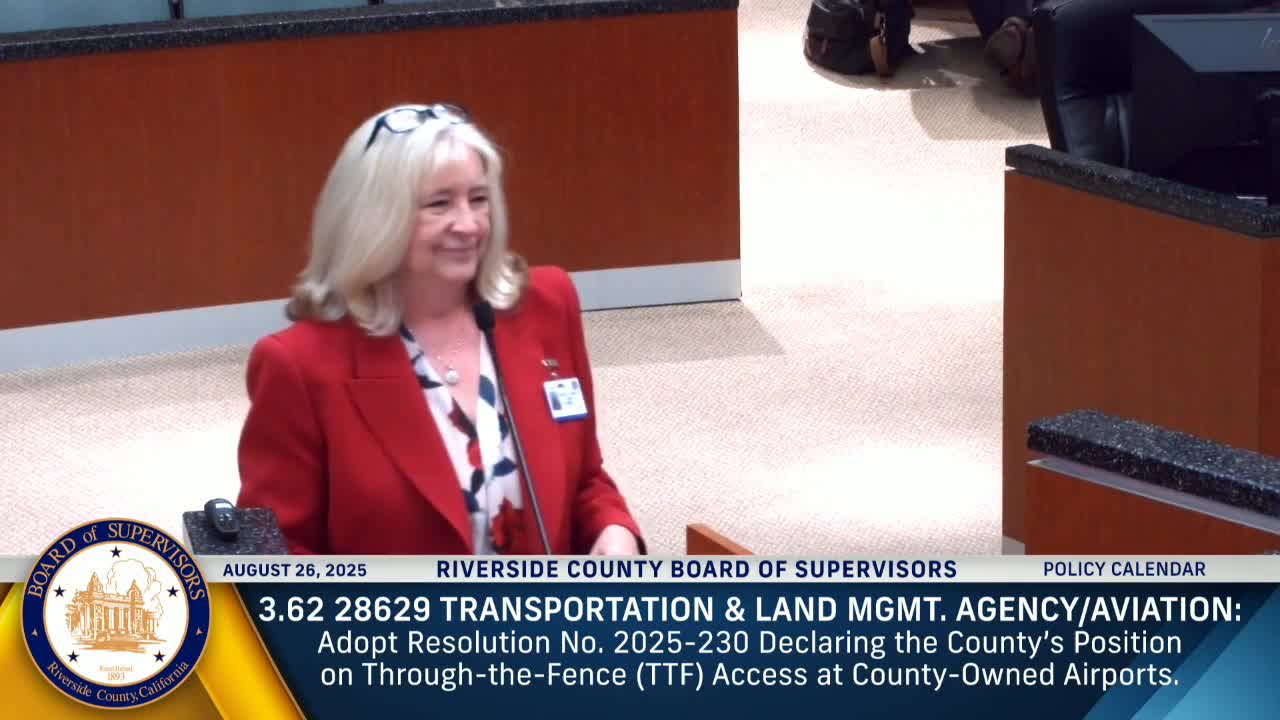
The board’s action follows an extended presentation from Angela Jamieson, Riverside County’s director of airports, who told supervisors that commercial TTF deals — agreements that would allow adjacent property owners direct access to airport facilities while keeping ownership of improvements off‑airport — risk violating Federal Aviation Administration (FAA) grant assurances, create unfair competition for on‑airport tenants and could imperil federal and state grant funding the county uses for airport improvements. “Allowing through‑the‑fence exposes our tenants and the county to really substantial financial risk,” Jamieson said.
The measure’s nut graf: County staff and a wide cross‑section of airport tenants warned supervisors that TTF arrangements could divert revenue away from airport tenants who underwrite airport operations and capital projects and might jeopardize millions in FAA and Caltrans grants that support airports such as Jacqueline Cochran Regional, Thermal and French Valley. After hearing both local tenants and outside proponents, supervisors approved a resolution that bars new commercial TTFs but explicitly will not apply retroactively to previously executed agreements.
Supporters of the resolution included multiple on‑airport tenants and aviation businesses who said they had invested tens of millions of dollars at county airports and would be disadvantaged by commercial TTF operators who would not assume the same lease, reversion or regulatory obligations. Jim McCool, majority owner of DesertJet at Jacqueline Cochran Airport, said his company halted a planned $20 million expansion after learning non‑airport parties proposed off‑airport hangars and fueling services. “This is an untenable situation for the county and for DesertJet and for any other company operating on airport land,” McCool said.
Atlantic Aviation and DesertJet executives warned supervisors that TTF proposals in other counties had prompted FAA scrutiny and that allowing off‑airport commercial access could reduce airport revenue and deter on‑airport investment. Eric Newman, Atlantic Aviation’s vice president of business development, said: “Allowing commercial through‑the‑fence access introduces a model that directly competes with businesses that have long invested in the airport’s infrastructure and financial sustainability.” Several airport operators and local officials also urged the board to preserve noncommercial, educational or nonprofit uses (for example, museum or youth aviation programs) by crafting a precise, commercial‑only ban.
Representatives of the 29 Palms Band of Mission Indians, Wayne Colson of Colson Aviation, and others argued the tribe and private investors could bring jobs, wildfire response capacity and major capital projects to the East Valley and asked the board to let discussions continue. Attorney Mark Nichols, who said he previously served as FAA chief counsel, urged the board to allow a structured, FAA‑reviewed TTF process rather than a blanket prohibition. “FAA scrutiny of a proposed TTF agreement is not something to fear,” Nichols said, noting the FAA has previously approved TTFs when they are carefully drafted and subordinate to grant assurances.
After debate the board added staff‑recommended clarifying language to the resolution that limits the ban to new commercial through‑the‑fence agreements and does not apply retroactively to prior written agreements. The resolution also directs the county aviation director to notify stakeholders and to update planning and leasing documents.
The action protects the county’s stated goal of maintaining on‑airport tenant investment and preserving FAA grant eligibility while leaving open further conversations about noncommercial partnerships or educational programs that do not present the same financial or compliance risks.
Ending: County staff said they will notify affected parties, revise airport leasing documents and publish the updated policy. Supervisors and staff also said they will continue outreach with municipalities and stakeholders that asked for more time to review the potential impacts on local development and jobs.
Votes at a glance: The board approved the resolution “as recommended with amendments,” recorded as 4 yes, 0 no, 1 abstain (mover/second not specified in the transcript). The resolution’s amended language states it will not apply retroactively to previously executed through‑the‑fence agreements and limits the ban to commercial uses.