Get Full Government Meeting Transcripts, Videos, & Alerts Forever!
Get email alerts on the Housing Element topic
No spam. Unsubscribe anytime.
Plumas County submits draft housing element to state; staff outlines next steps and areas for follow‑up
Summary
On Aug. 21 Planning Department staff said the county submitted its 2024–29 housing element draft to state reviewers on Aug. 18, outlined required appendices (vacant land inventory, Affirmatively Furthering Fair Housing), and noted staff expects HCD comments within the 90‑day review window.
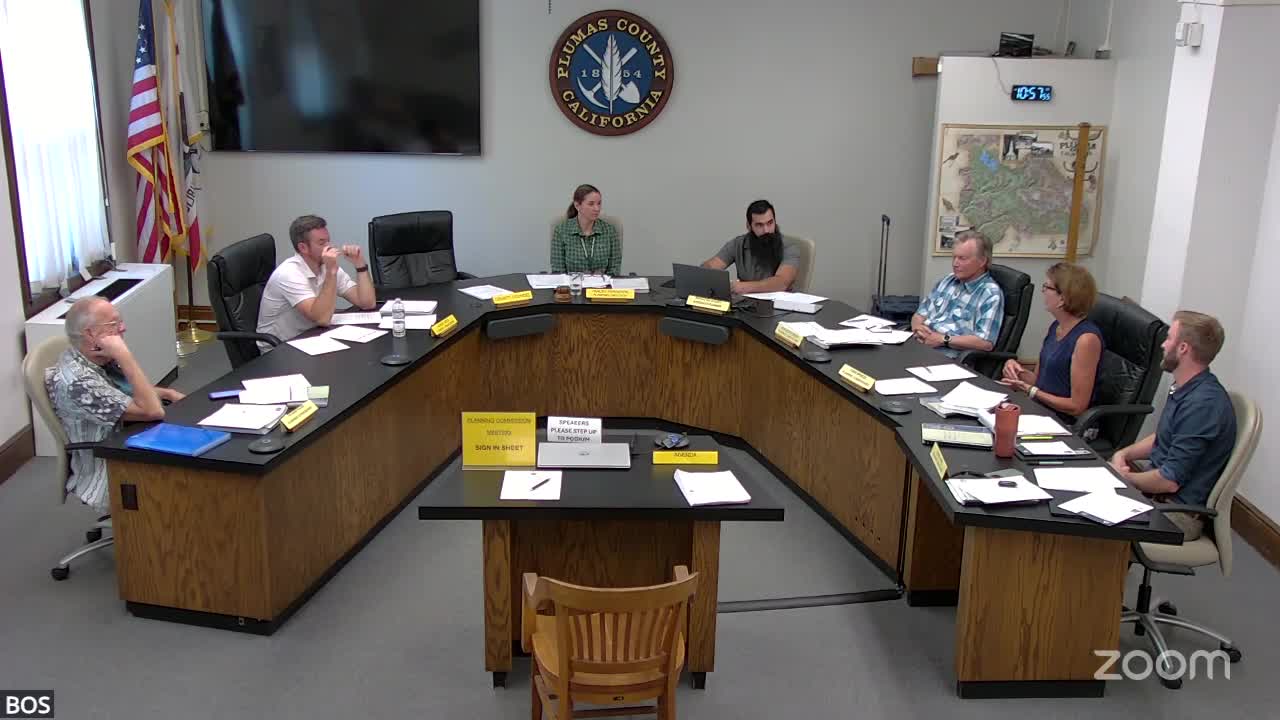
Plumas County Planning Department staff told the Planning Commission on Aug. 21 that the county submitted its draft housing element (2024–29 cycle) to the California Department of Housing and Community Development (HCD) on Aug. 18 and that a reviewer had been assigned.
Staff said the draft includes an updated vacant and underutilized land inventory, an expanded Affirmatively Furthering Fair Housing (AFFH) assessment, an ADU (accessory dwelling unit) pre‑approval plan appendix and a public‑participation appendix that documents workshops and stakeholder outreach. The draft also incorporates wildfire recovery context, including Dixie and Beckwourth complex fire losses, and addresses a newly emphasized income category the state calls “acutely low” (roughly 15% of area median income or below), which affects distribution of required housing units.
Tracy said staff added detail to appendix C (AFFH) and a matrix showing public comments and staff responses; she pointed to table C‑11 (identified sites and socioeconomic characteristics) and table C‑14 (factors that contribute to fair housing issues) as areas the state will scrutinize. She also highlighted policy/program proposals intended to support lower‑income workforce housing and to seek fee reductions or incentives (for example, reduced connection fees and expedited permitting) to encourage multifamily development.
Commissioners discussed several programmatic questions that could be added or revisited in future drafts, including whether to treat tiny homes on wheels as dwelling units rather than RVs, options for community‑scale solar that could reduce building costs, and developer connection fees that can impede multifamily projects. Tracy said staff will coordinate with HCD during the 90‑day review and will attempt to resolve issues through back‑and‑forth editing to reduce the number of formal comments.
Staff also noted program H‑2.5 (support for lower‑income workforce housing) and program 6.3 (encouraging special districts to consider reduced per‑unit developer water/sewer connection fees for multifamily projects) as concrete measures included in the draft intended to address affordability and availability.