Get Full Government Meeting Transcripts, Videos, & Alerts Forever!
Get email alerts on the Public Comment Employee Grievances topic
No spam. Unsubscribe anytime.
Sheriff’s office employee and residents sharply criticize supervisors’ priorities at public comment
Summary
At public comment during the Aug. 12 Board of Supervisors meeting, a sheriff’s office employee and residents criticized supervisors for perceived political priorities and executive pay decisions, calling for better resourcing of county employees and more equitable compensation practices.
Two public speakers at the Aug. 12 meeting used the public comment period to criticize the board’s priorities and recent supervisory statements about public safety funding and executive pay.
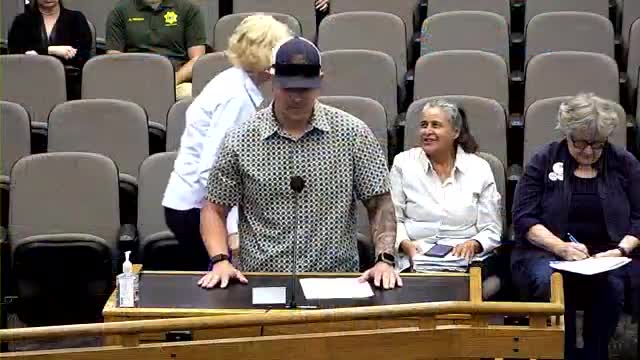
George Seracchi, identifying himself as “an employee at the sheriff's office representing Unit 30,” told supervisors that “public safety serves everyone” and accused the board of using public safety as a political platform. “We're done being political pawns,” Seracchi said, adding that “the board only serves its agenda.” He argued that staffing and workload for sheriff’s office employees have increased substantially and that funds the sheriff’s office was allowed to keep at year‑end were redirected, in his view, to “pet projects” instead of staffing. Seracchi also said the new jail and proposed administration building were “bare minimum” infrastructure rather than proof of extra support.
Another commenter, who identified himself as Andrew Gallagher, criticized the county’s executive pay practices and editorial positions by a supervisor. Gallagher questioned equal percentage raises, saying “7% of $200,000 is more than 10% of $60,000,” and argued equal percentage increases can widen dollar‑value gaps between higher and lower paid employees. He also contrasted earlier deputy pay adjustments with automatic supervisor pay increases and criticized what he called a “veiled public support for law enforcement” that still put employees at a disadvantage.
Neither public comment prompted formal board action; supervisors listened and acknowledged the remarks during the meeting’s public comment period.