Get Full Government Meeting Transcripts, Videos, & Alerts Forever!
Get email alerts on the Budget And Human Services Impacts topic
No spam. Unsubscribe anytime.
Merced County leaders warn federal, state cuts could force local service reductions
Summary
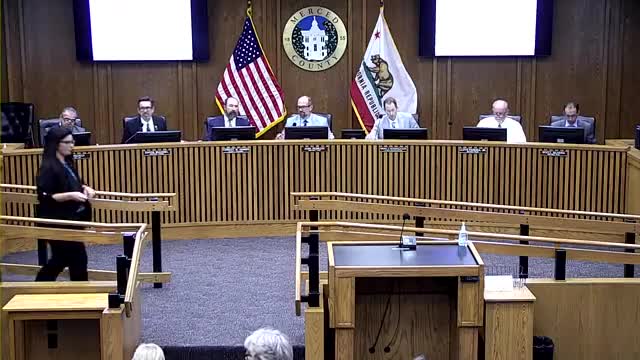
Merced County officials told the Board of Supervisors on Aug. 12 that federal and state budget changes could force the county to absorb millions in costs and reduce services for Medi‑Cal beneficiaries, people who rely on SNAP benefits and other vulnerable residents.
Merced County officials told the Board of Supervisors on Aug. 12 that a package of federal and state changes — including the federal HR 1 budget bill and several California actions — could reduce Medi‑Cal and other program funding and force county service reductions or larger local matches. County Executive Officer Mark Hendrickson opened the presentation by saying the briefing was intended to alert the board and the public about “known and or anticipated impacts to county programs and services” driven primarily by federal decisions.
The presentation combined perspectives from Behavioral Health and Recovery Services; the Human Services Agency; Public Health; Workforce Development; and the county budget office. Kimiko Vang, director of Behavioral Health and Recovery Services, framed the risk in blunt terms: “HR 1 is the largest cut ever to Medicaid and effectively shifts costs to the state and counties,” she said, citing the California State Association of Counties’ analysis.
Why it matters: Merced County’s health and human services programs largely run on federal and state funds tied to specific programs. County staff said those funds account for more than half of “other funding sources” in the county budget and are tightly restricted by reporting and maintenance‑of‑effort rules. If eligibility rules tighten or funding is cut, the county could lose reimbursement for services now paid by Medi‑Cal and other programs and face new local matching or penalty obligations.
Key department estimates presented to supervisors included: - Statewide and federal policy changes are projected to reduce Medi‑Cal coverage by millions; the state Department of Health Care Services estimates about 3,000,000 people may lose Medi‑Cal in California over 10 years if the federal work‑requirement changes are implemented. Central California Alliance for Health estimates roughly 34,000 Merced County residents could lose Medi‑Cal under those projected changes. Vang said that would translate to an estimated 3,370 individuals losing access to county behavioral health services and an estimated Medi‑Cal revenue loss for the county’s Behavioral Health and Recovery Services between $8.5 million and $11 million over four years. - A state enrollment freeze for certain immigration‑status adults starting Jan. 1, 2026, will cause an immediate projected Medi‑Cal revenue loss to BHRS of about $4.3 million. - Pending or recently passed state measures — including expansion of the definition of “gravely disabled” under SB 43 and changes from Proposition 36 and the Behavioral Health Services Act (Prop. 1/BHSA) — will expand services or change eligibility but include little or no new ongoing state funding according to presenters. Vang said SB 43 could require “about $1,500,000 in additional funding for staffing and about $80,000,000 per year in placement cost to the county,” with placement costs paid from realignment funds. - The county’s Human Services Agency warned that proposed SNAP/CalFresh work‑requirements and tighter eligibility for noncitizens could affect thousands of local residents and that potential penalty calculations tied to payment error rates could require Merced County to absorb a local share. Dr. Evonya Brown said the county’s SNAP benefits inflow is about $141,000,000 annually and that a possible penalty scenario could result in a local exposure of approximately $21,800,000. - IHSS redetermination penalties and backlog: Brown said the county currently has a liability allocation of roughly $1,400,000 for overdue IHSS redeterminations and is working to lower that amount by year’s end. - Public Health is facing elimination of SNAP‑Ed funding and partial holds or cuts to emergency preparedness funding. Dr. Sullivan (public health) said SNAP‑Ed — the county’s primary nutrition‑education funding source — will sunset Sept. 30 and that one preparedness program is facing an immediate 4% cut while another 30% of allocation remains on hold. - Workforce Development is facing uncertainty from two concurrent federal policy tracks: the administration’s Make America Skilled Again (MASA) executive order, which would convert federal workforce funding into a state block grant (potentially eliminating local youth funding entirely), and an uncertain WIOA reauthorization process. Eric Sarato, director of the Workforce Development Board, said either path could yield substantial reductions and programmatic change.
County finance context: Deputy CEO Vanessa Anderson and the budget office reminded the board that about 81% of the county’s $1.15 billion spending plan is tied to “other funding sources” (non‑discretionary program funds), leaving the board limited local discretionary revenue to fill gaps. Anderson said 54% of those other funding sources are attributed to health and human services, underscoring that cuts disproportionately affect programs for the county’s most vulnerable residents.
Board questions and next steps: Supervisors pressed staff for quantification of mandated obligations and for remedies. Supervisor McDaniel and others asked about the state methodology for the Department of State Hospitals “incompetent to stand trial” growth cap; staff said the baseline uses 2021 data that counties consider artificially low because COVID‑era placements were limited and that CSAC and county counsel are pursuing legislative fixes. Multiple supervisors urged advocacy at the state and federal level; staff recommended pursuing advocacy through CSAC and direct outreach to legislators and funders. No formal board action to change services or adopt new revenue was taken during the meeting; staff said they will return with more detail ahead of the county’s final budget hearing scheduled for Sept. 23.
What remains uncertain: Staff emphasized that many impacts are still unfolding and that estimates could change as federal and state guidance and implementation details are released. Departments said they are preparing contingency plans — including reorganizations, hiring pauses, and targeting flexible funding streams — to reduce the immediate service impact, but warned that program sunsets and matching requirements could force longer‑term reductions if funding is not restored.
County leaders asked the board to consider policy direction and advocacy to seek restoration of state or federal resources, to protect flexible funding streams such as the state’s Future of Public Health funding, and to explore technology investments that could reduce administrative error and improve eligibility redeterminations.
The county will return to the board with updated fiscal estimates and potential budget‑year resource requests as agencies receive more precise state and federal guidance.