
County committee starts formal review of logistics‑center regulations, flags data centers for future work
Get AI-powered insights, summaries, and transcripts
Subscribe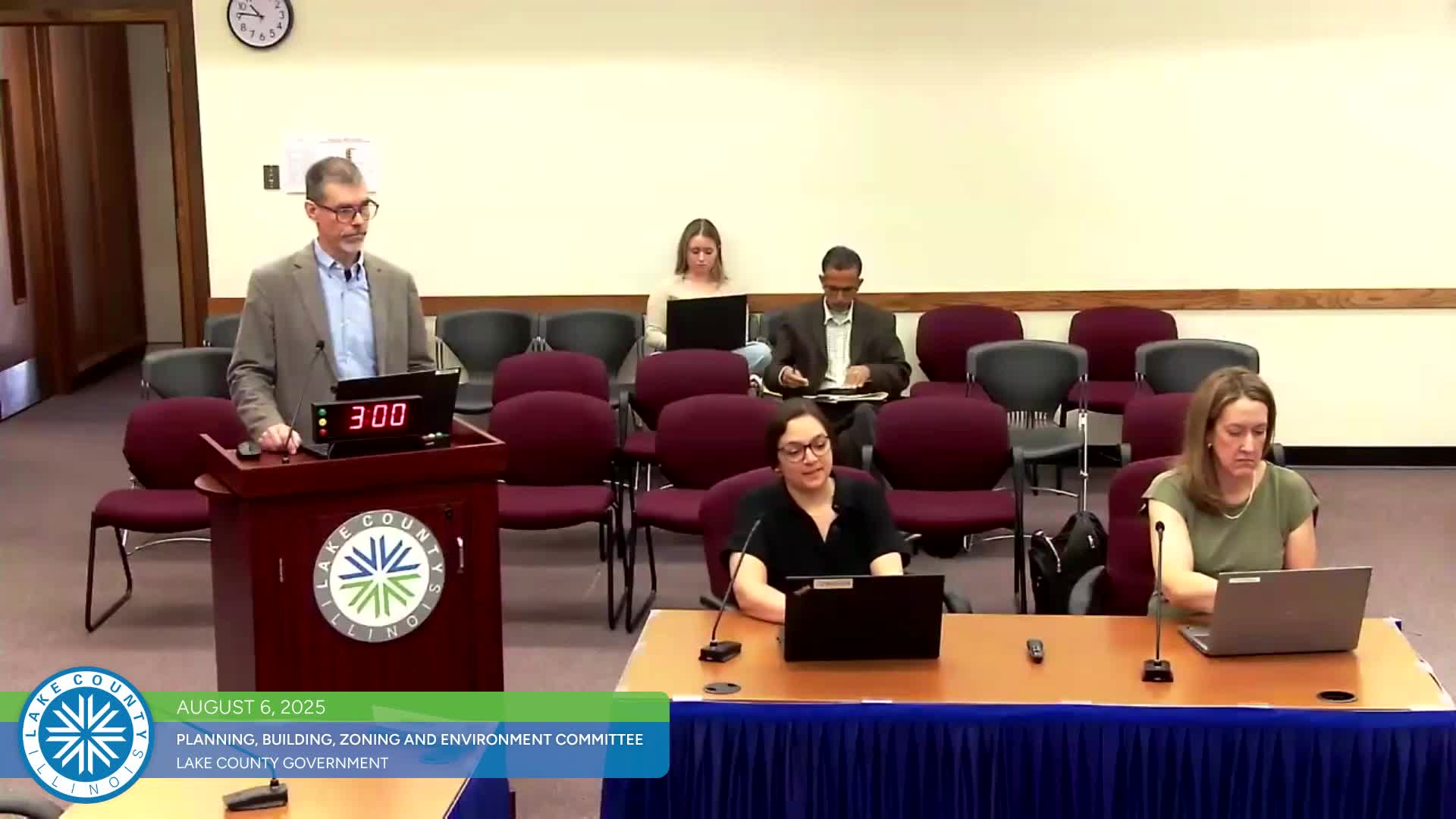
Summary
Staff will draft logistics‑center specific standards—use types, definitions, increased setbacks and conditional use permits—and the committee asked staff to prioritize future work on data center regulation and grid impacts.
Lake County's Planning, Building, Zoning and Environment Committee on Aug. 6 voted to initiate a formal public hearing process for draft text amendments to Chapter 151 that would create logistics‑center–specific standards for unincorporated Lake County.
Staff said the growth of e‑commerce and the logistics market has produced facilities that differ from traditional warehouses: logistics or distribution centers are typically larger, operate longer hours and generate substantially more truck traffic. The proposed amendments would create new use categories for small and large logistics centers, add definitions, increase setback requirements, require conditional use permits for logistics uses, and add operational standards addressing traffic, noise and aesthetics.
"From a land development perspective, these logistics centers ... are generally much larger. They operate more hours. They generate more truck traffic than a traditional warehouse," Taylor Gendel, senior planner, said. Staff said the county code currently lacks logistics‑specific standards and that the draft amendments come from best‑practice research.
Committee members supported moving forward and raised related issues. Member Frank asked whether the county should consider data centers in the same effort. Staff replied that data centers are a distinct land use with intense energy demands and specific siting and design needs; staff said they have begun research but are not ready to propose amendments and recommended that the county prioritize data center regulation in the near future. Member Wasik emphasized concerns about road impacts and diesel emissions from larger truck traffic; staff confirmed road impacts and construction/post‑construction performance guarantees will be part of the logistics amendment packet.
Action taken: Motion by Member Kanishnick, second by Member Frank to forward a resolution to the County Board initiating a Zoning Board of Appeals hearing on logistics‑center text amendments. The committee voted in favor.
Staff said the logistics amendments could include analysis of regional capacity and local need, but cautioned that any regulatory approach must remain within the scope of Illinois statutes governing county zoning authority. The committee also discussed potential county and state incentives that may be necessary to make infrastructure (particularly sewer) or other projects feasible in other agenda items discussed the same day.
Ending — Staff will draft logistics‑specific code language and return to committee with a ZBA hearing schedule; staff also said they will present future recommendations on data center regulation as research is completed.