
Lake County committee backs start of public hearing process for voluntary sustainable development incentives
Get AI-powered insights, summaries, and transcripts
Subscribe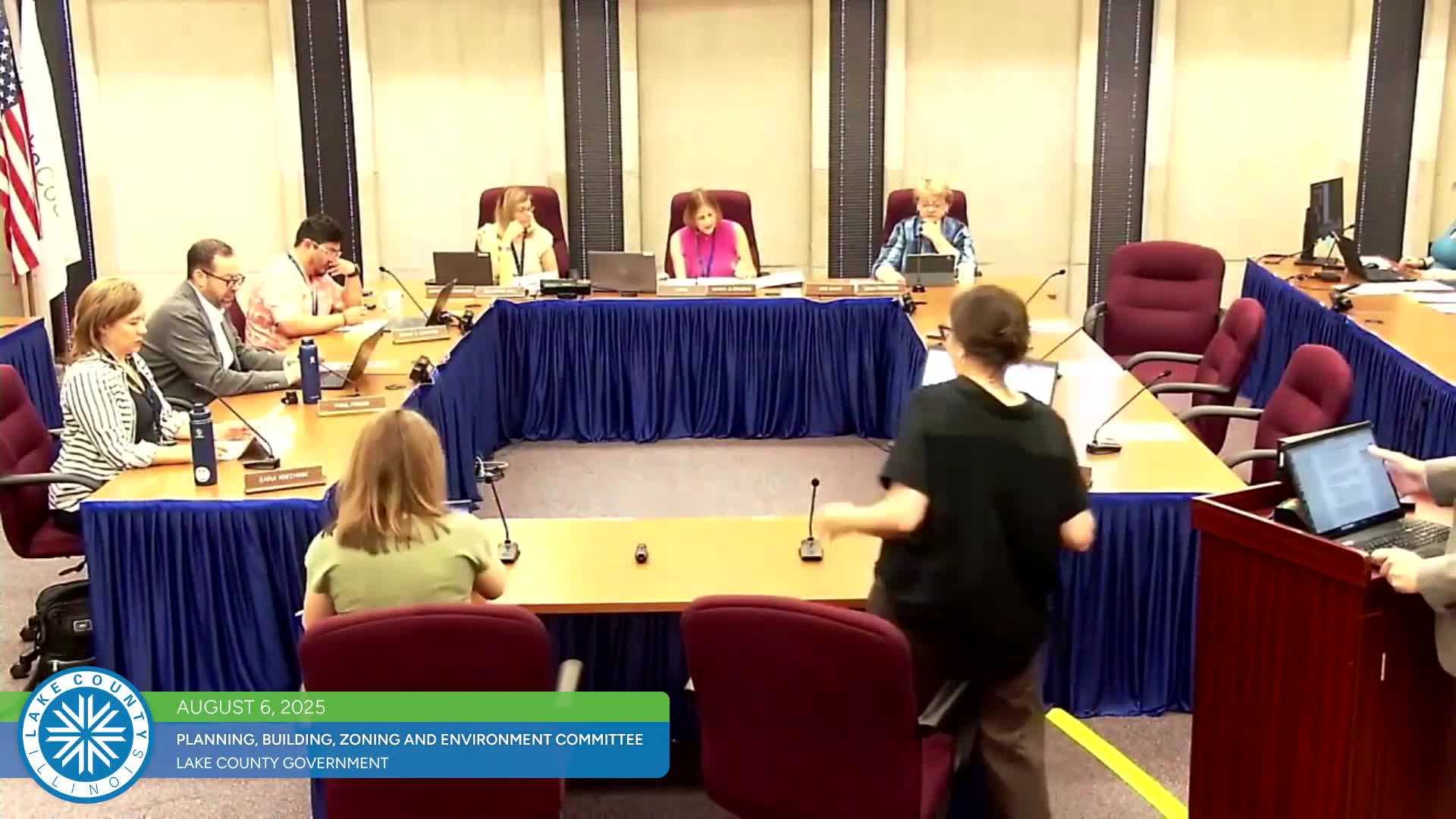
Summary
Committee voted to send a resolution to the County Board to begin a Zoning Board of Appeals hearing on draft text amendments to Chapter 151 that would offer density and dimensional incentives in exchange for voluntary sustainable building practices.
Lake County Planning, Building, Zoning and Environment Committee members voted Aug. 6 to direct staff to begin a formal Zoning Board of Appeals public hearing process on draft text amendments to Chapter 151 of the Lake County Code of Ordinances that would create a voluntary sustainable development incentives program for unincorporated Lake County.
The proposed ordinance would let applicants opt into a menu of sustainability practices—such as building electrification, EV readiness, geothermal heating, green roofs or rooftop solar—in exchange for administrative incentives including increased density or floor area and reduced building setbacks.
Staff said the amendments would establish a weighted point system to approve incentives administratively and that the ordinance would be written so the list of eligible sustainability practices could be expanded over time. "These proposed incentives available for including additional sustainable practices would allow for increased density or floor area and reduced building setbacks," Taylor Gendel, senior planner, said during the committee presentation.
Eric Wagner, director of Planning, Building and Development, described the proposal as a voluntary, market-driven approach: "This is a way that we can sort of add the carrot to the stick ... by offering developments ways in which they can improve their bottom line in exchange for additional sustainability benefits to the property, the environment, the community." He and staff said the draft is intended to encourage sustainable practices without making them mandatory.
Committee members asked whether the ordinance would operate as a menu of trade-offs—examples included building higher or closer to lot lines in exchange for multiple sustainability features—and staff confirmed that is the intended framework. Members also asked whether other Illinois counties use similar systems; staff noted Chicago has similar approaches and that other jurisdictions nationwide use point systems as a best practice.
Members raised technical limits to some sustainability measures. Member Frank asked whether graywater recycling could be included; staff replied the Illinois plumbing code currently limits reuse of graywater for irrigation and that accommodating graywater would require further legislative changes at the state level.
Action taken: Motion by Member Frank, second by Member Campos to forward a resolution to the County Board to initiate the Zoning Board of Appeals hearing. The committee voice vote was recorded as unanimous in favor.
The next steps described by staff are County Board approval of the resolution to initiate the ZBA hearing, completion of the ordinance drafting, then a ZBA public hearing and subsequent County Board deliberation. No ordinance text was adopted at the meeting; the committee action only initiated the formal hearing process.
Ending — Staff said they will complete drafting and return the item to the Zoning Board of Appeals and County Board as the public hearing process proceeds.