
Lake County committee reviews draft environmentally preferred purchasing policy; members press on 5% preference and local impacts
Get AI-powered insights, summaries, and transcripts
Subscribe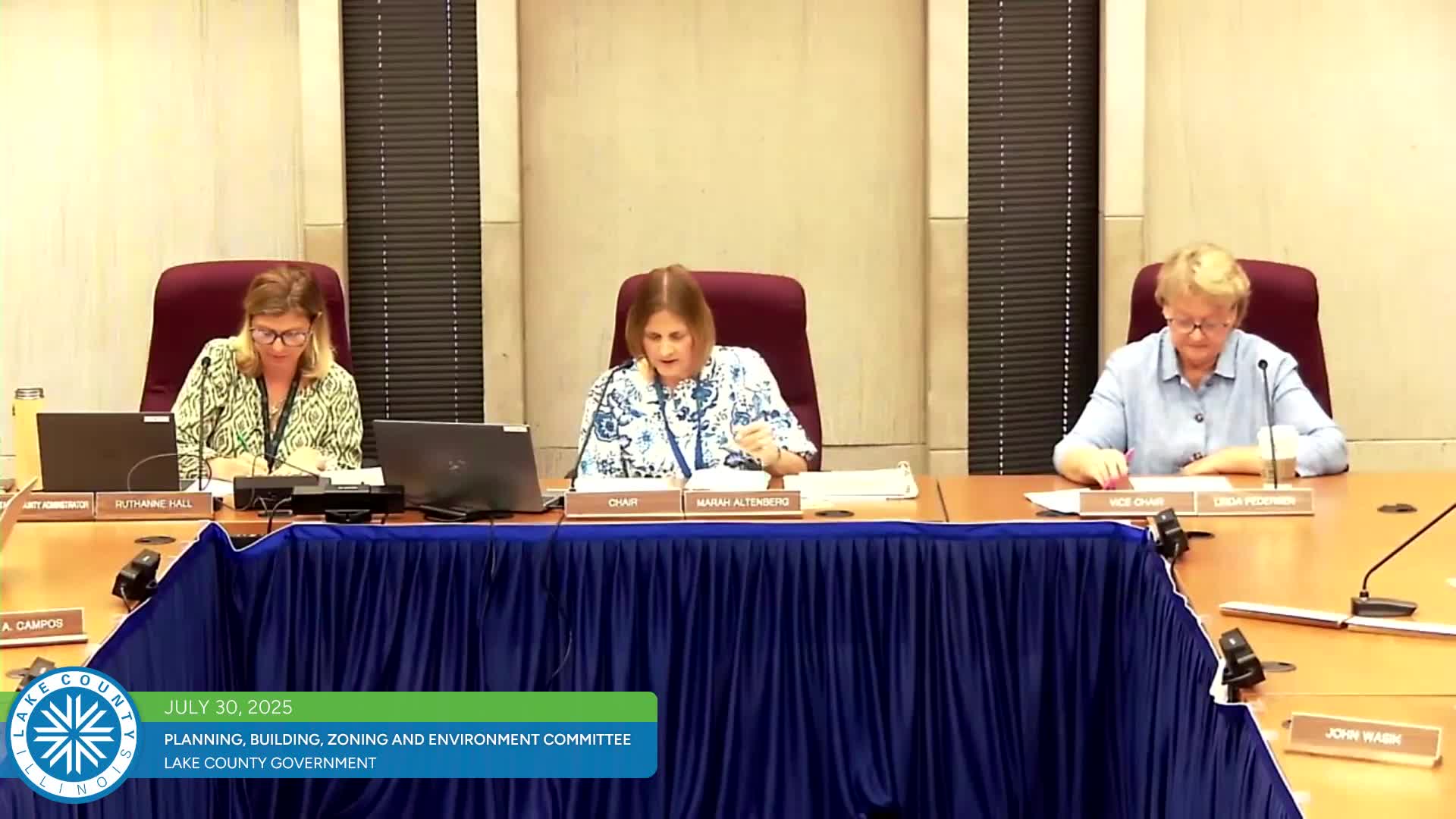
Summary
Lake County’s Planning, Building, Zoning and Environment Committee discussed an initial draft of an environmentally preferred purchasing policy on July 30, hearing presentations from sustainability and purchasing staff and pressing for guardrails on a proposed 5% green-price preference.
Lake County’s Planning, Building, Zoning and Environment Committee discussed an initial draft of an environmentally preferred purchasing policy during its July 30 meeting, hearing a presentation from Robin Grooms, the county’s sustainability programs manager, and Yvette Alberon, purchasing manager, and raising questions about a proposed 5% price-preference and effects on local vendors and large capital projects.
The proposal, presented by Robin Grooms, would apply a sustainability “lens” to county procurement and set the foundation for a countywide green purchasing program the presenters said they expect to begin in 2026. The draft calls for training for buyers, purchasing guides, an eco-label certification form for vendors, and tracking of green spend through a new enterprise resource planning (ERP) system. Under the proposal, a bidder that meets the county’s green specifications or holds a listed third-party eco label could be awarded a public bid if that bid is within 5% of the lowest responsive and responsible bidder.
Committee members pressed staff on how the 5% preference would interact with existing legal and program requirements, how the policy would treat procurements that use state or federal funds, and whether the preference would unduly favor a single green bidder. Grooms and Alberon said the policy includes a severability clause that would defer to statutory requirements — for example, Illinois Department of Transportation (IDOT) rules for DOT-funded projects — and that responsible-bidder prerequisites (such as apprenticeship or prevailing-wage requirements) remain a threshold that must be met before any green preference could be applied. Alberon said the 5% figure was drawn from other jurisdictions’ model policies and purchasing preferences.
Members asked for additional guardrails. Member Schlick (participating remotely) said a flat 5% could be problematic for large contracts and suggested adding a dollar-amount cap or safety trigger. Member Campos and others urged staff to protect local businesses, noting some small vendors may not afford third-party certifications. Several members suggested staff explore ways to encourage local vendors to pursue green practices or to reflect locality in scoring where legally permissible.
Grooms and Alberon described how the county arrived at the draft: the team synthesized existing programs nationally, worked with Northern Illinois University students in 2024, joined the Sustainable Purchasing Leadership Council in 2025 and reviewed model eco labels. They said eco labels will be the primary verification tool to limit self-certification and reduce “greenwashing.” The policy would require departments to use newly developed guides for departmental purchases and to include sustainability as an evaluation factor in RFPs for professional services.
Alberon described procurement thresholds as they appear in the county’s purchasing ordinance and how the policy would apply at different levels: departmental purchases (goods and services up to $30,000; IT up to $35,000; professional services up to $50,000) and competitive procurements (competitive bids above $30,000; RFPs for professional services above $50,000). Presenters said the policy is not intended to inflate budgets; they estimated — as an upper-bound scenario — that if an environmentally preferred option were chosen for every county construction bid in 2024, additional spend could total about $3,535,000. Presenters emphasized that departments would retain budget controls and that the preference applies only when the green option performs as required, is available within a reasonable time frame and maintains the annual department budget.
Staff described reporting and metrics the policy would require, including counts of training delivered, spend directed to green vendors, and category-level analyses that would produce a baseline in 2026 and year-over-year targets thereafter. Grooms said departments were included in focus groups and that feedback — including requests for peer-to-peer training, case studies and clearer purchasing guides — informed the draft. The county administration and finance offices reviewed the policy with department heads and clarified that no mandatory ecolabel purchase obligation would be imposed through existing contracts and that the policy would not be applied where it would make a project noncompliant with state statute.
The committee did not vote on the policy during the meeting. Alberon and Grooms said the draft will be presented to the Finance and Administration (FNA) committee the following day; staff indicated the item may return for formal action at a future date after additional edits. A separate procedural item on the committee’s consent agenda was approved earlier in the meeting (motion by Member Campos; second by Member Frank).
Committee members asked staff to return with clarifications about guardrails for high-value projects, whether the 5% standard should vary by project size or include a dollar cap, how the county will validate eco-label claims, and ways to avoid pricing out local vendors. Presenters said those questions would be considered as staff prepare materials for the FNA agenda and future drafts.
The discussion illustrated competing priorities: committee members generally endorsed the goal of using county purchasing power to promote sustainability but repeatedly raised concerns about fiscal responsibility, statutory constraints on local preferences, vendor verification and the practical effects on large capital work. Staff described the draft as an initial, implementable framework intended to evolve with additional data, training and procurement experience.
No formal policy vote occurred at the July 30 meeting; staff flagged the item for Finance and Administration review and said they would return with revisions and more detailed analysis.