
Lake County presents Safety Action Plan, proposes Vision Zero goal and high‑injury network targeting
Get AI-powered insights, summaries, and transcripts
Subscribe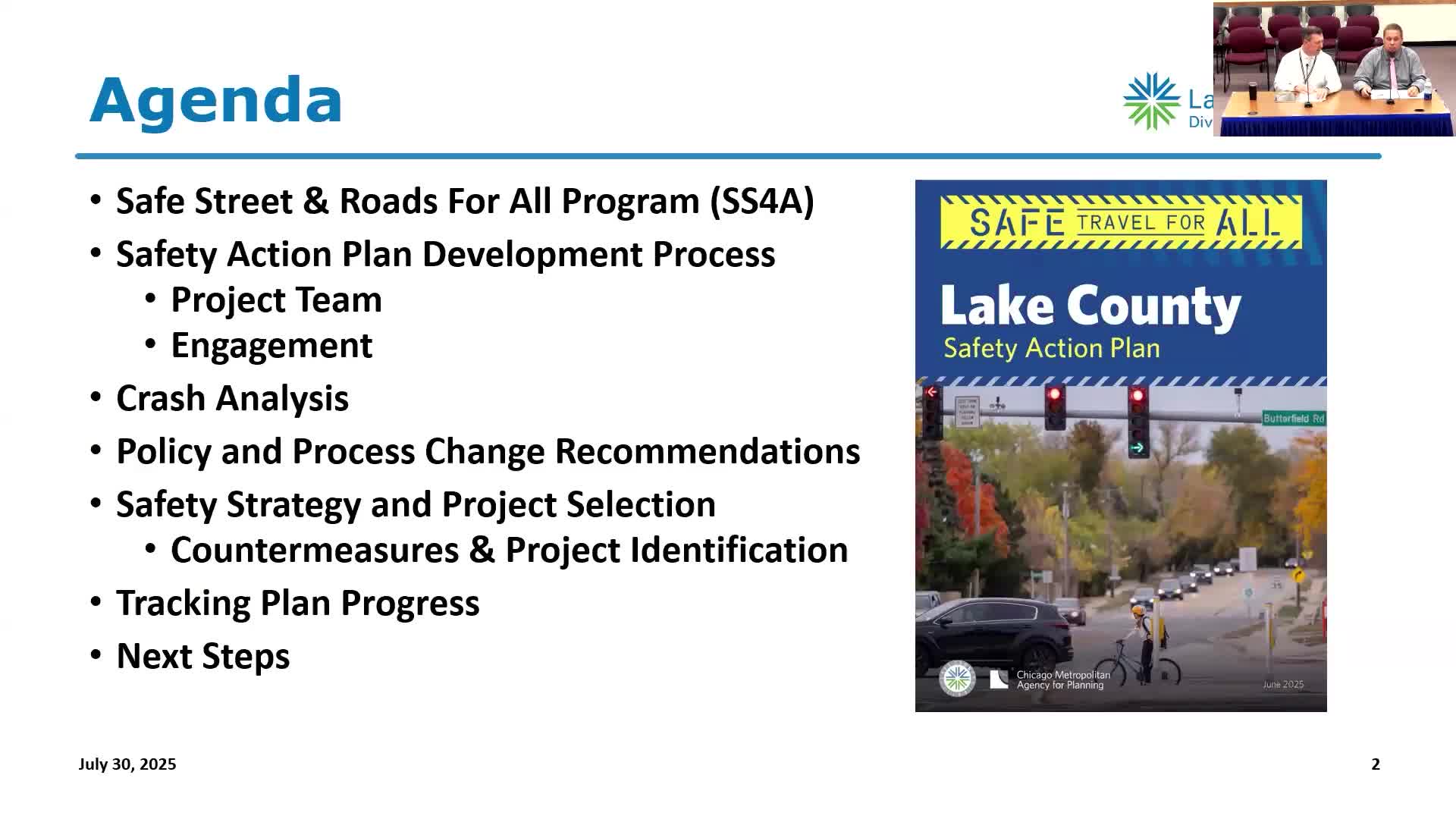
Summary
Staff presented a federally funded Safety Action Plan developed with CMAP and HDR that identifies a high‑injury network and recommended countermeasures; the county will consider a Vision Zero resolution and use the plan to prioritize projects and competitive federal grant applications.
Lake County staff presented the county’s Safety Action Plan on July 30, a planning document developed with the Chicago Metropolitan Agency for Planning (CMAP) and HDR under the U.S. Department of Transportation’s Safe Streets and Roads for All (SS4A) planning grant program.
Mike Clemens, manager of transportation planning, said the plan applies a Safe System approach and analyzes 2018–2022 crash reports to identify a high‑injury network — road segments with at least 2.5 fatal or serious injury crashes per mile — that accounts for 66% of the county’s fatal and serious injury crashes while comprising only about 7.5% of roadway miles. A very‑high‑injury subset (at least 6 fatal/serious injuries per mile) accounts for 35% of those crashes on just 2.4% of roadway miles.
The plan identifies four emphasis areas — intersections, speeding/aggressive driving, roadway departures, and impaired driving — that together accounted for more than 55% of fatal and serious injury crashes in Lake County during the study window. Clemens discussed countermeasures with empirically derived crash reduction factors, from low‑cost signal and backplate improvements to roundabout installations and lane repurposing (road diets). He noted roundabouts can reduce crashes by roughly 75% based on local experience and published factors cited in the plan.
Clemens said the plan includes performance measures aligned with federal metrics (fatalities, fatality rate, serious injuries, and nonmotorized fatalities/serious injuries) and proposes a Vision Zero goal to eliminate traffic deaths and serious injuries by 2050. He presented an S‑curve projection for reaching Vision Zero and a conservative economic valuation of preventing deaths and injuries that placed the potential economic benefit in the billions over several decades.
Committee members asked technical questions about statistical significance, weighting of risk factors, and how the high‑injury network would drive project selection. Clemens said the high‑injury network would be a primary focus but emphasized that the Safe System approach also seeks proactive interventions on roadways that exhibit risk factors even before fatal crashes accumulate. He acknowledged time constraints during plan preparation limited more complex weighting analyses but said further analysis could be pursued and that the Lake County Council of Mayors has already adopted the high‑injury network for grant evaluation.
The committee expressed support for incorporating the plan’s findings into the county’s long‑range transportation plan (Envision 2050) and asked staff to return with a Vision Zero resolution for consideration. Clemens said the plan and interactive maps are published on the county website for municipalities and the public to use when applying for competitive funding.