
Lake County committee agrees to audit as first step in review of South Lake Mosquito Abatement District
Get AI-powered insights, summaries, and transcripts
Subscribe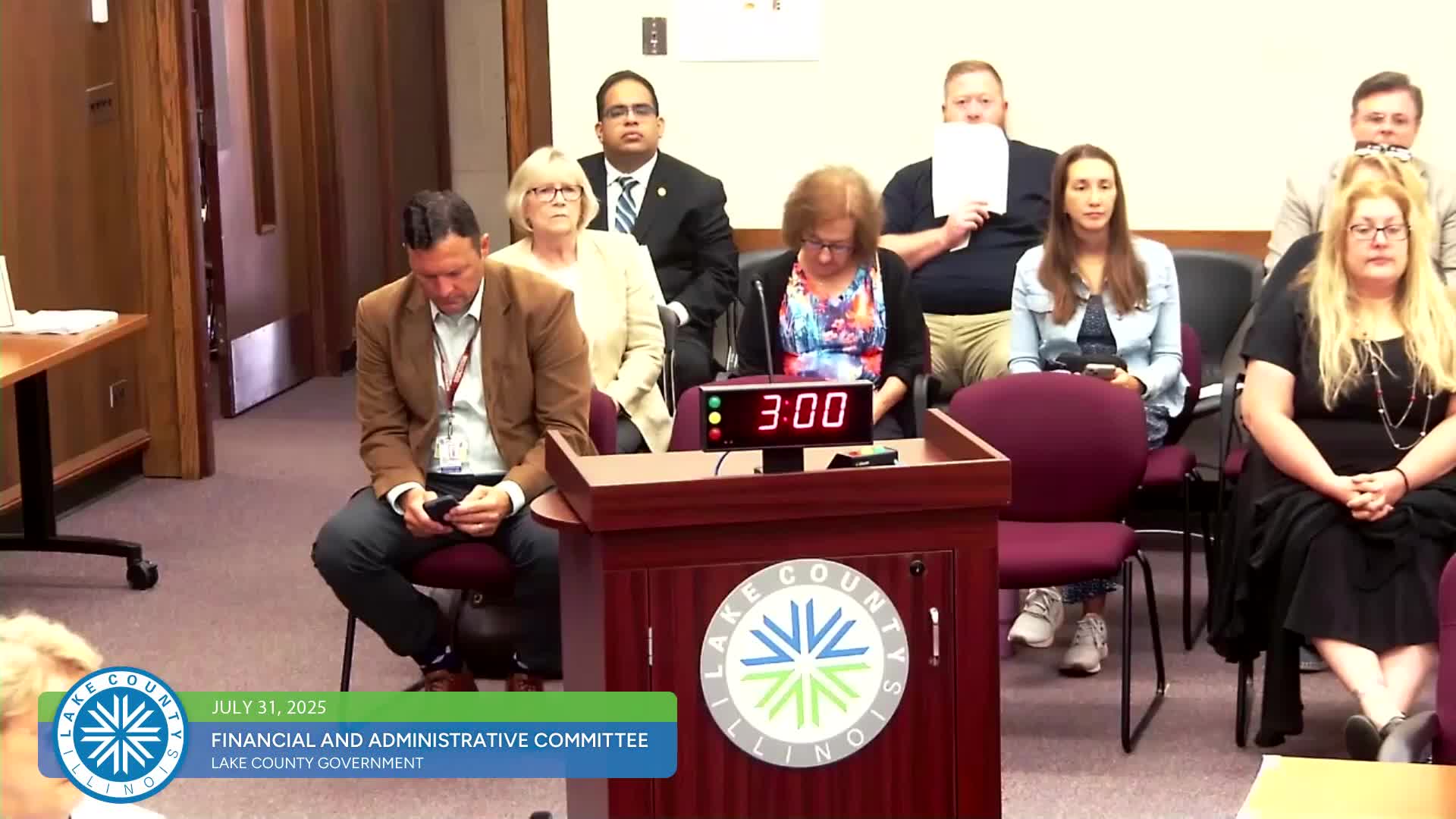
Summary
After public comment from village officials, the Lake County Financial and Administrative Committee directed staff to prepare a proposing ordinance that would trigger a financial audit and municipal outreach about dissolving the South Lake Mosquito Abatement District; no final dissolution vote was taken.
The Lake County Board’s Financial and Administrative Committee on July 31 directed county administration to prepare a proposing ordinance to start a financial audit and municipal outreach related to the possible dissolution of the South Lake Mosquito Abatement District.
The committee’s action followed public comment from municipal leaders who urged the county not to proceed without full public input. “The Bannockburn village board opposes district and strongly supports its continued operations,” said Stephanie Hannon, village manager for Bannockburn. She told the committee the district provides “coordinated mosquito abatement services” across multiple villages and described the district’s 2024 levy as “approximately $481,000.”
Why it matters: dissolving a special district would shift services and funding responsibility to municipalities and could change how mosquito-control services are provided across multiple communities. Committee members emphasized the proposal at this stage would only begin a review process, not remove services immediately.
Committee discussion and public comment Public commentators representing Bannockburn, Riverwoods and Deerfield told the committee the district organizes mosquito control across municipality boundaries and helps limit vector-borne disease. Chris Ford, mayor of Riverwoods, said the district operates on a relatively small levy and “the budget developed by the board attempts to match the difficult projected year to year adult climate with the associated mosquito levels.”
County staff described the dissolution mechanics. “With that approval of a proposing ordinance, you would ask for an audit of the financials, and you would be given 30 days after the completion of the audit…to put forth an authorizing ordinance,” Assistant County Administrator Ruth Ann Hall told the committee. Hall also reported the district’s fund balance is “just shy of a million dollars,” and that remaining funds would need to be used for mosquito abatement if distributed to municipalities.
Board members debated service delivery, local accountability and cost. Several members said municipalities might be better positioned to decide spray policies and priorities; others warned that dissolving a district simply shifts costs and responsibilities and that unincorporated areas could lose coverage. Member Main cautioned that services previously provided by a dissolved district may persist if a municipality absorbs them, but the funding source would change.
Action taken The committee agreed to direct county administration to prepare a proposing ordinance that would initiate the audit and municipal engagement described by staff. Committee members clarified this is an information-collection step and not a final decision to dissolve the district: a later authorizing ordinance and any required petition, referendum or court steps would follow statutory procedures.
What comes next If a proposing ordinance is approved at a subsequent committee and full board meeting, the county would commission a financial audit, notify and meet with member municipalities, and then determine whether to present an authorizing ordinance. Members stressed the audit and municipal outreach are intended to produce data and local input before any formal dissolution action.