
Governors State reports enrollment gain, housing demand and tests AI recruitment amid state budget uncertainty
Get AI-powered insights, summaries, and transcripts
Subscribe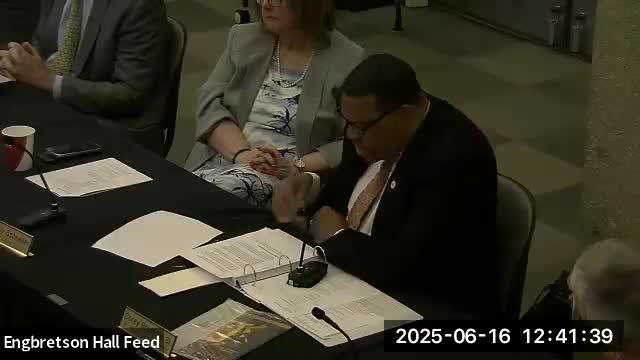
Summary
Interim President Dr. Bradford reported an increase in fall enrollment, strong housing applications and the university’s pilot of an AI recruitment tool, while warning that a 1% state funding increase may require cost‑saving measures.
Interim President Dr. Bradford told the Governors State University Board of Trustees on June 16, 2025, that the university has enrolled 2,816 students for the fall 2025 term, a gain of about 3.5% or 96 students compared with this time last year, and that the campus faces strong housing demand.
Dr. Bradford framed the enrollment news alongside state budget uncertainty. He told trustees the Illinois spring legislative session passed a $55,200,000,000 state budget and that public universities received a 1% across‑the‑board increase — short of the governor’s recommended 3% — prompting campuses to consider further cost‑saving measures. “What was viewed as a difficult budget year for the state, the legislators passed a $55,200,000,000 state budget,” he said. “Now, as for higher education, the budget includes a 1% across the board increase for public universities. Now this is down from the governor's recommended 3%.”
Dr. Bradford said the university’s fall enrollment stands at 2,816 students and is up about 3.5% (96 students) compared with this time last year. He also described several enrollment and retention targets: a goal to retain 85% of continuing students and active efforts by colleges and advisement staff to register students quickly.
Housing demand is strong, he said. The university has received about 318 housing applications and 238 deposits — a roughly 75% yield on applications to date — and the university has contingency planning underway, including negotiations with an outside company to provide overflow beds if needed. “So far, about 238 have made actual deposits,” Bradford said. “That's about 75% yield rate so far.”
Bradford also described the LEAP freshman bridge program, which runs July 7–Aug. 14 and lets students live on campus and earn seven credit hours free of charge. He said 53 students are enrolled, 60 have made deposits, and the program is expected to reach about 70 students.
On recruitment and yield, the board heard about a pilot of an AI tool called College Buying AI to increase undergraduate yield. Paul, a staff member overseeing parts of the pilot, described the tool as adaptive and conversational: “The AI is incredibly impressive,” he said. “It literally looks at what we're doing and it supplements it… it’s adaptive. So if the student then starts writing the AI back, it starts answering to the student.” The pilot included 38 campus testers and will be used both to retain admitted students and to engage prospective students.
Bradford said the university is also continuing external partnerships, noting a community college partnership meet‑and‑greet on June 25 to strengthen transfer and dual‑degree programs, and that the campus is preparing for the transition to incoming President Dr. Joyce Esther and for Bradford’s return to his prior CFO role on July 1.
Trustees asked questions during the report about the origin of LEAP participants (Bradford said many are local and from the Chicagoland area but some come from outside the area), the possibility of additional state funding if federal decisions change, and specifics of the AI pilot’s deployment schedule. Board members did not take a formal vote on these items during the meeting.