
Retired social worker urges Illinois Commerce Commission to reject Nicor rate increase, cites older adults facing disconnection
Get AI-powered insights, summaries, and transcripts
Subscribe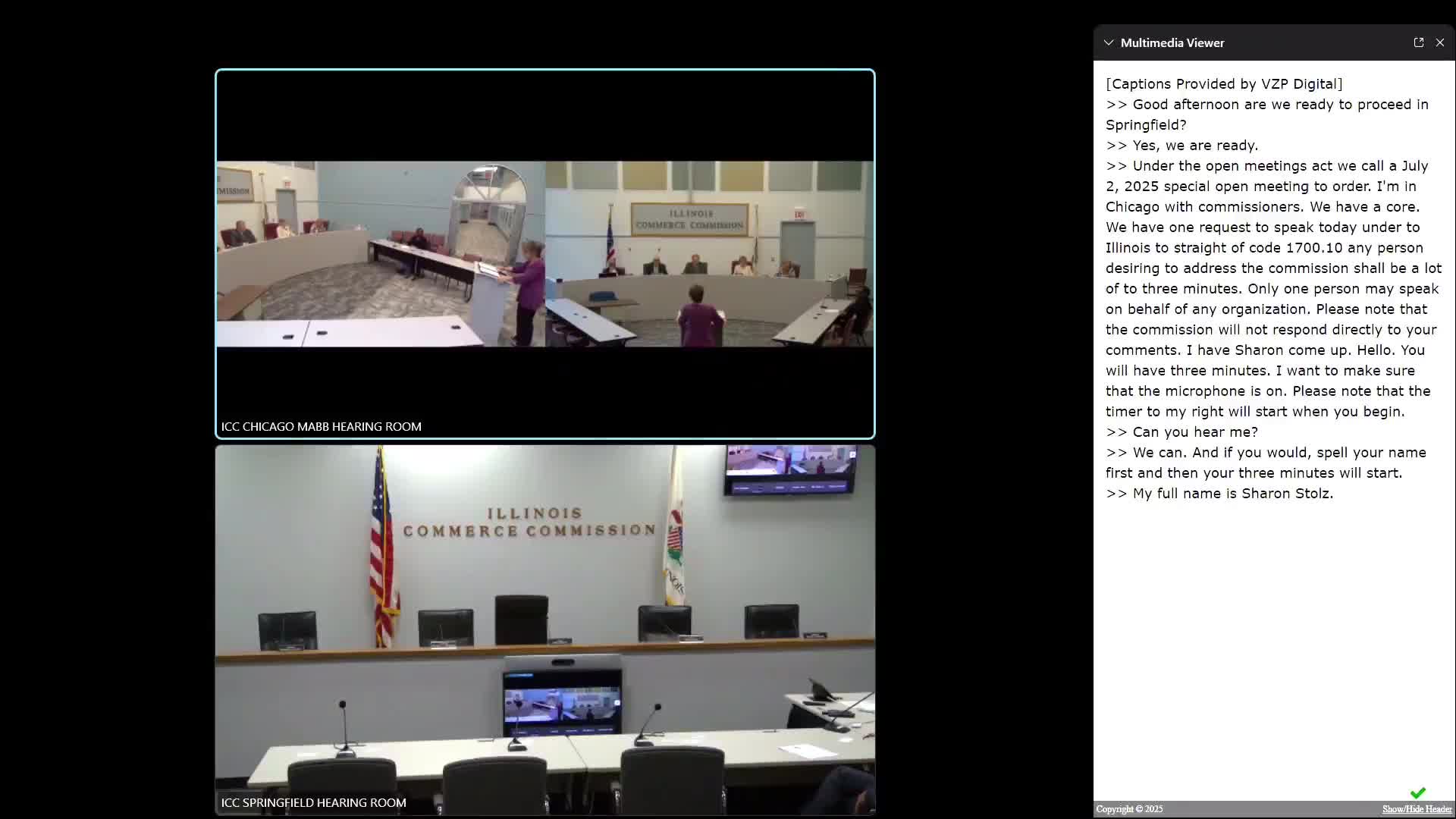
Summary
At the Illinois Commerce Commission special meeting July 2, 2025, Sharon Stoltz testified that a proposed Nicor rate increase would worsen utility disconnections among older adults and asked the commission to reject the request and require Nicor to align its plan with Illinois decarbonization goals.
Sharon Stoltz, a retired geriatric social worker and member of Third Act Illinois, told the Illinois Commerce Commission on July 2 that she asked commissioners to reject Nicor’s proposed rate increase to protect low-income older utility customers.
Stoltz told commissioners she recently assisted an older woman living with dementia who faced an imminent gas shutoff after an accruing Nicor balance. Stoltz said the client had been making partial payments but “by the time she reached me, she had gone from agency to agency to find help” and her gas disconnection was imminent. Stoltz said her agency obtained a state exemption for the client but was unable to pay Nicor by phone; staff found a currency exchange that could transmit the check and “we beat the disconnection deadline for this client living with dementia by 1 and 1 half hours.”
The comment was delivered during the commission’s public comment slot under the Commission’s speaker rules (2 Illinois Administrative Code section 1700.1). Stoltz urged the commissioners to deny Nicor’s requested rate increase, which she described as “the largest rate hike for a gas utility in the history of our state,” and to “direct Nicor to fit its plan to meet Illinois decarbonization goals.”
Stoltz said the rising cost of rent, food and utilities had left some older clients ineligible for existing state and federal assistance: she said one client’s income was “just enough over the poverty level” to disqualify her for some programs and that emergency LIHEAP appointments were unavailable. Stoltz also told commissioners that “in recent years, disconnection notices became so frequent among older adults that whole days of my agency’s work became a race against the clock.”
Stoltz also referenced recent state-level legislative actions she said would reduce social safety-net resources and said many of her clients live with heart and lung conditions; she tied that concern to an ask that Nicor’s plan address Illinois decarbonization goals. The commission did not take formal action on the comment during the meeting.
The commission’s public-comment rules were read at the start of the meeting, and the chair thanked Stoltz when her three-minute speaking period ended.