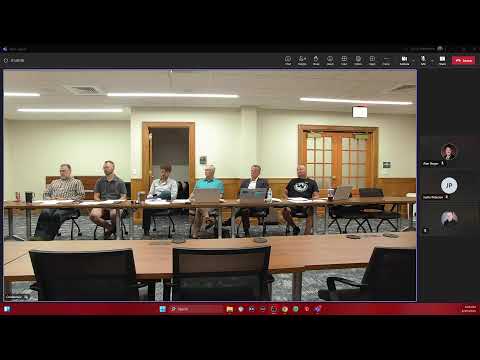
City attorney summarizes home-rule charter, hierarchy of laws and mayor's duties
Loading...
Summary
At a council briefing, the city attorney explained how Watertown's Home Rule Charter, state statute and city ordinances interact, outlined limits on council administrative action, and reviewed the mayor's formal duties.
City Attorney Lisa told the Watertown City Council on Oct. 5 that the Home Rule Charter sits at the top of the local legal hierarchy and that matters not addressed by the charter fall to state statute, then city ordinance and then administrative policy. "Under, state law, your home rule charter is actually what is in the hierarchy and precedence is above state statute," Lisa said during a presentation broadcast on Facebook, YouTube and GovTV.
She said the charter assigns administrative responsibility to the city manager and directs the council to avoid direct involvement in management except through oversight of the city manager. "Under our current home rule charter, the council is to avoid direct involvement in management and administrative matters. Those are assigned to the city manager," she said.
Why it matters: The explanation clarifies limits on the council's powers and the pathway residents must use to challenge local laws. Lisa also reviewed the initiative and referendum processes allowed under state statute and how petition thresholds are tied to turnout in the last gubernatorial election. She said petition-signature requirements in Watertown are verified by the finance office and estimated that an initiative or referendum previously would have required about 1,600'1,800 verified signatures, though she offered to confirm the exact number.
The attorney reviewed the mayor's formal functions under the charter: presiding over meetings, representing the city in intergovernmental relations, voting as a council member and appointing advisory boards and commissions with council advice and consent. She said the charter allows council to assign additional powers to the mayor by ordinance but that the charter itself cannot be overridden by ordinance.
On executive sessions and rules of order, Lisa said municipal practice must reconcile the charter language with state law and parliamentary rules. When a council member asked whether a vote may be taken in executive session if the charter appears to allow it, Lisa answered that state statute generally controls and that the council should avoid actions that conflict with state law. She offered to provide a written follow-up clarifying the interplay among the charter, state statute and Robert's Rules of Order.
Discussion vs. decision: The presentation was informational; no policy changes were proposed or adopted during the briefing.
Ending: The city attorney encouraged council members to raise specific charter questions for follow-up memos and said the staff would supply additional citations on request.