
Longview adopts amended ordinance limiting storage of personal property on public land after contentious debate and procedural votes
Get AI-powered insights, summaries, and transcripts
Subscribe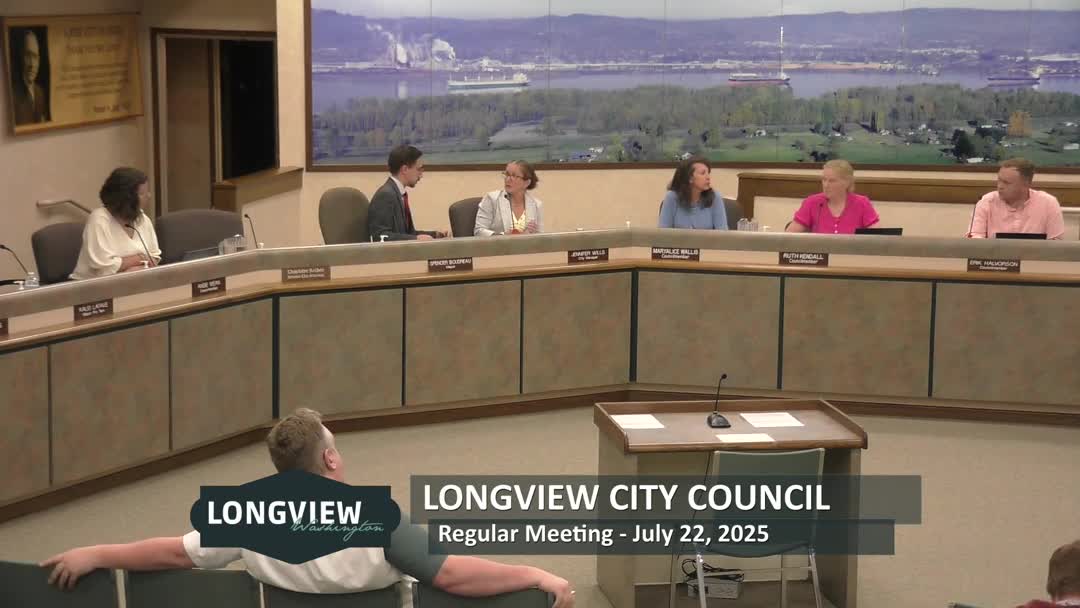
Summary
After a series of amendments, reconsideration and a suspension of rules, Longview City Council adopted Ordinance 3564 with multiple edits to definitions governing storage of personal property on public property; council debated subjective language about "interferes with ordinary use or enjoyment."
Longview City Council on July 22 adopted Ordinance 3564, which amends Longview Municipal Code sections related to storage of personal property on public property. The ordinance passed after the council considered and voted on three proposed amendments, including removal of a clause relating to constructed tents, a contested change to the definition of "excessive storage," and a simplification of the definition of "public property."
Council member Kendall introduced three amendments. The first amendment removed language in the bulky‑item definition that excepted a “constructed tent” from that definition; council approved that change unanimously. The second amendment would have removed subsection D from the definition of "excessive storage," which would have stripped the clause that described items that "interfere with the ordinary use and enjoyment of the public space by others." That amendment initially resulted in a 3‑3 tie and failed. The council then voted to suspend rules and reconsider that failed amendment; after reconsideration the council restored subsection D. The third amendment simplified the definition of "public property" to read: "all publicly owned and maintained or controlled property," which the council approved.
City staff and the city attorney participated in the discussion; the attorney advised on the structure of the "excessive storage" subsection and noted that the listed criteria are joined by the word "or," so any single criterion would meet the definition. Council members expressed differing views about subsection D: one council member said the phrase was too subjective and could be interpreted broadly, and said they would vote no on the ordinance if D remained; other council members urged retaining D. After suspension of the rules and reconsideration, the council voted to adopt the ordinance as amended.
Manager Wills said the ordinance language had been adapted from another jurisdiction and that staff plans to reconvene the task force in the coming week to continue work on document recording fees and other next steps. The council also discussed enforcement and staff noted the definition and enforcement approach will need further vetting with task force partners and law enforcement to ensure clarity.
The ordinance motion was moved and seconded; following amendment votes and procedural motions the main motion as amended passed. One council member announced they would record a NO vote for the ordinance as adopted because of concerns over the reinstated subjective language.
Staff said they will continue outreach with partner organizations and the task force to refine enforcement approaches and to coordinate broader work on camping, sheltering, and associated fees and services.