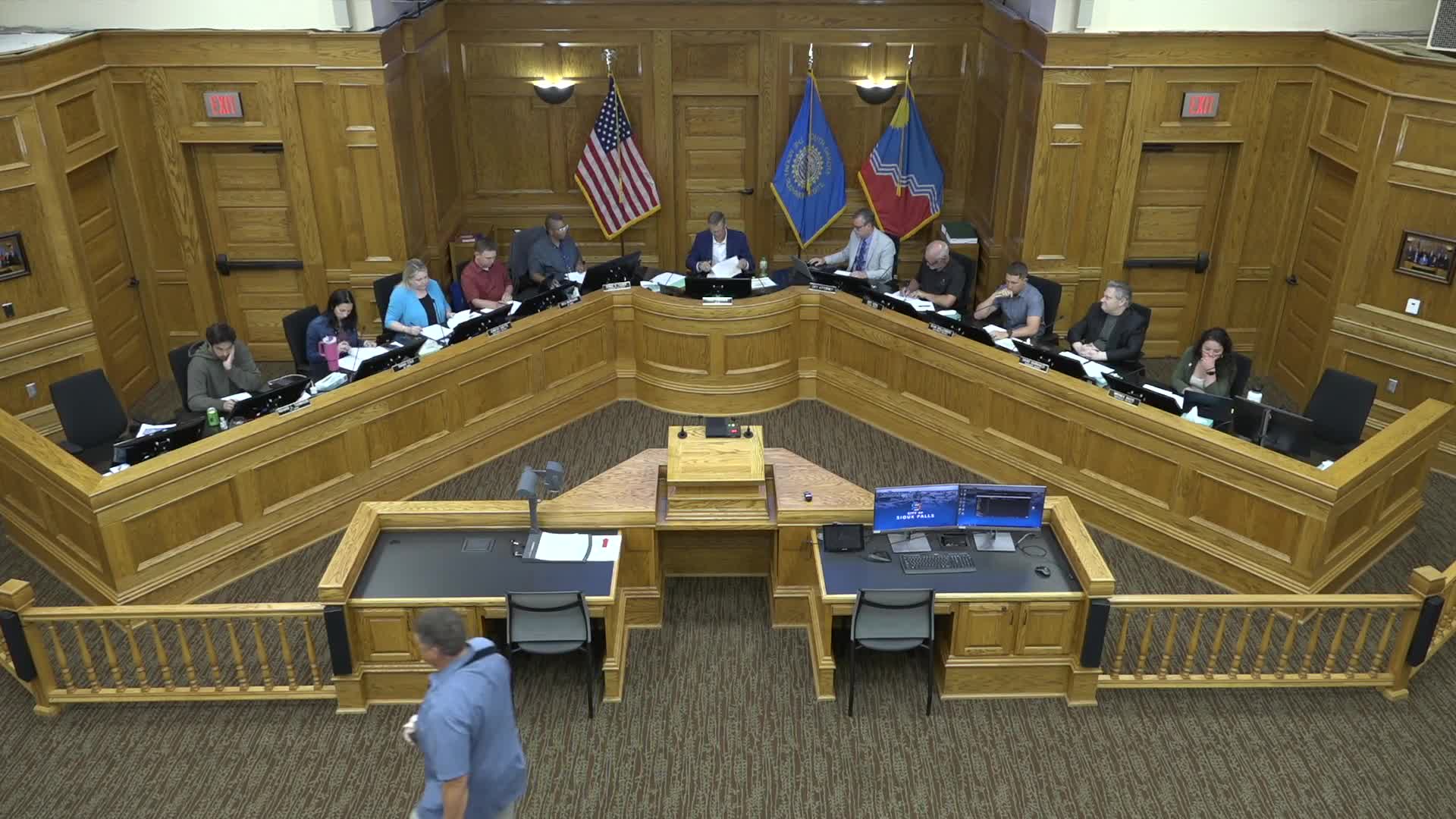
Sioux Falls council advances ordinance to restrict public encampments after adding outreach, storage and notice requirements
Loading...
Summary
After hours of public comment, the City Council approved second reading of an ordinance restricting certain structures in public places, added an amendment requiring service-provider engagement, 24-hour notice for removal of unoccupied dwellings and coordination of up to 60 days’ storage; the measure moves to final consideration on Aug. 19.
Sioux Falls City Council members advanced an ordinance to prohibit certain structures in public places after adopting amendments that add outreach and storage protections for people living in encampments.
The council voted 8-0 on Aug. 12 to adopt the ordinance as amended and then voted 8-0 to send the item to a final (third) reading, scheduled for Aug. 19, for possible adoption.
The amendment introduced by Councilor Rich McCuris requires city staff to (1) engage a service provider before issuing a violation notice, (2) provide 24-hour notice before removing an unoccupied dwelling so occupants have an opportunity to recover belongings, and (3) coordinate a storage option for personal property for up to 60 days during transitions. McCuris said those three elements were modeled on practices in Des Moines and Spokane and intended “to reflect the complexity of the situation and put processes in place.”
The ordinance and amendments drew extensive public comment Monday night. Dozens of residents, service providers and people with lived experience of homelessness urged either rejection or modification. Speakers including Shannon Ward, a downtown business owner, and Claire Ketchum, a nurse and volunteer who provides street outreach, said enforcement without accessible shelter or services would push people into more dangerous hidden locations and make outreach harder. June Copperstead warned the council that recent federal and judicial developments create incentives to criminalize camping and that similar bans in other cities had not reduced homelessness.
Others told the council they supported stronger enforcement. Francis Room and other residents who live near downtown service sites described safety and quality-of-life concerns and urged action. Speakers repeatedly asked the city to pair any enforcement with increased shelter, mental-health and substance-use services.
City staff and council members said the amendment is meant to balance public-safety concerns with the need to connect people to services. Michelle Treasure, the city’s homelessness services coordinator, and Councilor McCuris described the amendment as “offered in a spirit of collaboration” and said it codifies engagement steps already used by the police and outreach teams.
The City Attorney told the council that state law requires an additional reading if the ordinance is substantially altered after first reading; with the McCuris amendments adopted, the council scheduled final consideration for Aug. 19.
What was added: the amendments require outreach before citation, 24-hour notice before removing a structure when no one is present, and city-coordinated storage for up to 60 days. Several speakers and service providers asked the council to ensure the city can actually deliver the alternatives being promised — shelter capacity, low-barrier services, storage locations and tracking — before enforcement begins.
Votes and next steps: the council adopted the McCuris amendment 8-0, approved the ordinance as amended 8-0, and voted 8-0 to return the item for final consideration on Aug. 19. Council members and staff said they expect continued discussion with service providers, Minnehaha County and community stakeholders between readings.
Public-health and outreach groups present — including Midwest Street Medicine, Union Gospel Mission and Southeastern Behavioral Health — told the council that forced displacement causes people to lose identification, medication and trust, which makes placement and care harder. Several speakers reported local cases in which people discharged from hospitals returned to streets with unmet care needs. Those concerns were prominent in public testimony and in council discussion about how enforcement should be implemented.
The final ordinance text and the amendment language (referenced as ordinance 0057a during the meeting) were added to the public record and will be available with the agenda for the Aug. 19 meeting.