
Dearborn adopts package of ordinances to restrict short‑term rentals outside business districts
Get AI-powered insights, summaries, and transcripts
Subscribe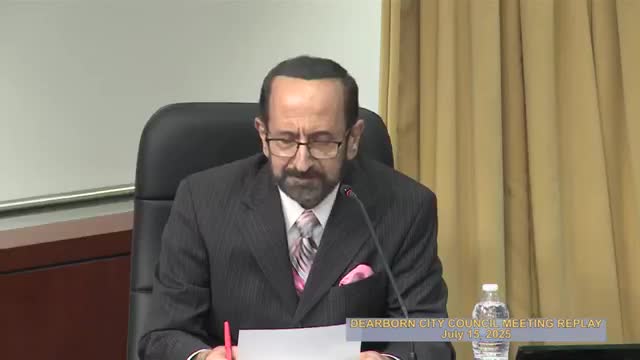
Summary
The Dearborn City Council on July 15 approved a package of ordinances that restrict short‑term rentals to designated business districts, introduce permit and safety requirements for STRs, and remove overlapping bed‑and‑breakfast rules. The package takes effect Jan. 1, 2026 after council accepted an amendment to delay enforcement.
The Dearborn City Council on July 15 approved a package of ordinances that restrict short‑term rentals outside designated business districts, create a new registration and safety regime for STRs, and replace older bed‑and‑breakfast rules in the city code. The council amended the effective date for the package to Jan. 1, 2026 to give operators time to comply.
Council President Cerini said the measures are intended to “keep Dearborn’s residential neighborhoods truly residential” and to reduce nuisance and safety problems residents raised during months of public hearings and study sessions. The ordinances drew lengthy public comment at the meeting, with dozens of residents, rental hosts and organizational representatives giving testimony for and against the changes.
The package includes: zoning changes that limit STRs to existing downtown/business districts (Ordinance No. 25‑18‑45); new occupancy and building‑standards rules requiring a city certificate of occupancy, local point‑of‑contact and basic safety equipment (Ordinance No. 25‑18‑47); removal of separate bed‑and‑breakfast rules to avoid overlap with the new STR framework (Ordinance No. 25‑18‑48); and an update to prohibitions and enforcement language for hotels and STRs (Ordinance No. 25‑18‑49). Together the ordinances create a permit system and fines for nuisance violations: $750 for a first offense, $1,000 for a repeat violation, and revocation of a rental certificate after a third separate violation within 12 months.
Council Member Abraham said he supports the package because residential zoning should not be turned into commercial hubs: “There’s really no other ordinance on our books that allows for a primary business to operate in residential zoning,” he said, adding that the changes are intended to “put our neighborhoods first.” Council Member Hamoud, who proposed the amendment to move the ordinances’ effective date to Jan. 1, 2026, said the later date gives hosts additional time to wind down operations or comply.
Opponents and supporters both addressed council. Resident Joseph LeBlanc, who said he hosts visitors in his house, described STR income as necessary for homeowners and urged a carve‑out for owner‑occupied rentals. He told council that STRs “help me pay my mortgage and bills and it’s how I can afford to stay in the home and the city that I love.” Several neighborhood association leaders, including Nancy Harmon of the Morley Area Residents Association and the Dearborn Federation of Neighborhoods, urged restrictions, citing recurring problems with parking, noise and property maintenance tied to nonlocal investors who buy houses to operate multiple STRs.
Other speakers raised legal and practical concerns. Attorney and resident Suad Biziahemi warned of court risk if a total ban were attempted and cited case law including the Michigan Zoning Enabling Act, Reeves v. Township of Spring Lake (2022, Mich. Ct. App.) and other appellate decisions that treat many STRs as residential uses for zoning purposes. The council and city attorneys reviewed case law during deliberations; a city staff member noted a relevant Sixth Circuit/New Buffalo decision in 2023 had also influenced the drafting.
Council members and staff said the package attempts to balance property‑rights concerns with neighborhood quality of life by relying primarily on zoning (to control where STRs may operate) plus an enforceable permit, safety inspections, a local agent requirement for non‑owner‑occupied units and fines for repeat offenders. The STR ordinance requires operators to provide the city with reservation details via an online form (the council struck an earlier proposal that would have required guests’ dates of birth); the city said it will publish the online form and administrative guidance before the Jan. 1, 2026 effective date.
Votes at a glance: Ordinance 25‑18‑45 (zoning amendment) — passed final reading, 5‑0; Ordinance 25‑18‑47 (occupancy/building standards) — passed final reading, 5‑0; Ordinance 25‑18‑48 (licenses/business regs—remove B&B references) — passed final reading, 5‑0; Ordinance 25‑18‑49 (offenses/prohibitions) — passed final reading, 5‑0. Council recorded the roll calls during the meeting; the package includes the council’s accepted amendments: the city removed the renter date‑of‑birth request from its administrative form and moved the ordinances’ effective date to Jan. 1, 2026.
The council and staff said enforcement will rely on the new permit process, noise and nuisance ordinances, and targeted inspections. Council members asked staff to publish clear guidance for hosts and to pursue additional business‑district expansions later if needed. The city’s planning commission had unanimously recommended the zoning changes after a May 12 public hearing.
Council members said they intend to monitor enforcement outcomes and adjust rules if court decisions or state law change. Several commenters asked the council to consider narrower options — for example, permitting modest, owner‑occupied rentals — and some hosts asked the city to work with them to create compliance pathways. The council’s amendment to delay the effective date was offered to give hosts more time to wind down or comply and to allow the administration to finalize forms and outreach.
The ordinances passed on unanimous recorded votes among members present; the council recorded five “yes” votes on the final readings. The city said administrative guidance and the online registration form will be published in the coming months ahead of the Jan. 1, 2026 effective date.