
Delano council approves 500-foot buffer, administrative permits for private-property food trucks
Get AI-powered insights, summaries, and transcripts
Subscribe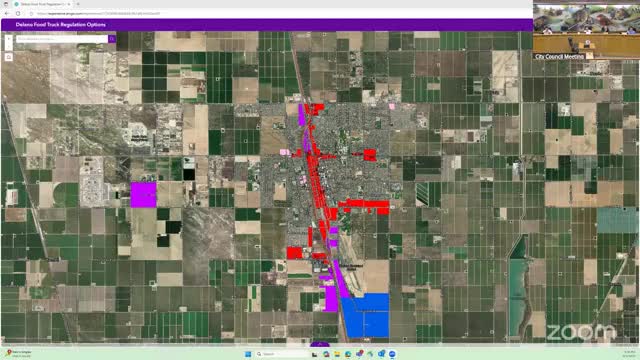
Summary
The Delano City Council voted 3-1 to allow food trucks on private property with a 500-foot buffer from brick-and-mortar restaurants, make permitting administrative, and allow the use in commercial, industrial and residential-commercial zones without a citywide cap.
The Delano City Council voted 3-1 Aug. 4 to allow food trucks to operate on private property with a 500-foot buffer from existing restaurants, an administrative permitting process and no cap on the number of permits.
Council action came after staff presented maps showing how 500- and 1,000-foot buffers would affect commercially zoned parcels. The council directed staff to prepare a zoning-code amendment implementing the council’s direction, take it to the Planning Commission and return to council for final adoption.
The move responds to complaints from brick-and-mortar restaurant owners about competition from food trucks and to an applicant request to permit food trucks on private lots without a conditional-use hearing. City staff noted an alternative approach would be a citywide cap on food-truck permits; council members discussed both buffers and caps before selecting a buffer-only approach.
Roman Dowling, the contracted community development engineer who prepared the maps, showed that a 1,000-foot buffer would exclude most central commercial areas and leave primarily industrial parcels to the south. Dowling said the 500-foot option leaves more central parcels available but still removes many locations in the downtown core.
Council members debated tradeoffs between protecting existing businesses and preserving opportunities for mobile entrepreneurs. Council Member Solorio Riis said he favored a smaller buffer and noted the city could later establish a food-truck plaza. Council Member Rosorio voted no; Council Member Osorio Riis, Mayor Pro Tem Nunez and Mayor Morris voted yes. The final roll call on the motion recorded Rosorio: No; Osorio Reis: Yes; Mayor Pro Tem Nunez: Yes; Mayor Morris: Yes. Council Member Linda Howe was absent. The motion passed 3-1.
Staff clarified that trucks already operating on private property would become legal nonconforming uses and could remain unless they ceased operations for a period specified in the code. Council members asked staff to draft grandfathering language and to return maps showing alternative buffer distances alongside any proposed cap for further consideration.
The council also discussed enforcement and parking impacts: staff noted that if a food truck occupies required parking spaces for a primary business, that could create a zoning violation independent of the truck-permit rules.
The council’s direction was procedural: staff will draft the ordinance language reflecting the 500-foot buffer, administrative permitting, the zones covered (commercial, light industrial and residential-commercial) and the grandfathering approach for existing permitted trucks, then bring the draft to the Planning Commission and back to council for final action.
The council’s decision does not change any federal or state rules; it amends local zoning and permitting procedures once the ordinance is adopted.