
Urban Renewal Authority briefs D60 board on Dillon Drive project, potential tax‑increment impact
Get AI-powered insights, summaries, and transcripts
Subscribe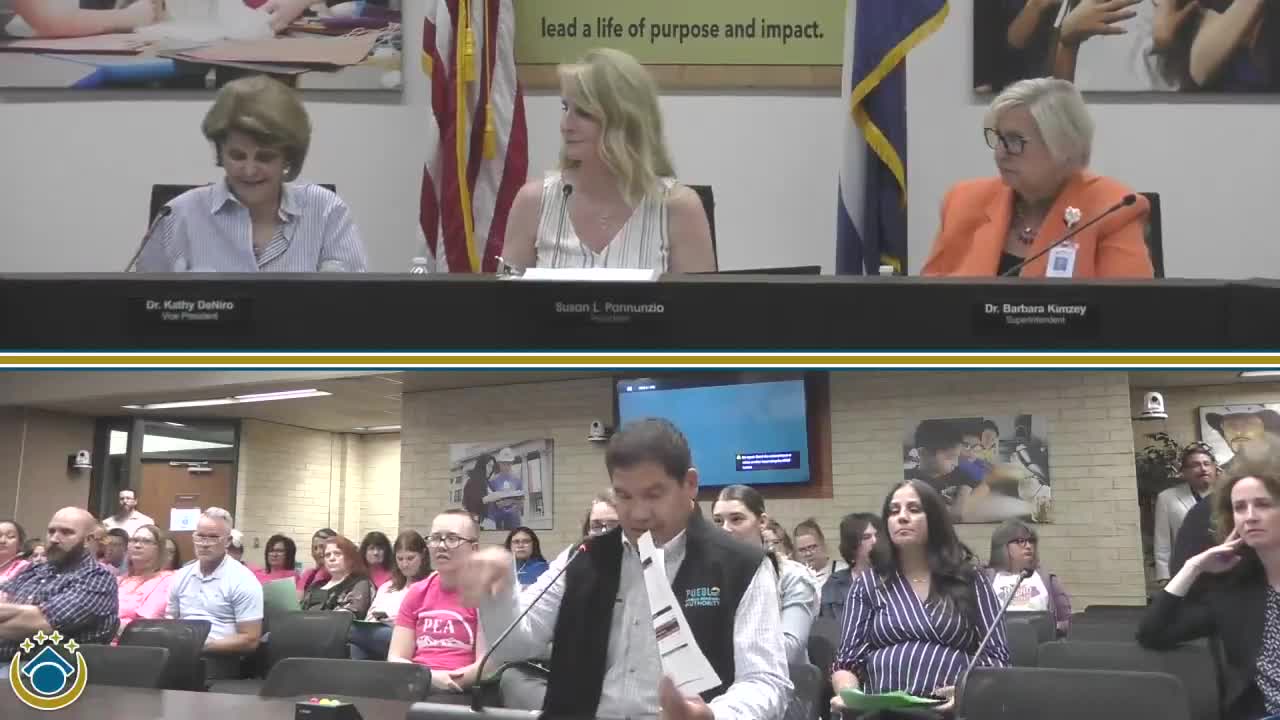
Summary
Jerry Pacheco of the Pueblo Urban Renewal Authority presented the proposed Dillon Drive urban renewal plan, describing 104,000 square feet of commercial development and discussing possible tax‑increment financing (TIF) that could affect school district property‑tax revenue over the life of the project.
Jerry Pacheco, executive director of the Pueblo Urban Renewal Authority (PURA), presented an update on the Dillon Drive proposed urban renewal project at the D 60 Board of Education meeting on June 24. The authority has worked on the plan for roughly 2½ years and is preparing to present it to Pueblo City Council.
Pacheco said the site is southeast of the north‑side Walmart (the “Grey Coast” site) and is largely in a regulatory floodplain and therefore currently has little taxable value. The project proponent proposes roughly 104,000 square feet of commercial improvements, including several inline retail buildings (12,000 and 9,000 sq ft), a 4,000 sq ft convenience store, an 11,000 sq ft tire shop, a quick‑serve/drive‑up coffee, a 3,000 sq ft fast‑service restaurant, a three‑story medical office building, a car wash and a proposed 27,000 sq ft grocer described as “new to market.”
Pacheco said the project would use tax‑increment financing and that historically the district’s general‑fund mill levy and the debt‑service mill levy are the two components affected by TIF arrangements. He said PURA’s standard sharing arrangement and the district’s rights under state law would guide negotiations; PURA’s attorney will forward draft agreements to the district attorney for review. Pacheco also said a small portion of revenue could be set aside for affordable‑housing efforts or other district priorities if the board and authority prefer.
Board questions focused on the philosophy of TIF, potential “cannibalization” of existing businesses, uncertainty in state funding and the variability of expected property‑tax increments. Director Thibault said he remains skeptical of TIF for ordinary commercial projects and worried that projected revenues have not materialized in past projects; he urged caution because the state’s school‑finance contribution remains uncertain.
Pacheco said PURA does not assume the district must forfeit all revenue and offered a range of sharing options; he told the board the earliest formal agreement could come back to the board in August after further legal review. The presentation was informational; no board action was required at the June 24 meeting.