Get Full Government Meeting Transcripts, Videos, & Alerts Forever!
Get email alerts on the Voter Registration Maintenance topic
No spam. Unsubscribe anytime.
State election officials and county clerks outline voter‑list maintenance steps, ERIC use and audit findings
Summary
The lieutenant governor's office and county clerks reviewed how Utah maintains voter registration lists, described regular monthly certifications and ERIC data matches, and presented audit results showing high accuracy after recent process improvements.
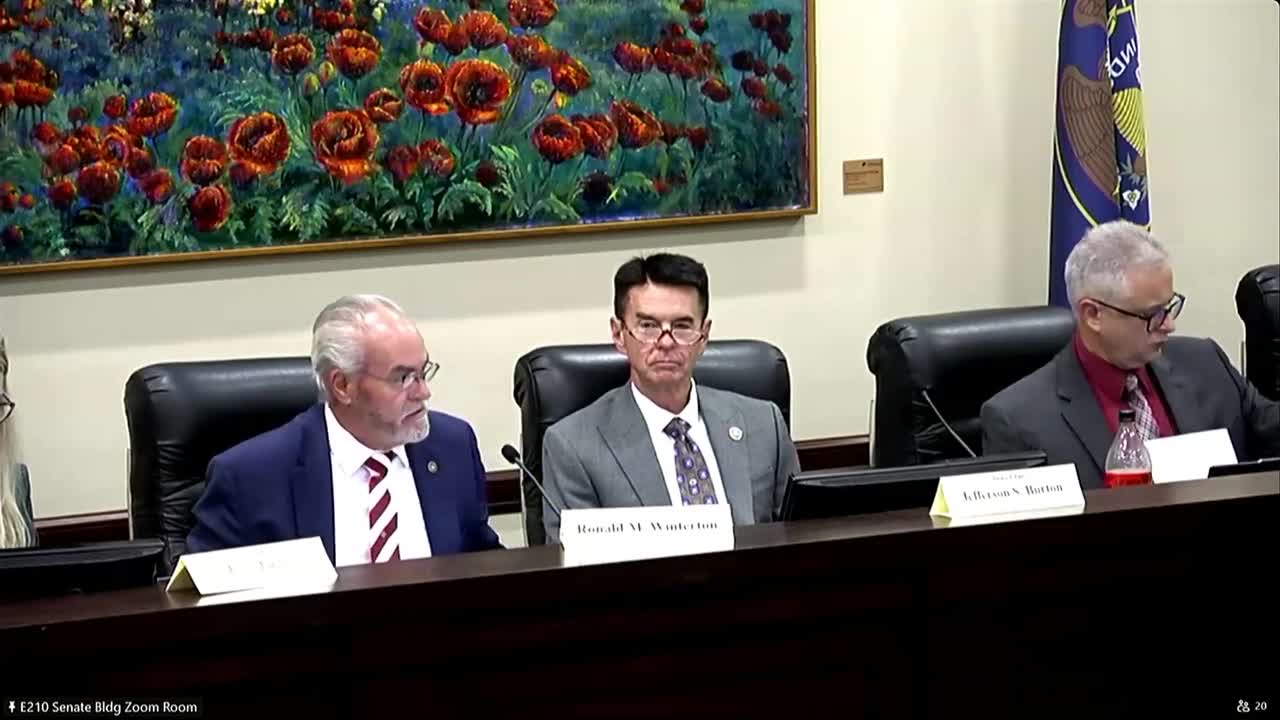
Megan Bolin, policy analyst with the Office of Legislative Research and General Counsel, opened a committee briefing with a refresher on federal and state voter‑registration rules, noting that the National Voter Registration Act and the Help America Vote Act set baseline requirements while states can implement specific deadlines and procedures.
County clerks described how registrations are verified and maintained. Brian McKenzie, Davis County clerk, explained clerks verify forms, confirm identity and residency, and run records through the statewide VISTA voter‑registration system. ‘‘If an individual does not provide valid voter identification at the time of registration, they will be required to provide that at the time of voting,’’ McKenzie said, describing the office’s two‑stage verification: in‑person ID checks and a database comparison with the Driver License Division.
Cambria Cantrell of the lieutenant governor’s office described a required monthly ‘‘voter‑list maintenance certification’’ the counties complete by the fifth of each month. The certification requires clerks to confirm online and paper registrations received within seven days are processed, deceased voters removed within five days of vital‑records notice, duplicate checks (in‑state and cross‑state) are completed, required confirmation mailings are being sent, VISTA user lists are reviewed, and a national change‑of‑address (NCOA) check will be run before producing the ballot mailing extract.
Ryan Kelly, director of elections in the lieutenant governor’s office, described the state’s participation in the Electronic Registration Information Center (ERIC), a multi‑state data‑sharing nonprofit funded by member states. Kelly said ERIC membership helps Utah identify cross‑state movers, duplicates and deceased voters; the transcript records Utah’s ERIC membership cost for the year as $53,000. Kelly said ERIC does not have write access to VISTA and that ‘‘changes to the voter rolls can only be made by the county clerks.’’
Lane Baron, data analyst for the lieutenant governor, described recent efforts to remove deceased voters. Baron reported that, after enhanced weekly checks and training, the office identified 1,052 high‑confidence matches of deceased records to voter records and the counties removed 1,012 of those, a removal rate above 96 percent. Baron also reported 68 likely duplicate voter records (34 pairs) and 72 duplicate driver’s license numbers; most duplicates were merged or corrected after clerk review.
Daniel Wade, election assistant specialist, presented the statutorily required voter‑registration audit for the committee. Wade said the law requires auditing 0.02% of active voters; the office audited 694 records as required and, on a voluntary basis, conducts quarterly audits of paper registrations. Wade summarized that across required and voluntary checks the office had reviewed 30,351 data points over two years and reported an overall accuracy rate of about 98–99 percent after improvements and additional clerk training.
Committee members asked follow‑up questions: Representative Cutler and others pressed clerks on cure lists and on how certain materials (for example, scanned return envelopes) are optional for counties to create; Aaron Davidson noted small counties could buy basic scanners but that workload and staff responsibilities vary. Senator Brammer and others urged continued work to expand archival access and long‑term preservation of electronic images and records.
Ending: Officials said improvements to data exchanges and audits have increased confidence in Utah’s voter‑list maintenance processes but acknowledged remaining work — including better statewide archiving and additional technical resources for small counties.