Get Full Government Meeting Transcripts, Videos, & Alerts Forever!
Get email alerts on the Aprn Pa Clinical Experience topic
No spam. Unsubscribe anytime.
Review urges minimum pre‑licensure clinical training for APRNs, recommends aligning PA requirements
Summary
A state review found a wide spread in clinical experience among nurse practitioners and recommended establishing pre‑licensure clinical minimums for APRNs while recalibrating physician assistant (PA) requirements to align scopes of practice and protect patient safety.
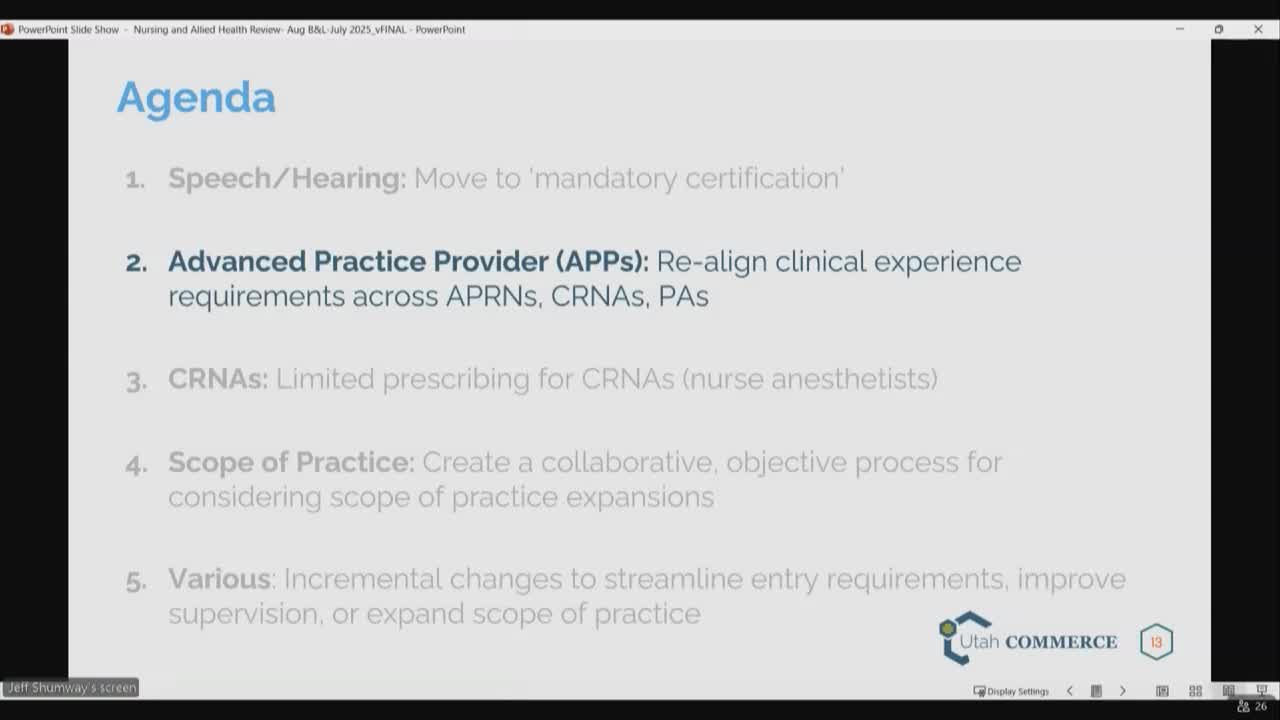
The Office of Professional Licensure Review told the Health and Human Services Interim Committee that rapid growth in advanced practice providers prompted recommendations to realign clinical‑experience requirements. "We are supportive of full independent practice for advanced practice providers," Director Jeff Shumway said, but he added that some recent APRN graduates have markedly less workplace experience than historical cohorts. The office reported that the number of APRN licensees in Utah rose from roughly 2,000 about a decade ago to about 7,500 today, and that the office surveyed practitioners about pre‑licensure and workforce experience. The review found a wide distribution of prior clinical experience among APRNs: while many report seven to nine years of RN experience before becoming APRNs, a measurable tail of recent graduates have little to no workplace experience beyond clinical rotations in school. By contrast, PAs operate under a statutory pre‑independence requirement the office described as high and clustered around the statutory figure; the review cited PA statute that sets a substantial supervised‑practice requirement before independent practice. The office showed survey results in which 1,300 of 7,500 APRNs and about 700 of the more than 3,000 PAs responded. It reported average clinical hours delivered in educational programs of roughly 630 hours in RN programs and about 890 hours in nurse‑practitioner programs, while accreditors historically required lower minimums that are in flux (present minimums cited at 500 and moving to 750 for some accreditors). The review recommended instituting a pre‑licensure clinical‑experience requirement for APRNs and suggested lowering the PA pre‑independence requirement somewhat to harmonize the two professions' expectations, noting that both groups now have similar scopes of practice in Utah. Shumway and committee members framed the proposal as restoring the legislature's original intent when independent practice was expanded—namely, that practitioners would come to independent practice after substantial real‑world clinical work, not immediately on graduation. The office said it had not recommended returning to written practice agreements or physician supervision and that it preferred proactive, pre‑licensure adjustments rather than waiting for substantiated complaint trends to appear. No legislation was enacted at the meeting; the presentation was framed as committee guidance for possible bill language in the coming session.