Get Full Government Meeting Transcripts, Videos, & Alerts Forever!
Get email alerts on the Mining Critical Minerals topic
No spam. Unsubscribe anytime.
Utah mining leaders press state role in critical minerals and energy supply
Summary
The Utah Mining Association outlined the state's mineral endowment, role in critical minerals production and ongoing coal and energy issues, urging GOEO coordination and targeted support for workforce and processing capacity.
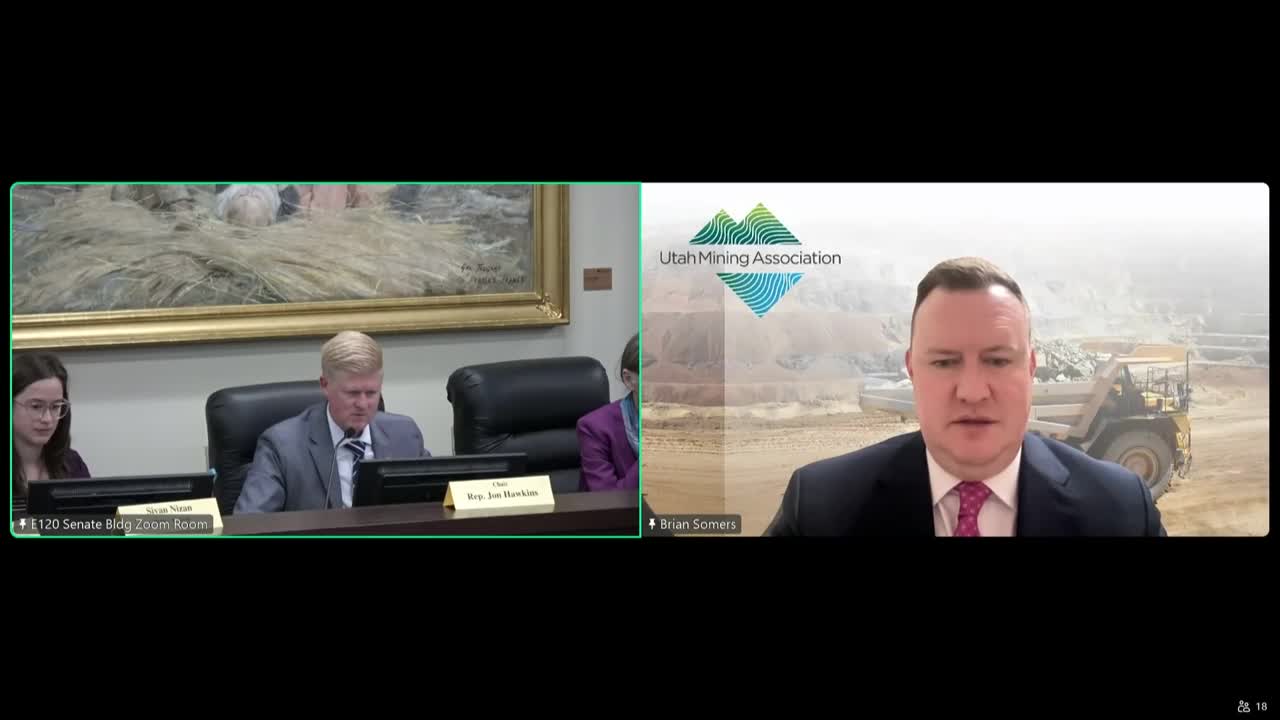
Utah Mining Association President Brian Summers told the Economic Development and Workforce Services Interim Committee on Wednesday, Aug. 20, that Utah has an "amazing mineral endowment" and can help reduce U.S. dependence on foreign critical minerals for defense and industry. "Utah actually holds 40 of the 50 critical minerals that are on the current list," Summers said during his presentation to the committee.
Why it matters: Summers framed mining as a statewide economic engine that supplies raw materials for national defense, manufacturing and clean-energy technologies, and he argued the state can expand production quickly because many resources and projects already exist in Utah.
Summers said U.S. dependence on foreign suppliers is substantial: "On this table, blue is bad. Blue means import dependence...we're more than 50% import dependent for 47 different mineral commodities, and we're a 100% dependent for 16 different mineral commodities." He pointed to state projects such as the Lisbon Valley project in San Juan County and noted Utah firms and facilities already producing rare earths and uranium byproduct recovery.
He also described energy and coal as part of the state's current electricity mix and economic base. "About 55% of our electricity generation comes from coal, and about another 30% from natural gas," Summers said, and he discussed recent state efforts to preserve coal-fired generating capacity and fuel supply contracts. Summers said some coal that is produced is exported and that rail and port access affect export capacity.
Discussion points: Summers urged the committee and the Governor's Office of Economic Opportunity (GOEO) to treat mining as a formally targeted industry within GOEO and cited state incentives that have aided mining: the mineral exploration tax credit, post-performance tax credits, expanded high cost infrastructure tax credits, and ED TIF eligibility for mining projects. He also stressed workforce needs in rural areas and recommended using Talent Ready Utah, technical colleges and targeted training to fill skilled positions.
Questions from legislators focused on workforce and recruitment. Senator Karen Kwan asked how the industry planned to recruit workers; Summers said mining employers hire across the skill spectrum and that Utah State University, technical colleges and on-site training programs can help meet demand.
Ending: Summers closed by urging continued state coordination, noting GOEO can help convene state agencies (Division of Oil, Gas and Mining, Utah Geological Survey, Public Lands Office) and industry groups to align permitting, workforce and processing needs.