Get Full Government Meeting Transcripts, Videos, & Alerts Forever!
Get email alerts on the Prison Capacity topic
No spam. Unsubscribe anytime.
Utah corrections officials warn state prison beds will run out by 2030 without new capacity or parole‑violation alternatives
Summary
The Department of Corrections reported a steady population increase driven largely by parole violators and longer stays; officials said the state could reach emergency capacity in 2029–2030 and called for expansion of community correction options and parole‑violation treatment centers.
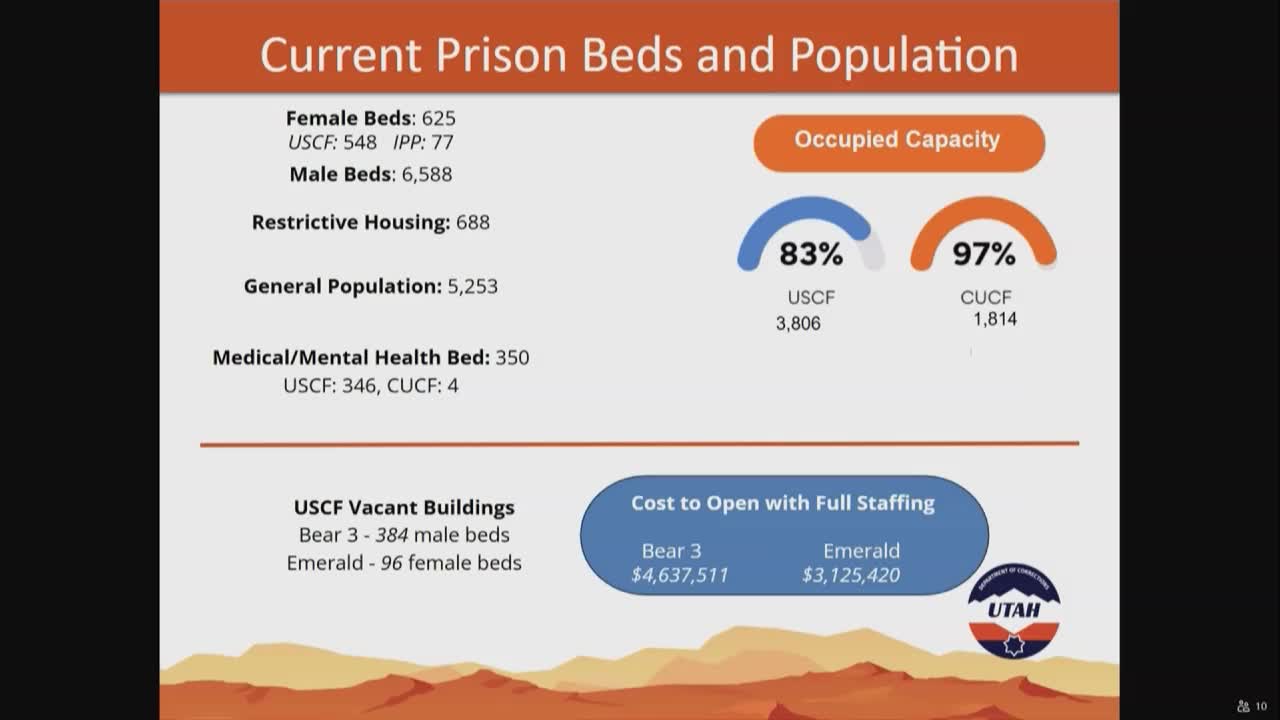
Deputy executive directors Spencer Turley and Becky Brown briefed the committee on Aug. 20 about prison capacity and factors driving population growth. The department told the committee that statutory physical capacity is 7,220 beds and that operational capacity thresholds would require emergency releases at roughly 7,076 (98%) and that operational targets are 96.5% (about 6,967 beds). The department reported a prison population of approximately 6,500 as of the briefing and said that juveniles certified as adults and out‑of‑state placements (102 inmates) are counted separately. Turley and Brown said parole violators are the largest driver of prison admissions, accounting for 57 percent of the current prison population for 2025. They reported steady annual prison population growth roughly aligned with state population growth (about 2% per year) and warned that at current trends the state will reach emergency operational capacity by 2029 and full capacity around 2030. The department said it keeps some buildings dormant (two houses at the Utah State Correctional Facility, Bear 3 and Emerald) because current population and funding do not require their activation; funding and staffing constraints also keep positions vacant to offset operating costs. Officials recommended expanding alternatives for parole violators, increasing treatment access early in sentences, enhancing reentry and vocational services in community correctional centers, and using assessment‑driven placements to reduce returns to prison. The department described contracted county jail bed arrangements (20 jails contracted with variable allocations) and said the statutory jail reimbursement rate is $120.75 per day while the average actual prison bed cost for FY25 was $153.20 per inmate per day. No committee action was taken during the briefing; officials said they are developing a 10‑year master plan and will return with recommendations.