Get Full Government Meeting Transcripts, Videos, & Alerts Forever!
Get email alerts on the Lake Powell Ferry topic
No spam. Unsubscribe anytime.
Lake Powell ferry operations uncertain as water levels fall; UDOT outlines costs and options
Summary
UDOT briefed the committee on Lake Powell ferry operations, saying low lake elevations have repeatedly forced suspension of service. The agency reported limited ridership, rising fixed costs and expensive options to extend or replace ferry infrastructure.
UDOT staff told the Transportation Interim Committee that ferry service across Lake Powell has become intermittent because of declining lake elevations and that continued operation will be uncertain and potentially costly.
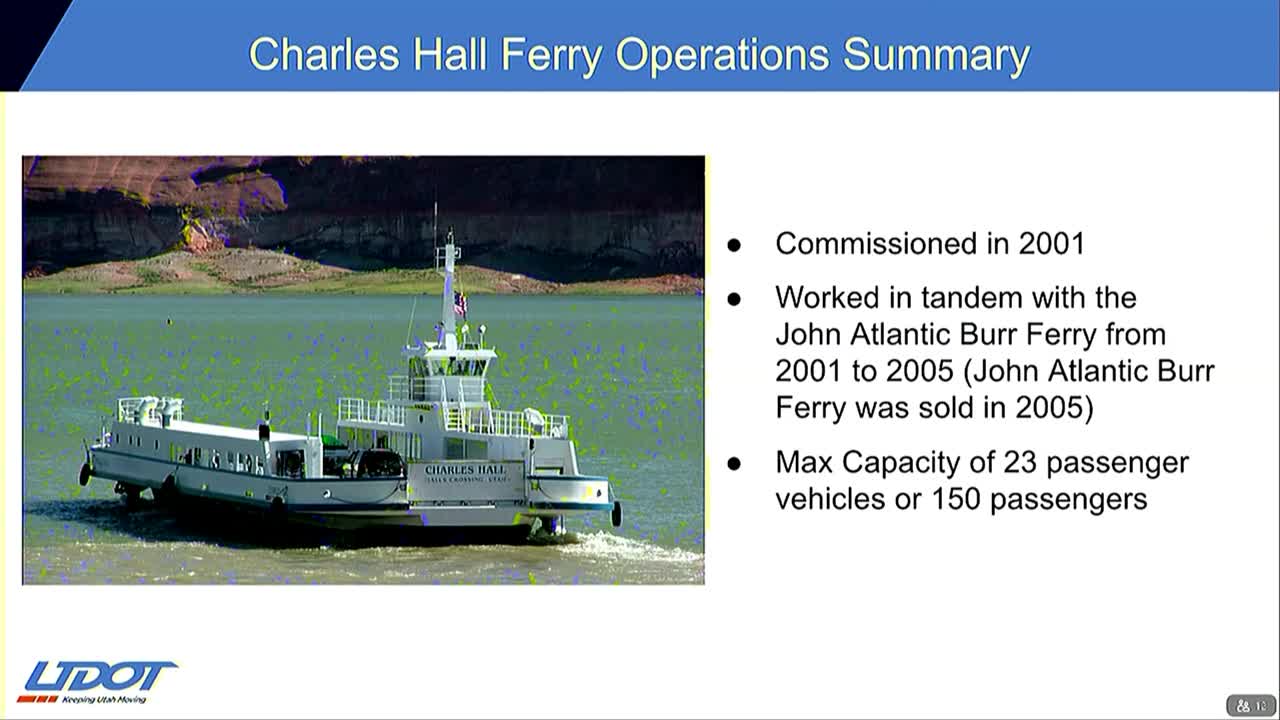
Jared Beard, deputy director for UDOT Region 4, said UDOT has operated a ferry at Lake Powell since 1985 and currently runs the Charles Hall ferry. The ferry’s channel is about 4 miles long and the crossing takes about 25 minutes; the vessel’s capacity is about 23 vehicles and roughly 150 passengers per run. Under normal operations the ferry runs hourly with the final daily run returning from Bullfrog to Hall’s Crossing around 5 p.m.
Beard explained that a “primary route” using dedicated ramps is operable down to a lake elevation of 3,585 feet. The park service has permitted use of public ramps to extend operations down to about 3,565 feet, but below that level the ramps are unusable and the ferry cannot operate. Staff said lake elevation was about 3,550 feet at the time of the briefing — roughly 15 feet below the agency’s primary operating minimum — and Bureau of Reclamation projections showed a most‑probable 2026 peak near 3,555 feet, still below the threshold for reliable service.
UDOT said operation has become sporadic in recent years: the agency reported roughly 1,000 vehicle crossings in fiscal year 2025 (down dramatically from a 2008 peak of about 11,500), and that season required suspending service when water levels fell and when the vessel required repairs after a rock strike. For fiscal 2025 UDOT said its annual budget set for ferry operations was $487,000, expenditures were about $475,000 and fare revenue was approximately $30,000.
Beard outlined fixed and recurring costs that continue even when the ferry is inactive: annual insurance costs alone run about $150,000, and UDOT estimates roughly $200,000 per year to keep the vessel and certification in place while it is idle. The agency also reported it will need a full hull rehabilitation at an estimated $1.5 million and that locating and constructing deeper ramps or other infrastructure to operate at lower lake elevations could cost in the range of $50 million to $150 million depending on location and scope.
UDOT contracts with concessionaire Aramark to operate day‑to‑day ferry service; UDOT owns the ferry and capital infrastructure and pays for major repairs. The National Park Service permits UDOT’s presence in Glen Canyon National Recreation Area and provided housing support for ferry crew when Aramark could not house staff locally during recent low‑visitation years.
Committee members asked about alternatives. Senator Reebay and others asked whether a bridge or a floating/pontoon crossing could be feasible; staff said a bridge feasibility study is under way but would expect large costs. Members also noted that local traffic levels are currently low and that alternative road access routes exist for most trips when the ferry is not running.
Why it matters: The ferry is an expensive, low‑utilization service that has historically provided a seasonal link across Lake Powell; sustained low water puts that legacy service and its economic support for local recreation at risk.
What’s next: UDOT is studying bridge feasibility, will pursue hull rehabilitation as maintenance requires and will keep the Legislature updated on costs and the operational outlook.