
Legislators hear wide-ranging views on 340B transparency as ND study begins
Get AI-powered insights, summaries, and transcripts
Subscribe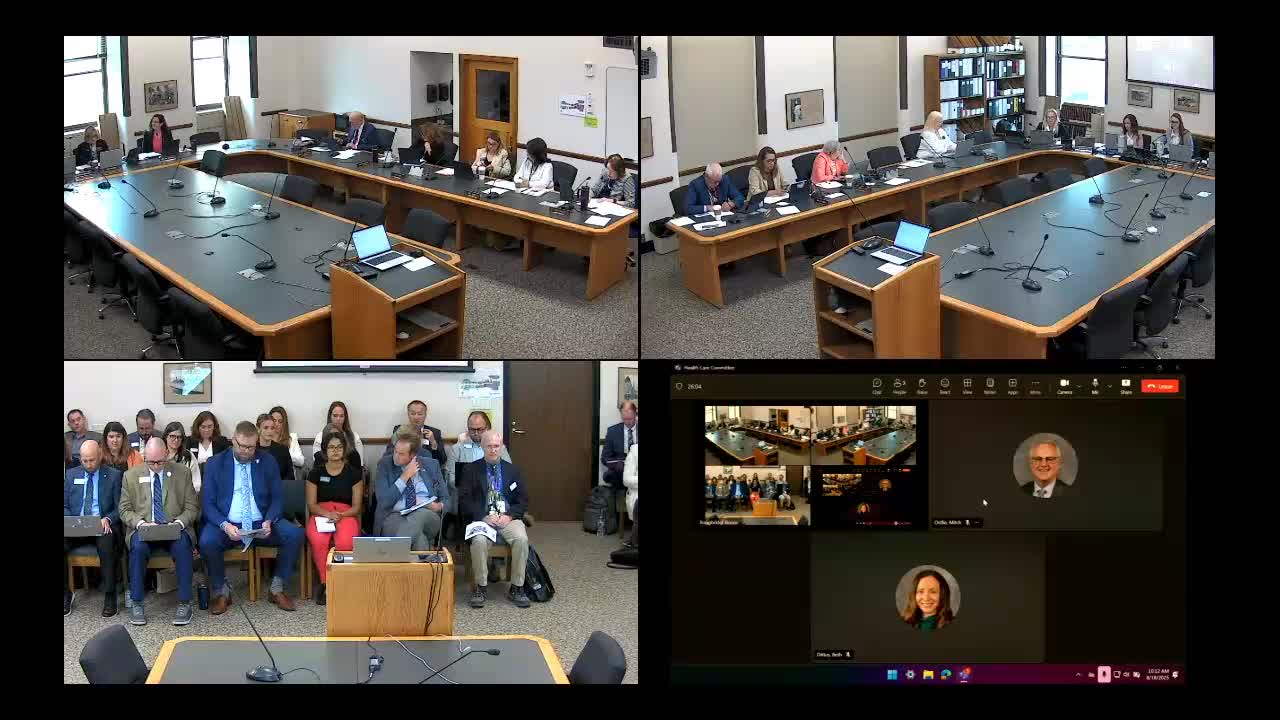
Summary
The North Dakota Legislative Interim Committee on Health Care spent Aug. 4 taking testimony on whether the state should require reporting by entities that participate in the federal 340B drug-discount program, with hospitals and clinics calling 340B a "lifeline" for rural services and insurers saying a lack of state-level data shifts costs to employers and members.
BISMARCK, N.D. — The North Dakota Legislative Interim Committee on Health Care spent an entire day Aug. 4 hearing testimony about state reporting on the federal 340B drug-discount program, with hospital and clinic leaders defending the program as critical to rural services and insurers urging more transparency to measure cost impacts.
The committee’s study of 340B reporting was directed by state legislation and is intended to consider which covered entities — hospitals, federally qualified health centers, contract pharmacies and others — should report data to the state, what data to collect and how that information could be used to benefit patients, legal counsel Katie Carpenter told the panel. The memorandum establishing the study references 42 U.S.C. §256b (Section 340B of the Public Health Service Act) and the work ordered by Senate Bill 2370.
Why it matters: 340B allows qualifying safety-net providers to buy outpatient drugs at steeply reduced prices; how those savings are used has become a national policy debate. Supporters say the discounts let rural hospitals and community health centers keep services open and subsidize care for uninsured patients. Critics — including some payers and industry groups — say a lack of state-level reporting leaves employers and insurers unable to see whether 340B profits reduce patient costs or instead flow elsewhere, potentially increasing premiums and out-of-pocket costs.
The hearing brought a wide cross-section of stakeholders, including North Dakota’s insurance commissioner, Medicaid officials, hospital systems, federally qualified health centers, national hospital and industry representatives, pharmacists and insurers.
Overview from state and federal vantage points
John Godfrey, North Dakota insurance commissioner, gave the committee a primer on how 340B works and why states are studying it. He said 340B is intended to “stretch federal dollars” for safety-net providers and that discounts can range from roughly 25% to 50% off list prices, depending on the drug and manufacturer rules. But he and other witnesses noted there is no federal reporting requirement that obligates covered entities to disclose how they use 340B savings or how much revenue the program generates locally.
"I believe that more data and clear insights often lead to better outcomes," Godfrey told the committee, arguing the state’s study could help determine whether transparency measures are warranted in North Dakota.
Medicaid and provider perspectives
Bridal Joyce, pharmacy and clinical services director for North Dakota Medicaid, told the committee how Medicaid interacts with 340B. She said North Dakota Medicaid has about 133,000 unduplicated clients and an average monthly enrollment just over 107,000. Joyce noted Medicaid’s average pharmacy rebate is about 49% (pharmacy claims) and about 42% for medical claims, and described federal “duplicate discount” rules that prevent manufacturers from being charged both a Medicaid rebate and a 340B discount on the same drug. North Dakota Medicaid also limits use of 340B in managed-care contracts to preserve rebate collections, she said.
Hospital and clinic officials described how 340B revenues are used locally. Alyssa Walden, director of pharmacy at Coal Country Community Health Center (an FQHC), said monthly 340B savings are “a lifeline” used to fund sliding-fee drug programs, transportation, substance-use initiatives and uncompensated care. "We fully support transparent reporting that shows how 340B savings benefit our patients," she said, while asking the committee to weigh administrative burdens on small clinics.
Essentia Health’s pharmacy director described the program’s compliance and audit practices and said the system performs internal monthly audits, uses independent mock audits and participates in HRSA recertification. "We take our responsibilities under the 340B program very seriously and strive to comply fully with all 340B program requirements," said Nick Schiro, identified as Essentia Health’s pharmacy business services director.
Legal and policy context
Speakers reviewed recent state-level action and litigation. North Dakota’s House Bill 1473 (enacted earlier this year) aims to protect access to 340B drugs — particularly for rural patients — by restricting manufacturer practices that limit contract-pharmacy arrangements and by treating some violations as unfair trade practices. John Godfrey and others explained the measure is being litigated; manufacturers including AbbVie have sued, and the outcome could be appealed to higher courts. Committee members heard that the Eighth Circuit upheld a similar Arkansas law, creating precedent relevant to North Dakota, but witnesses also warned that North Dakota’s statute contains unique provisions that could prompt additional legal questions.
National models and state reporting
Witnesses described a range of state approaches. Godfrey and others pointed to examples — Colorado and Michigan require reporting of 340B profits and uses, Hawaii requires reporting on contract pharmacies, Illinois directed an attorney general review of many 340B financial flows, and Maryland and Indiana have pursued broader prohibitions or reporting structures. AHR A’s director of health policy, Bharath Krishnamoorthy, emphasized that Congress designed 340B to allow hospitals to decide locally how to use savings to expand access: "The 340B program is a critical resource for hospitals and other providers to maintain, improve, and expand access to care for all patients," he said.
Payer concerns and data needs
Commercial and public insurers urged reporting that would illuminate the program’s downstream effects on premiums and patient costs. Dan Conrad, president and CEO of Blue Cross Blue Shield of North Dakota, said pharmacy costs now account for roughly 28–30¢ of every health-care dollar in the state, up from about 10–12¢ a decade ago, and argued that state reporting would help policymakers understand how 340B-related pricing affects employers and insured consumers. He and other payers warned that rebates negotiated by payers — and sometimes withheld when 340B discounts apply — can shift costs to employers and members.
Industry and advocacy perspectives
Pharmaceutical industry representatives pushed back on some critical claims and highlighted program growth and mission drift concerns in other states. The Pharmaceutical Research and Manufacturers of America (PhRMA) urged careful design of any reporting mandate, saying some studies find substantial markups when hospitals sell drugs purchased at 340B prices. Industry witnesses recommended looking at large-state studies such as Minnesota’s and North Carolina’s treasurer’s analysis.
Process, next steps and committee response
Committee members did not vote or adopt any policy at the meeting. Members asked staff to assemble comparative materials from other states (Minnesota, Indiana, South Dakota and neighboring states) and to produce a crosswalk of existing reporting requirements that might overlap with proposed 340B reporting (state vendor, Medicaid, nonprofit 990 filings, HRSA audits and other sources). The panel scheduled further interim work; staff indicated a November meeting is under consideration to continue the study.
What the committee heard, in short: health centers and hospitals argued 340B funds support essential services in rural and underserved communities; Medicaid and hospitals explained federal constraints (duplicate-discount rules, HRSA audits) and program mechanics; payers and some industry groups said state reporting is necessary to gauge whether 340B savings reduce patient costs or instead contribute to higher overall health spending; and several witnesses urged carefully tailored reporting that avoids excessive administrative burdens on smaller providers.
Ending
The committee will collect the requested state-by-state materials and a reporting crosswalk and resume discussion at a future meeting. Lawmakers and stakeholders told the panel the choice of whether to require reporting is a policy question that must balance program stewardship, rural access and administrative cost.
(Reporting: this article summarizes testimony presented to the North Dakota Legislative Interim Committee on Health Care on Aug. 4, 2025. No committee votes or formal rule changes were made at that session.)