Get Full Government Meeting Transcripts, Videos, & Alerts Forever!
Get email alerts on the Higher Education Enrollment topic
No spam. Unsubscribe anytime.
Midwestern compact warns North Dakota officials of a coming demographic cliff and outlines closure risks
Summary
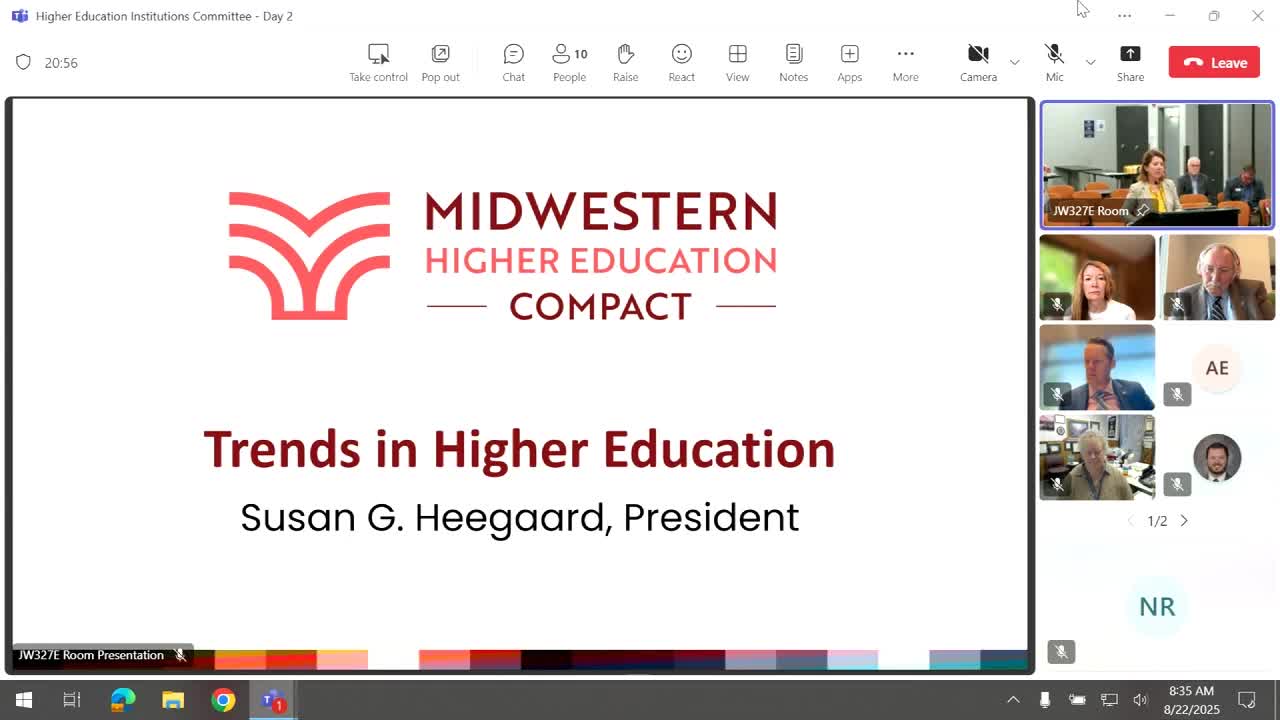
A Midwestern Higher Education Compact presentation to North Dakota legislators highlighted regional enrollment declines, a projected “demographic cliff,” and policies states use to reduce student harm when campuses close or merge.
Susan Heegard, president of the Midwestern Higher Education Compact, told the North Dakota Legislative Committee on Higher Education on Friday that regional and national enrollment trends show a potential multi‑year decline in the traditional college‑age population and urged state leaders to prepare.
Heegard said the region faces a “demographic cliff” driven by lower birthrates dating to the Great Recession and that enrollment effects are likely to begin appearing in the mid‑2020s. She told committee members, “a demographic cliff is projected over the next 2 decades and yes, it'll even happen here.”
The warning matters because enrollment determines tuition revenue and institutional viability. Heegard said enrollment and financial stress have already produced closures and consolidations elsewhere in the Midwest, with 190 campus closures regionally in the past decade and the private for‑profit sector accounting for most of those shutdowns.
Her presentation summarized policy tools states use to reduce student harm when institutions close or consolidate. Key protections include: robust student‑record retention policies; tuition‑recovery or surety mechanisms; formal teach‑out agreements so students can finish programs elsewhere; and enforceable financial‑responsibility measures. She told the committee that researchers found students “are 37 to 51% less likely to complete a credential if they experienced a closure in a state lacking a teach out or student records maintenance.”
Heegard also reviewed how demographic shifts vary by state and by institution type. She said North Dakota currently fares better than many Midwestern states because of net in‑migration and higher rates of high‑school‑to‑college enrollment, but she urged legislators to examine campus‑level differences rather than rely on statewide averages. “Some institutions have experienced upticks in enrollment and others have not,” she said, recommending targeted supports such as expanded internships, apprenticeships and student supports that increase retention among historically underrepresented groups.
The presentation covered examples of state responses. Heegard described mergers and consolidations in Pennsylvania, Georgia and Minnesota that centralized administration or combined campuses; Connecticut’s move to a single accredited multi‑campus community college; and Indiana’s recent program‑level consolidations. She emphasized these reorganizations often accompany investments in academic advising and student support, which in some cases raised on‑time graduation and retention rates.
Committee members asked about cross‑border effects: whether neighboring states such as Montana, South Dakota or Minnesota were showing similar trends and how North Dakota’s relatively younger and growing population might alter the outlook. Heegard said projections show North Dakota’s total population is expected to grow through mid‑century, and she offered to provide specific border‑state slides flagged in her presentation.
Heegard cited multiple data sources during the briefing, including research from the Philadelphia Federal Reserve Bank on institutional distress, Lumina Foundation attainment data, and federal financial responsibility metrics used to flag institutions at risk. She also noted the compact’s role in administering programs such as NC‑SARA (state authorization for distance education) and inter‑state contracts and services for higher education.
The committee did not take formal action at the meeting. Heegard closed by offering the compact’s staff as a follow‑up resource; legislators asked for additional state‑level data and for copies of the cited reports.
Ending
Heegard’s remarks framed the coming years as a time to plan rather than panic: states that have merged campuses or refocused programs often combined those steps with investments in advising and student supports. Committee members said they would follow up with the compact’s staff and review the cited reports as the panel continues its interim study of potential reorganizations within the North Dakota University System.