Get Full Government Meeting Transcripts, Videos, & Alerts Forever!
Get email alerts on the Federal Tax Credit Implementation topic
No spam. Unsubscribe anytime.
Sen. Cassidy aide says 45V extension preserves billions in Louisiana hydrogen plans; industry urges GREET updates
Summary
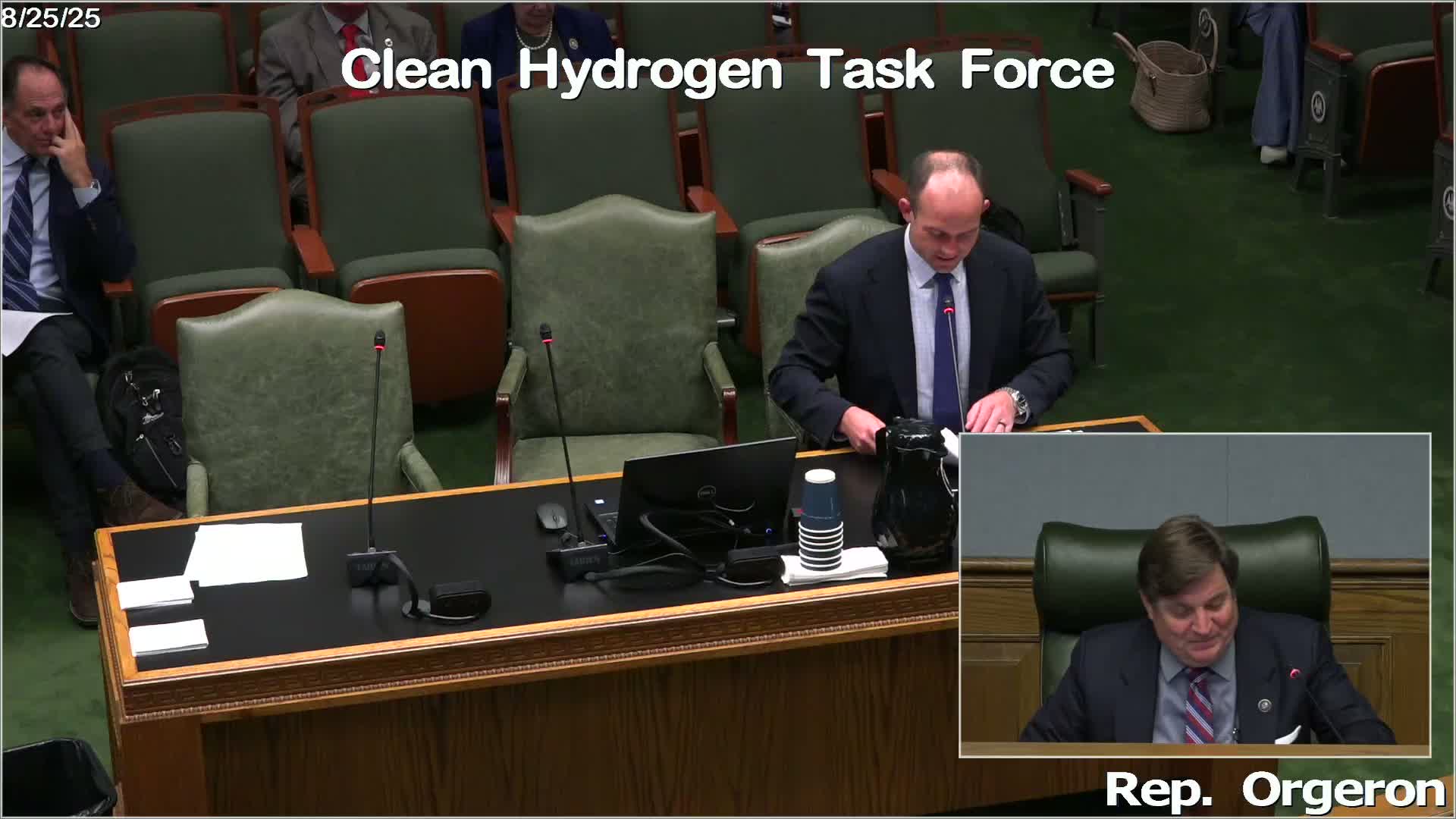
At the Aug. 25 Clean Hydrogen Task Force hearing, Jake Parker of Sen. Bill Cassidy’s office described a two‑year extension to the federal 45V hydrogen commenced‑construction deadline and summarized industry requests to the Department of Energy to update the GREET model to make the tax credit more usable for Louisiana projects.
BATON ROUGE, La. — Jake Parker, a trade and tax policy adviser in U.S. Sen. Bill Cassidy’s office, told the Clean Hydrogen Task Force on Aug. 25 that congressional action extended the federal 45V hydrogen tax‑credit commenced‑construction deadline and that industry is urging technical changes to the DOE GREET model so the credit is more usable in Louisiana.
Parker said the current commenced‑construction deadline for projects to qualify is Dec. 31, 2027, and explained two commonly used methods to show construction has begun: a 5 percent “safe harbor” investment test and a physical work test under IRS guidance. “If 5 percent of the overall project cost has been invested by the date of that begin construction, then that will qualify,” Parker said.
The extension matters because, Parker said, roughly $43 billion in announced and nonannounced hydrogen‑related investment is expected to move forward in Louisiana with a more usable 45V. He summarized four technical changes industry wants DOE to address in the GREET lifecycle model rather than asking Treasury to reopen rulemaking, which he said would inject uncertainty late in the compliance window:
- Allowing blended renewable natural gas (RNG) with fossil gas within a single process pathway so blended methane can count toward lower carbon intensity; - Relaxing narrow geographic deliverability limits so energy attribute certificates (EACs) from interconnected regions that can physically deliver electricity (for example, parts of the Midwest connected into the Delta transmission footprint) can be used in temporal accounting; - Adding hour‑by‑hour (hourly) accounting of greenhouse‑gas emissions and electricity supply mix for electrolytic hydrogen so developers can model compliance under hourly temporal matching rules; and - Lifting or revising GREET restrictions on coproduct steam export when amine carbon‑capture systems are used, and instead applying a proportional limit tied to lower‑heating‑value output (industry proposed a 17.6% LHV cap with required plant steam subtracted prior to export).
Parker said DOE has shown willingness to update GREET and that industry prefers model updates now to provide certainty for project bankability over the next two‑plus years instead of reopening Treasury rulemaking. “Revisiting rulemaking at this very sensitive time … would be counterproductive,” he said.
Task force members and industry advisers who asked questions — including state task members and technical advisers — raised related issues about how GREET changes would be applied, whether projects may be able to switch calculations later, and how 45V compares to other tax incentives such as Section 45Q for carbon sequestration. In response, Parker said projects are performing internal analyses of 45V versus 45Q and that GREET updates could materially change the calculus for projects that rely on electrolytic or blended feedstocks.
No formal actions or votes were taken on federal policy at the hearing; Parker offered to continue coordination with the task force and DOE on the specific GREET model changes industry outlined.
Ending: The task force will receive additional technical presentations from industry and follow up on GREET and 45V implementation details as federal and DOE engagement continues.