Get Full Government Meeting Transcripts, Videos, & Alerts Forever!
Get email alerts on the Municipal Debt Borrowing topic
No spam. Unsubscribe anytime.
Commission delays New Orleans request to issue bonds to pay long‑standing judgments
Summary
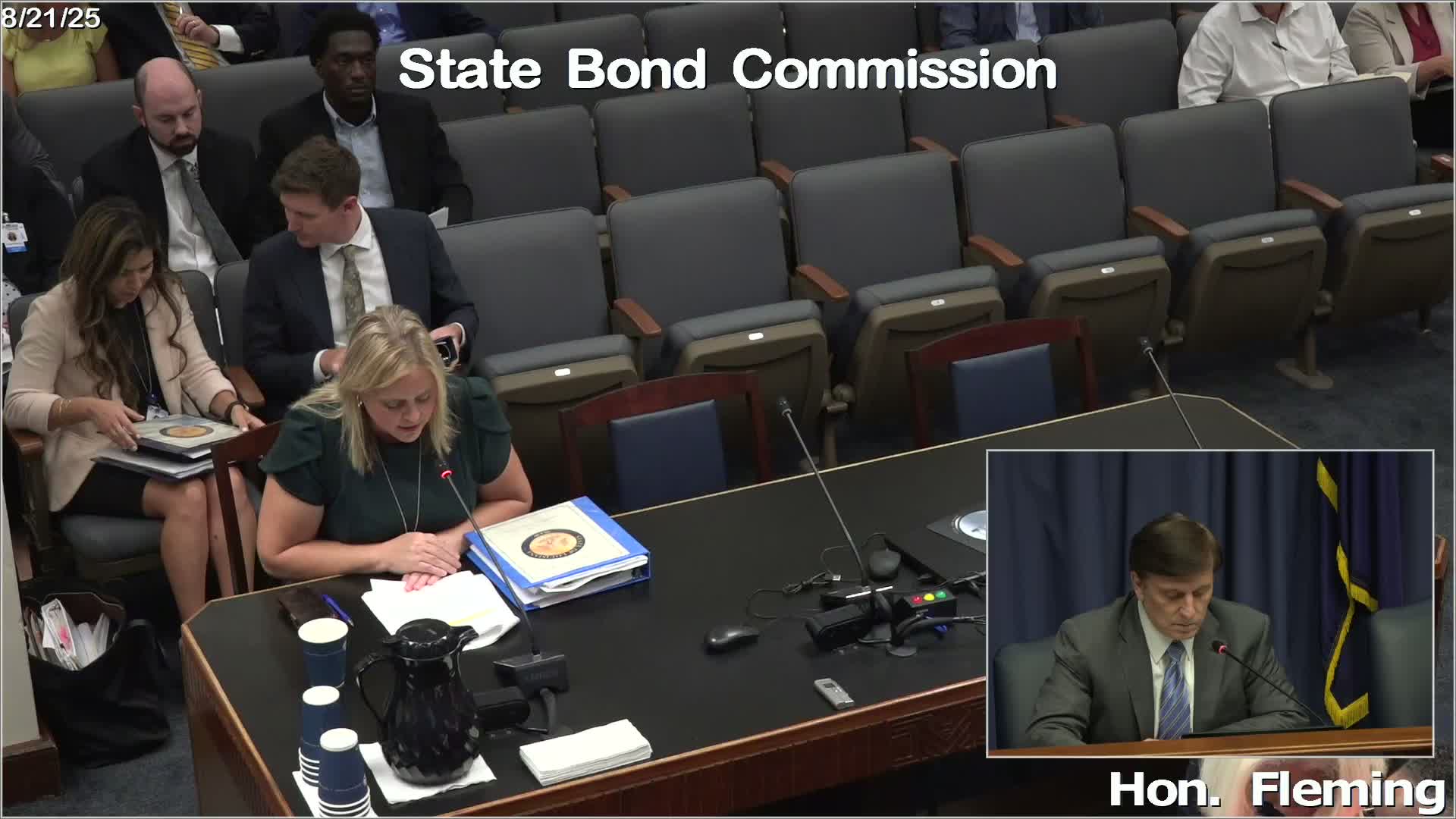
The State Bond Commission on Aug. 21 declined to finalize approval of a City of New Orleans request to issue up to $90 million in limited‑tax revenue bonds to pay longstanding judgments and agreed to defer a decision after the city offered a smaller initial tranche and commissioners sought more repayment detail.
The State Bond Commission on Aug. 21 declined to finalize approval of a City of New Orleans application to issue up to $90 million in limited‑tax revenue bonds to pay legal judgments, and instead agreed to delay final action while staff and city counsel clarified the plan.
Commission staff earlier described the proposal as limited‑tax revenue bonds secured by the city’s constitutional millage and said proceeds would be used to pay off judgments that, in some cases, date back to 1993. Jason Akers, appearing for the city’s financing team, said the city’s plan would structure the borrowing in two tranches of about $45 million each and that the repayment plan had been designed to be “budget neutral” for the city over time.
“It is being structured so that there’s no impact on the budget, not in the current years or in future years,” Akers said during the meeting.
Commissioners pressed the city on the prudence of authorizing debt that would be issued near the end of the current city administration’s term. Several members — including Representative Bakala and others — asked whether the next city council or the next mayor should have the opportunity to approve the second tranche. Akers said the two‑tranche approach was chosen in part to give a subsequent administration the chance to decide whether to issue the second tranche.
Senator Morris and others questioned details: the taxable nature of the bonds (the city sought taxable bonds because proceeds would not fund a capital project), the plan for debt service, and why the city was seeking a two‑tranche structure. Akers told the commission the first tranche was intended to pay the oldest judgments first and that the two‑tranche structure allowed the city to maintain short‑term budget neutrality while clearing older liabilities.
After discussion, Akers told the commission he had consulted with the city and that the city would accept an approval limited to “not exceeding $45,000,000” for the first tranche if the commission preferred that approach. Commissioners debated whether to approve the smaller first tranche immediately or to delay action until the next meeting so members could review additional details and allow the city to confirm the change in terms.
Ultimately the commission voted to delay the item to the next meeting to give staff and commissioners time to review the documents and for the city to confirm the proposed change to a single tranche of up to $45 million. No final sale or authorization for the $90 million figure was approved at the Aug. 21 meeting.
Why this matters: The proposal would clear longstanding court judgments from the city’s books but also creates a debt obligation tied to a millage that the city already uses for other payments. Commissioners said they wanted clearer, short‑term repayment detail before approving a borrowing that could affect a future administration.